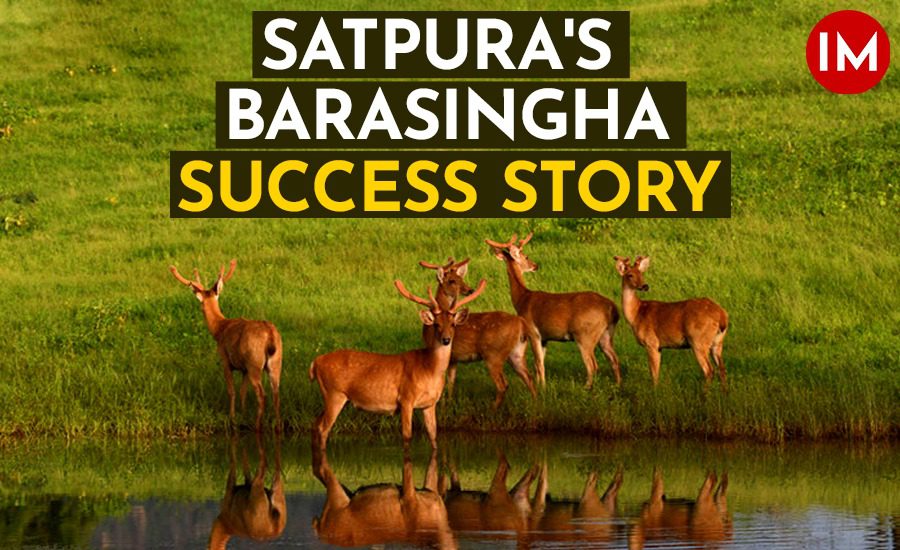
The Hard Ground Barasingha is one of the most vulnerable wild ungulates that had been confined to Kanha Tiger Reserve in Madhya Pradesh for about 47 years. With its population ranging around 1100 only, they were susceptible to diseases and catastrophic events that could impact the population. Hence, reintroducing them to Satpura Tiger Reserve, where Barasinghas were found historically 100 years ago, was an important initiative to safeguard the Hard Ground Barasingha population by finding a new habitat for them for their long-term conservation.
Satpura Tiger Reserve was chosen for the reintroduction because it had a historical distribution of the species and is also known as a less disturbed area in comparison to other reserves in the state. However, for reintroduction to succeed, post release monitoring of the species is essential, and Satpura management followed IUCN guidelines for standard reintroduction along with scientific methodology such as Population Habitat Viability Analysis (PHVA), demographic parameters and movement ecology for releasing Barasinghas in multiple sites within the Satpura landscape.
Indian Masterminds spoke to Field Director of Satpura Tiger Reserve, Mr. L Krishnamoorthy, IFS, to know about the Hard Ground Barasingha reintroduction success story.
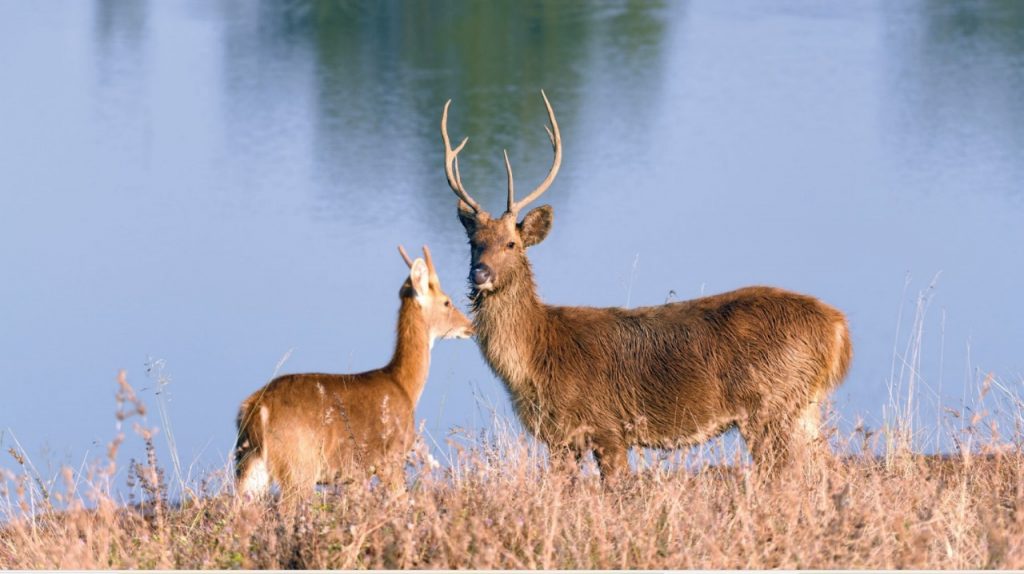
REINTRODUCING HARD GROUND BARASINGHA
Hard Ground Barasinghas are categorized as vulnerable as per the IUCN Red list of threatened species. Their hooves are adapted to hard ground conditions in open forests with grass. However, they also have an affinity for wetlands and swampy areas.
STR comprises three protected areas namely, Satpura National Park, Bori and Pachmarhi Wildlife Sanctuary. Post relocation of 49 villages, park management added more than 10,000 hectares of area under grassland.
With permission from the Union government, STR has successfully trans-located 98 Hard Ground Barasingha from Kanha Tiger Reserve in 10 phases over a period of 9 years, from 2015 to 2023. The population of Barasingha has substantially increased from 16 Barasinghas to 172 Barasinghas in 9 years of successful monitoring and management interventions.
DAILY MONITORING AND DATA RECORDING
The reintroduction was also done introduce new genetic material into an inbred population. To assure long-term survival, a network of viable populations is needed. Successful reintroduction critically depends upon accurate behavioral data, including knowledge of species activity cycle, diet and social behaviour.
All three metapopulation structures of the Barasingha are monitored daily in the Bori Sanctuary. The park management ensures that the entire structures of all the populations get reported to the head office at Narmadapuram in the prescribed format. The field data register includes all possible age and sex classes of the individuals with the total population size seen. The data help estimate the annual growth rate, to identify trends; whether population increased, decreased or was stable over time. This analysis allows researchers and managers to access annual recruitment pulses in the population.
The studying of the activity patterns is carried out with the aid of 32×8 binoculars and from observation towers which are at least 100-metre distant, so that the focal herd does not get disturbed.
After the hard release of the animals, it is important to monitor and track the animal movements so as to know their behavior, survival rate, fawning events and habitat preferences. “Park management records the group size, age-sex structure and GPS location of the animal movement from one beat compartment to another if they ever observed the group in different ranges of the park. We also compare Satpura Barasingha population with the Barasingha population of Kanha National Park,” said Mr. Krishnamoorthy.
CREATING GRASSLANDS AND WATERBODIES
Growing population and the consequent competition for specialized habitats and healthy grasslands with adequate water availability for breeding are the major reasons for Barasingha dispersal in Satpura.
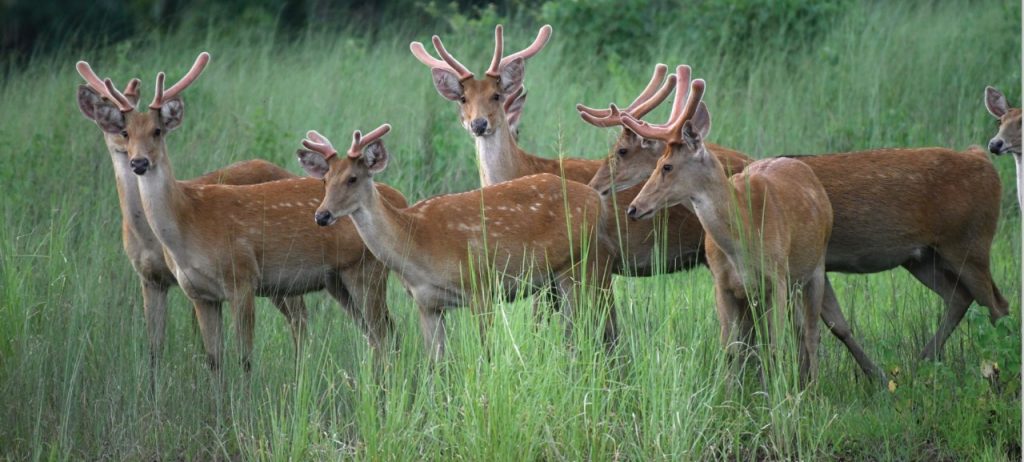
Tall grass cover is essential for fawning and post-natal care by females. The fawning cover protects newborns from scavengers and predators, ensuring good recruitment to the population.
The park management made a great effort in the sowing and planting of the species of tall grasses such as Heteropogon contortus, Bothriochloa odorata, Themeda triandra, Saccharum spontaneum and Iseilema prostratum and their associates in the areas of the metapopulations .
The breeding enclosure is equipped with python-proof fencing and 24×7 solar power to prevent the entry of pythons and other carnivores to completely stop the predation.
The park management created dykes in various locations had transformed the habitat. Ponds of suitable size to hold water during summer were created in new places and also deepened the old ponds in the relocated villages. Solar power pumps are also installed in the abandoned borewells to replenish water bodies in the relocated sites.
TRAINING STAFF
Prior to every monitoring operation, transportation and release of the animals outside the enclosure, training of the entire forest and frontline staff, supporting personnel, including park officials, are held by the Field Director, Satpura Tiger Reserve for 3-4 days in each range where Barasinghas and their habitat is available. “Training on monitoring protocols and field methodology were discussed comprehensively so that clear roles and responsibilities could be assigned to the staff members of each range,” Mr. Krishnamoorthy said.
CREATING PREY BASE FOR CARNIVORES
To ensure protection of Barasinghas , it was necessary to safeguard not just the habitat itself, which includes crucial plant species, but also various other species that rely on grasslands and open forests. Some of these species are significant as prey for the tiger and co-predators in the area.
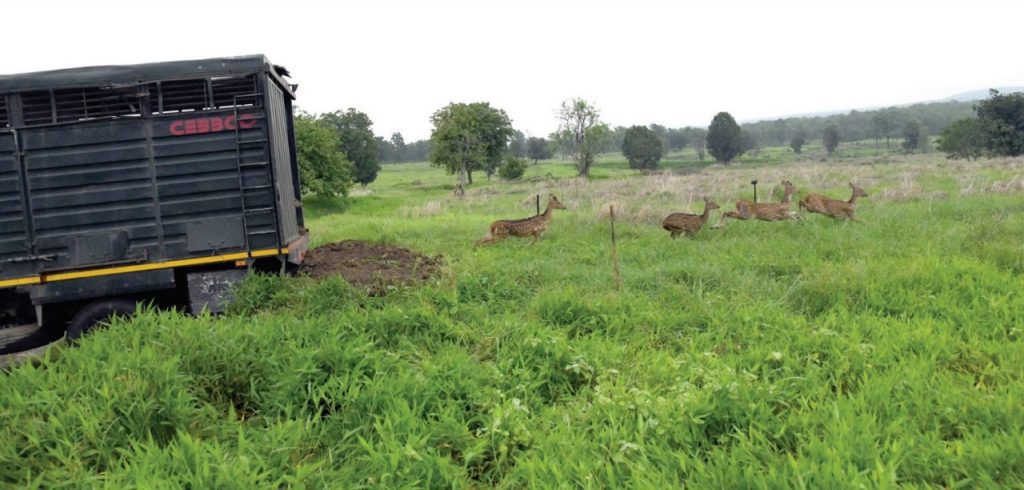
Hence, Chitals have been translocated to different grassland habitats of Satpura from Pench Tiger Reserve to increase the prey population for carnivores, to act as buffer species for Barasingha against predation. Around 1800 chitals have been translocated from Pench TR to Satpura TR and released into different grasslands to augment the prey species.
IDENTIFYING CORRIDORS
Conservation efforts for large mammals by wildlife managers typically focus on identifying and maintaining dispersal corridors to facilitate movement through different habitat types. For smooth and safe movement, different corridor routes are being designed of 100-meter width to facilitate movement of the Barasingha from one habitat to another. These corridors are planted with preferred grass species interconnecting grassy meadows. Once the Barasingha is released into the wild, they will easily disperse through these corridors.
CREATING NEW HABITATS WITHIN SATPURA
After the successful reintroduction, Satpura Tiger Reserve has now proposed introducing Barasingha in relocated sites of Matkuli and East Pachmari ranges. Already park management has created Barasingha soft release enclosure in Dhargaon, and also created waterbodies. The possibility of releasing animals in more than one site with high quality habitat in Satpura will allowing Barasingha population to increase at each site before density dependence drives them to areas that have lower habitat quality.
The park management has accumulated a lot of field experience over the 8 years in managing, monitoring and successfully creating a second home for the Barasingha population. “The field inputs and interventions show the increase in the population over the years. The ongoing conservation and habitat improvement works in the proposed Barasingha habitats, will help in creating metapopulations across the park and ensure a viable population in the future,” Mr. Krishnamoorthy said in conclusion.