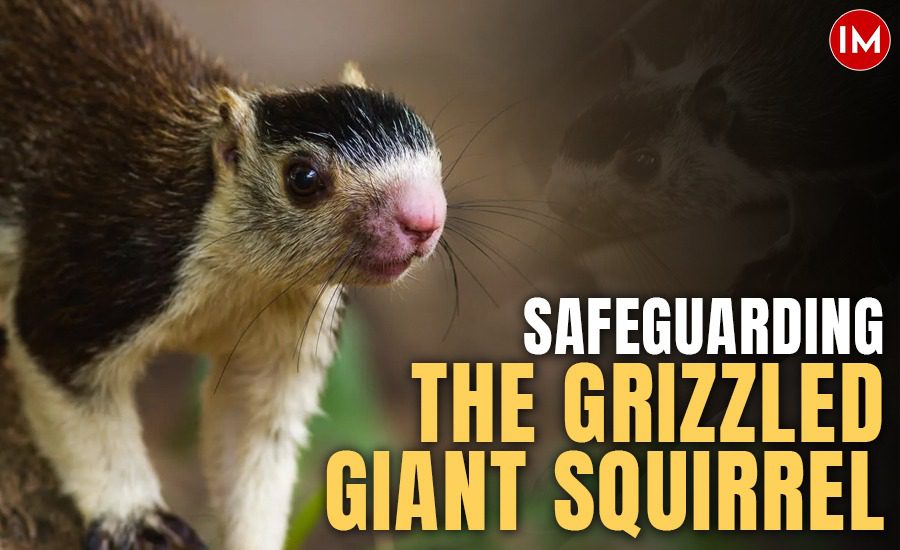
The Grizzled Giant Squirrel (Ratufa macroura), an arboreal mammal native to the riparian forests of Southern India, is facing increasing challenges due to habitat loss, climate variability, and human-induced pressures. With fewer than 700 mature individuals estimated to remain in India, the species is classified as Near Threatened by the IUCN, making targeted conservation measures critical to its survival.
A FRAGMENTED RANGE AND DWINDLING NUMBERS
In India, the distribution of the Grizzled Giant Squirrel is largely confined to the southern stretches of the Western and Eastern Ghats, isolated by the highlands of the Deccan Plateau. The Srivilliputhur Grizzled Squirrel Wildlife Sanctuary in Tamil Nadu currently supports the highest known population—over 200 individuals—followed by the Chinnar Wildlife Sanctuary, which hosts 150–200 squirrels.
Beyond these strongholds, small fragmented populations are scattered across forest patches in Tamil Nadu and Karnataka, including the Anamalai Reserve Forest, Palani Hills, Teni and Hosur forest divisions, and Sirumalai hills. The species has even been recorded as far east as Gingee in Tamil Nadu and in the Cauvery Wildlife Sanctuary in Karnataka. These isolated populations, however, remain vulnerable due to fragmentation and loss of ecological connectivity.
THREATS ROOTED IN HABITAT DEGRADATION AND HUMAN ACTIVITY
The Grizzled Giant Squirrel is highly dependent on riparian forest ecosystems dominated by tall, mature trees lining riverbanks and hill streams. This ecological preference exposes the species to both natural and anthropogenic threats. Frequent floods can damage tree cover, while growing human activities—particularly unregulated adventure tourism—disrupt natural forest regeneration.
“Many squirrels are increasingly found in private plantations bordering forests, where they face higher risks from hunting and predators,” P. Devaraj, IFS, Deputy Director of the Srivilliputhur Megamalai Tiger Reserve (SMTR), told Indian Masterminds. “These areas lack formal protection, making them ecological traps.”
Adding to the challenge is the sympatric range expansion of the Indian Giant Squirrel (Ratufa indica), which may lead to interbreeding and threaten the genetic integrity of the Grizzled Giant Squirrel populations.
ECOLOGICAL ROLE AND THE NEED FOR PROTECTION
Despite their declining numbers, Grizzled Giant Squirrels continue to play a vital ecological role. As frugivores, they contribute to seed dispersal, which is essential for forest regeneration. They also participate in pollination and the distribution of fungal spores, impacting plant growth and forest structure.
Furthermore, their sensitivity to habitat changes makes them reliable indicators of forest health. “Their presence or absence is a sign of how well a forest ecosystem is functioning,” said Mr Devaraj. “When they begin to disappear from an area, we know something deeper is going wrong.”
CONVERSATION AND EDUCATION
Launched in 2024, the Innovation and Incubation Centre at Srivilliputhur has become a key platform for connecting research, environmental education, and community participation. Within a year, the Centre reached over 2,200 students across 75 schools and five colleges through guided nature walks, squirrel-watching sessions, digital exhibits, and storytelling. A government bus was also painted with the squirrel’s image to serve as a moving symbol of awareness.
“Conservation isn’t just about protecting a species—it’s about creating an understanding that lasts across generations,” Mr Devaraj told Indian Masterminds. “The Incubation Centre was envisioned to bridge that gap.”
In tandem with education, research initiatives funded by the Tamil Nadu State Planning Commission have focused on population surveys and habitat analysis within the Grizzled Squirrel Wildlife Sanctuary. These findings help refine management strategies and inform reforestation efforts.
MANAGING AND RESTORING HABITATS
The squirrel’s survival depends on the preservation of dense riparian forests at lower elevations (1000–3000 ft), as these areas offer ideal canopy cover and food resources. These habitats are now being actively managed within the SMTR. Gaps in the forest canopy, where squirrel presence was historically recorded, have been reforested with native riparian species.
Local community-based bodies such as the Eco Development Committees (EDC) and Eco-Tourism Management Committees (ETMC) have taken up the responsibility of protecting saplings, maintaining forest cleanliness, and minimising disturbances caused by tourism.
“Without local involvement, long-term conservation simply won’t work,” Devaraj noted. “These groups help us keep the forest intact—not just for the squirrel but for all biodiversity in the reserve.”
CLIMATE RISKS AND LONG-TERM ADAPTATION
Climate change poses additional risks to the Grizzled Giant Squirrel, particularly through prolonged droughts that can decimate tree cover. Given the species’ limited range and fragmented habitat, even small environmental shifts can lead to cascading effects on population viability.
In response, the SMTR’s conservation strategy includes ecosystem-based adaptation, restoration of degraded forest patches, and strengthening of ecological corridors. However, the foundation of these efforts remains community engagement and awareness.
“Climate change can’t be addressed in isolation,” Mr Devaraj said. “Building ecological literacy at the grassroots is our best bet for protecting not just one species but entire ecosystems.”
INDICATORS OF SUCCESS
The integration of education, scientific research, and grassroots involvement has already yielded positive signs. Increased student participation, public interest, and support from government and non-governmental organisations point to growing awareness. The Incubation Centre’s model—where conservation learning is embedded in the school curriculum—offers a replicable blueprint for similar efforts elsewhere.
While the challenges facing the Grizzled Giant Squirrel are complex, the steps taken in the Srivilliputhur Megamalai region demonstrate that conservation, when grounded in knowledge and shared responsibility, can begin to reverse the tide.