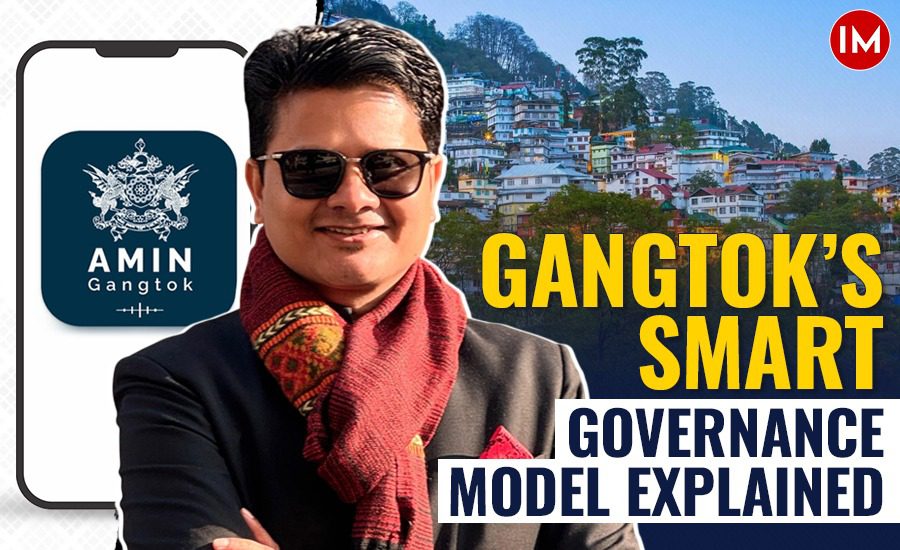
Gangtok, the capital of Sikkim, is witnessing a transformation in governance under the leadership of Tushar G. Nikhare, IAS (2015 batch, Sikkim Cadre), the District Collector. Through a combination of digital innovation, administrative restructuring, and citizen-centric policies, Mr. Nikhare is streamlining processes, ensuring transparency, and making public services more accessible. His flagship initiatives—the Amin App, Faceless Administration, and a structured Leave Management System—are setting new benchmarks for efficient governance.
AMIN APP
One of the most significant innovations under Mr. Nikhare’s leadership is the Amin App, a digital solution designed to simplify and expedite land record management. In a region where land-related disputes and delays have long been a challenge, this app has introduced a transparent, accessible, and efficient system.
“The Amin App eliminates the need for physical visits to government offices,” Mr. Nikhare shared with Indian Masterminds. “It provides citizens with real-time access to land records, allowing them to verify property details and access essential documents from their smartphones.”
Previously, land-related processes involved multiple visits to government offices, lengthy waiting periods, and manual interventions that often led to inefficiencies. With the Amin App, the system is now paperless and tamper-proof, reducing the scope for errors and corruption. This initiative is a step toward ensuring transparency, fairness, and ease of access for all residents of Gangtok.
FACELESS ADMINISTRATION
In addition to digitising land records, Mr. Nikhare has introduced Faceless Administration, a model that minimises the need for physical interactions with government offices. By shifting most administrative services online, this initiative ensures that citizens can access essential services without long queues or bureaucratic delays.
“Faceless administration is about making governance more accessible,” explains Mr. Nikhare. “People no longer need to physically visit government offices for approvals and verifications. These services can now be accessed online, from anywhere.”
This system is particularly beneficial in a geographically diverse state like Sikkim, where reaching government offices can be difficult for those in remote areas. Moreover, it significantly reduces bureaucratic red tape and the potential for corruption, as it removes unnecessary human interactions in service delivery.
LEAVE MANAGEMENT SYSTEM
A well-functioning administration requires continuous workflow, and Mr. Nikhare has introduced a leave management system to ensure that the government machinery remains operational at all times.
“In the past, there were instances where both Sub-Divisional Magistrates (SDMs) or both Additional Deputy Commissioners (ADCs) were on leave at the same time, causing administrative slowdowns,” Mr. Nikhare explains. “To prevent this, we implemented a structured system where if one ADC is on leave, the other must remain available.”
Additionally, the system incorporates a digital responsibility-sharing mechanism. When an officer applies for leave, they must assign their responsibilities to a designated second person. This information is made public through an online domain, ensuring that citizens know whom to approach in case they require assistance.
“This ensures that no work is left unattended,” says Mr. Nikhare. “Even in an officer’s absence, the Token Management System tracks pending work, and the second officer automatically takes over.”
The system is also linked to the Citizen Charter, allowing people to monitor progress on their applications and requests in real time. By ensuring continuity in governance, this initiative has enhanced efficiency and accountability.
CITIZEN-CENTRIC APPROACH
Despite spearheading large-scale digital reforms, Tushar G. Nikhare remains personally involved in key aspects of administration. Unlike many bureaucrats who delegate correspondence, he personally reviews and responds to official mail, ensuring that public concerns are addressed directly.
“When citizens take the time to write to the administration, they deserve a response,” he says. “By handling the mail myself, I stay connected to their concerns and can ensure swift action.”
Moreover, his leadership style empowers his team of two Additional District Magistrates (ADMs), who play a crucial role in executing initiatives. While Mr. Nikhare provides the vision and strategy, the ADMs actively engage with the public, ensuring policies are effectively implemented.
CHALLENGES AND FUTURE PLANS
While these initiatives have significantly improved governance, challenges remain—particularly in ensuring digital literacy and internet accessibility in remote areas. To bridge this gap, Mr. Nikhare’s administration is working on expanding connectivity and conducting awareness campaigns to educate citizens on using digital tools effectively.
Looking ahead, his administration aims to expand e-governance across all departments, making faceless administration a standard practice in Gangtok. The Amin App will also be upgraded to include additional services that cater to the evolving needs of citizens.
Under Tushar G. Nikhare’s leadership, Gangtok is evolving into a model city for modern governance. By integrating technology into the core of administration, he is ensuring that governance is efficient, transparent, and accessible.
“The success of governance lies in its ability to adapt,” says Mr. Nikhare. “Our focus is not just on delivering services but on creating a system where people feel heard, valued, and empowered.”
Through his visionary leadership and citizen-first approach, Gangtok is setting a new standard for digital governance in India. His reforms demonstrate how administrative innovation can bridge the gap between the government and the people, fostering a more efficient and inclusive society.