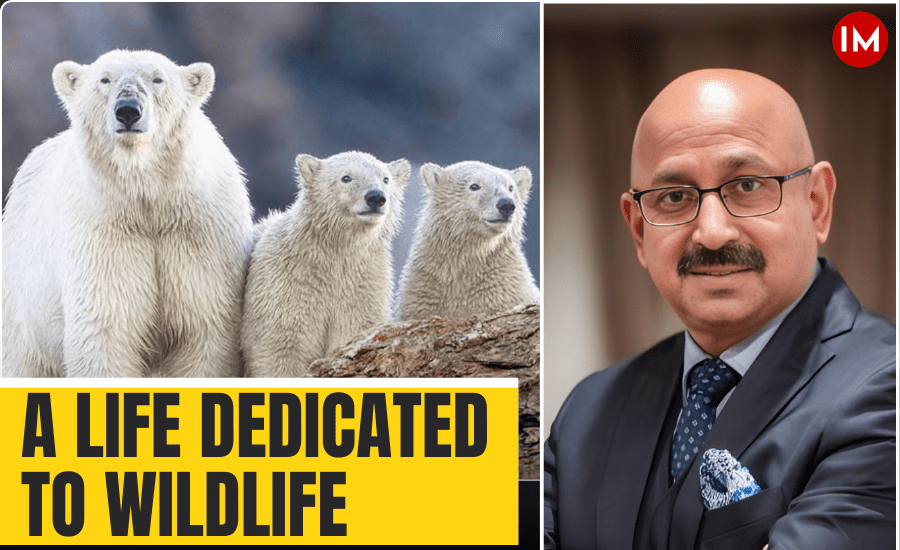
When retired Indian Forest Service officer Dr Sanjay Shukla looks back at the path that brought him into wildlife conservation, he sometimes smiles at how accidental it all seems. A young postgraduate student at Allahabad University, deeply immersed in human biochemistry and dreaming of a career in immunochemistry, he appeared far more destined for a laboratory in Hyderabad or Bangalore than the dense sal forests of Madhya Pradesh. But life, he says, “has its own design.”
“I had cleared the PhD entrance exams for both CCMB and IISc,” Dr Shukla shared in a conversation with Indian Masterminds. “My plan was clear—I wanted to become a scientist and work abroad. UPSC was not a serious thought at that time.”
Yet, the casual decision to fill the Civil Services form because “friends were doing it” changed the course of his life. Shukla qualified for the UPSC interview in his first attempt in 1988, an unexpected outcome that shifted his sense of possibility. “After the first interview, I felt maybe I could clear this exam if I committed to it,” he says.
CHOOSING THE FOREST SERVICE AND FINDING HIS LANDSCAPE
For four consecutive attempts between 1988 and 1990, he reached the interview stage. During the same period, he was selected as a Customs Appraiser and even travelled to Kolkata to join the post. “On the very day I reached Kolkata, the Forest Service result came out,” he says, still amused by the coincidence decades later. He sought an extension and made a decision that defined the next 35 years of his life: he chose forests over customs, conservation over customs law, and eventually Madhya Pradesh over everything else.
He calls getting the Madhya Pradesh cadre “a blessing.” Though originally from Banaras, he believes the posting shaped everything that followed. Madhya Pradesh, with its vast forest tracts and rich wildlife, offered him unmatched responsibilities and exposure. “Whatever happened, happened for good,” Dr Shukla says. “Madhya Pradesh gave me the kind of field experience a wildlife manager can only hope for.”
Over the years, challenging postings came one after another, and Dr Shukla embraced each of them as an opportunity to learn and build. Although wildlife was an area of interest from the beginning, he received dedicated wildlife postings only later in his career. Those roles became some of the most defining phases of his professional life.
LEADING TIGER RESERVES AND SHAPING CONSERVATION EFFORTS
Mr Shukla headed two of India’s most celebrated tiger reserves—Pench and Kanha. His tenure at Kanha, especially, remains marked by strong conservation outcomes, scientific interventions, and management innovations. Among his most impactful contributions was the rewilding of orphaned tiger cubs, an intricate and sensitive process where cubs separated from their mothers are trained to survive independently and eventually released back into the wild.
“Every time a cub returns to the forest as a confident, capable tiger, it feels like a small victory for conservation,” he says. “It requires patience, scientific planning, and a lot of field coordination.”
Another major milestone from his Kanha years was the translocation of the hard-ground Barasingha—a species once on the brink of extinction. In the 1970s, only about 60–66 individuals remained, all confined to Kanha. During IFS Sanjay Shukla’s tenure, the species was successfully given a second home in Satpura Tiger Reserve. “Seeing the Barasingha population cross 1,000 has been extremely satisfying,” he notes. “Translocation was important for the species’ long-term survival.”
He also initiated practical improvements in tourism management, including the development of the “Bagheera” app, which streamlined vehicle regulation and reduced chaos at Kanha’s entry gates. “Tourism needs regulation, not restriction,” he says. “The idea was to make movement more efficient and transparent.”
NATIONAL LEADERSHIP AND A RETURN TO HIS ROOTS
Beyond Madhya Pradesh, Dr Shukla’s experience expanded when he moved to the Ministry of Environment, Forest and Climate Change, serving as Member Secretary of the Central Zoo Authority. Here, he led national conservation breeding programmes for species like the Red Panda, Snow Leopard, Indian Pangolin, Gharial, and multiple endangered birds. He also held additional charges at the National Afforestation and Eco-Development Board, Green India Mission, and Wildlife Crime Control Bureau.
One of the most forward-looking initiatives during his tenure at CZA was the establishment of the National Referral Centre for Wildlife Health in Junagadh. Dr Shukla describes it as an upcoming institution that will transform wildlife forensics and health monitoring. “It will be to wildlife what AIIMS is to human health,” he explains. “This centre will play a major role in the One Health framework.”
Despite the complexities of the roles he handled, Dr Shukla insists he never regretted not becoming a scientist. “My academic interest was always there, but the Forest Service gave me something a laboratory could not—an intimate connection with nature,” he says. “I have no regrets. I gained experiences I could never have imagined as a student of biochemistry.”
Even after retiring in March 2025, IFS Sanjay Shukla returned to his old domain when he rejoined the Ministry as a Senior Consultant in the CZA division.
Looking back, he describes his journey as “unexpected, but deeply fulfilling.” It took him from tiger landscapes to national policy tables, from field camps to international forums like the G20, where he served as co-theme chair for biodiversity conservation and land degradation.
But there’s one more side of him that people often discover later—his photography. Dr Shukla is an accomplished wildlife photographer, known for his portraits of big cats, birds, and forest life. His images capture the same landscapes he has spent his career protecting.
As he puts it: “Photography came naturally because I was already spending so much time in the field. It became another way to understand and appreciate wildlife.”
(This article is the first part of Dr Sanjay Shukla’s journey. In the second part, we will explore his photography, expeditions, and the stories behind some of his most remarkable images. Stay tuned.)