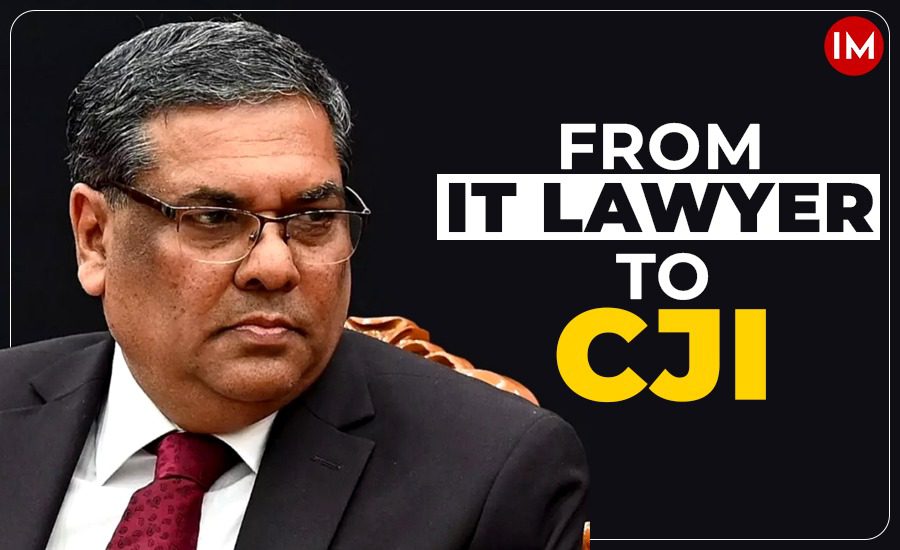
When Sanjiv Khanna started his career in Delhi’s Tis Hazari Court as a Tax lawyer in 1983, little did he know that 41 years later, he would be the top judge of the country. Justice Khanna will succeed Justice DY Chandrachud as Chief Justice of India from November 11, 2024. He is acting chairman of the National Law Services Authority (NALSA).
At one point, Khanna used to represent the Income Tax department as a Senior Standing Counsel. In 2005, he was appointed to the Delhi High Court as an additional judge and a permanent judge in 2006. He was elevated to the Supreme Court of India on January 18, 2019.
Justice Khanna during his stint in the Apex Court, has delivered some historic judgements. He was part of the constitutional bench that upheld Modi Government’s decision to abrogate Article 370 bestowing a special status to Kashmir. He also declared electoral bonds unconstitutional. In another landmark judgment, he granted divorces by invoking special powers of the Supreme Court under Article 142 on grounds of ‘irretrievable breakdown of marriage’.
Earlier this year, he also decided against allowing the counting of 100 percent VVPAT chits, terming it as a ‘retrograde step’ as it would lengthen the electoral process and delay the results. “This step is unnecessary as our electoral system already has adequate safeguards,” he noted in his decision.
Justice Khanna took another pioneering decision in bringing the office of the CJI into the ambit of the right to Information (RTI), a huge step in ushering in transparency and enhancing the Supreme Court’s credibility. Now anybody can just put an RTI to peep into the workings of the SC. He was also part of the SC bench which granted bail to Aap Aadmi Party convenor and then Delhi Chief Minister Arvind Kejriwal.
PERSONAL DETAILS
Justice Khanna was born in Delhi on May 14, 1960. He did his graduation in law from Delhi University and started practicing law in the Delhi District Court in 1983. He was appointed as a judge in the Delhi High Court in 2005 and served there for 14 years before being elevated to the Supreme Court of India.
He is known to specialize in criminal, civil, and tax besides of course constitutional matters.
THE CONTROVERSY
Justice Khanna’s appointment to the Supreme Court on January 10, 2019, was not without a fair share of controversy. He was 33rd in the seniority list of High Court judges in the country. He was appointed by the collegium as SC judge by superseding 32 other HC judges.
The Collegium system is a system for the appointment and transfer of judges in the Supreme Court and the High Court is not rooted in the Constitution. It has evolved through judgments of the Supreme Court. Under the system, the Chief Justice of India (CJI), along with four senior-most Supreme Court judges, recommends the appointment and transfer of judges.
A High Court Collegium, meanwhile, is led by the incumbent Chief Justice and the two seniormost judges of that court. The government can also raise objections and seek clarifications regarding the Collegium’s choices, but if the Collegium reiterates the same names, the government is bound to appoint them to the post.
THE PROCEDURE OF CJI’S APPOINTMENT
There is a set procedure for the appointment of CJI. It is called the Memorandum of Procedure. As a custom, the outgoing Chief Justice of India nominates the senior-most judge of the SC as his successor. That’s why Justice Chandrachud nominated Justice Sanjiv Khanna’s name as the 51st CJI.
SHORTEST TENURES
Justice Khanna will, however, have a short tenure of only six months and two days. Justice Kamal Narain Singh was the shortest-serving Chief Justice Of India, he held the Supreme Court Office as CJI just for 17 days from 21st November 1991 to 12th December 1991. Justice Jayantilal Chhotalal Shah served as CJI for only 36 days from December 17, 1970, to January 21, 1971, while Justice S Rajendra Babu served for 30 days from May 2, 2004, to June 1, 2004. Justice Gopal Ballabh Patnaik had a tenure as CJI of 41 days in 2002 – from Nov 8 to Dec 18.
In the recent past Justice UU Lalit as CJI had a tenure of 74 days from August 27 2022 to November 8, 2022.
AVERAGE TENURE
The average tenure for a CJI is 18.1 months or about 1.5 years. The Constitution of India doesn’t specify a fixed tenure for the CJI, but the Chief Justice remains in office until they turn 65.