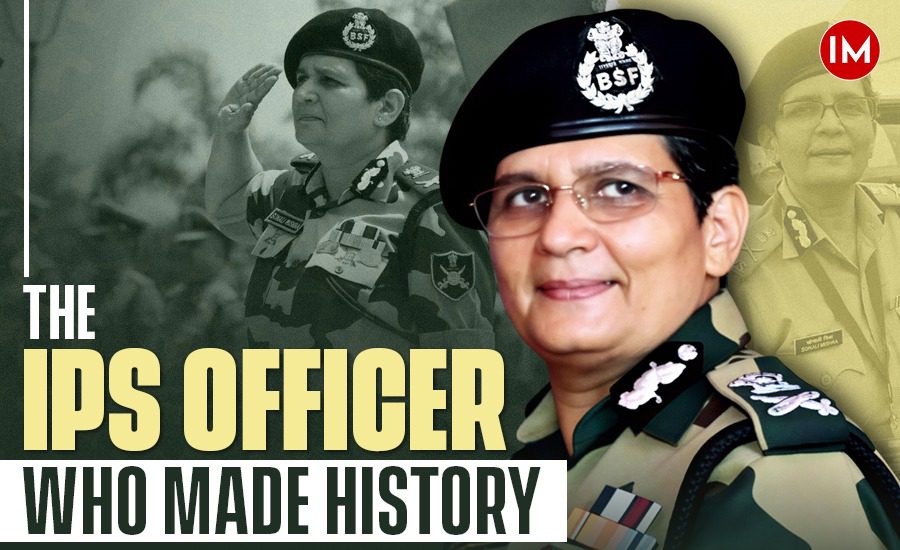
On a calm morning in August 2025, a quiet yet significant moment unfolded in India’s security establishment. When Sonali Mishra walked into the headquarters of the Railway Protection Force to assume charge as its Director General, she was not merely taking over another senior policing assignment.
She was stepping into a position no woman had held before in the 143-year history of the force.
The RPF is responsible for safeguarding one of the world’s largest railway networks. Every day, more than two crore passengers travel across thousands of trains and stations. Protecting this vast system demands constant alertness, rapid coordination and careful planning.
For Mishra, the responsibility was immense, but it was also the natural continuation of a career built over more than three decades in uniform. Her journey has not been shaped by dramatic leaps but by steady professionalism, thoughtful leadership and a keen focus on public service.
EARLY LIFE AND ENTRY INTO THE IPS
Born on 9 October 1966, Mishra grew up in an environment where discipline and education were deeply valued. Like many young Indians drawn to public service, she saw the civil services as a meaningful way to contribute to society.
In 1993, she joined the Indian Police Service and was allotted to the Madhya Pradesh cadre. At that time, policing remained largely male-dominated, and women officers were still relatively few in field positions.
During her early years in district policing, Mishra quickly developed a reputation for composure and careful decision-making. Colleagues often described her as someone who listened carefully before acting but whose decisions were clear and firm once taken.
In one tense law-and-order situation during the early phase of her career, crowds had begun gathering and tensions were rising rapidly. Mishra chose to directly engage with community leaders and address the situation through dialogue, preventing the confrontation from escalating into violence.
The incident quietly established her reputation as an officer capable of combining firmness with empathy, an approach that would continue to define her leadership style.
LEARNING THE CRAFT OF POLICING
Over the years, Mishra served in a wide range of assignments across Madhya Pradesh, including district policing, investigations and administrative responsibilities. Each role helped expand her understanding of the complexities of law enforcement.
Her career later took her to the Central Bureau of Investigation, where she worked on complex cases requiring detailed investigation and careful analysis of evidence. Colleagues remember her as an officer deeply invested in understanding every aspect of a case, often spending long hours reviewing files and guiding investigators to examine details more closely.
The experience further strengthened her belief that effective policing requires patience, evidence-based investigation and clarity of judgment.
COMMAND ON A SENSITIVE BORDER
One of the most notable phases of Mishra’s career came during her tenure with the Border Security Force.
In 2021, she became the first woman officer to command a BSF formation along the India-Pakistan border in Punjab, one of the most strategically sensitive frontiers in the country.
Border duty demands constant vigilance. Personnel operate in extreme weather conditions and remain alert against infiltration, smuggling and other cross-border threats.
During this assignment, Mishra regularly visited forward posts and interacted directly with personnel stationed along the border fence. These visits were not merely inspections but opportunities to understand operational realities and ensure that leadership remained connected to the challenges faced by officers and jawans on the ground.
Her presence at remote posts, often during long night patrols, left a strong impression among personnel serving in the region.
INTERNATIONAL EXPERIENCE IN PEACEKEEPING
Mishra’s career also gained an international dimension when she served in a United Nations peacekeeping mission in Kosovo.
Working in a post-conflict region exposed her to complex policing challenges where maintaining stability required cooperation between officers from multiple countries. The assignment offered a broader understanding of international policing standards and conflict management in fragile environments.
The experience reinforced the importance of community trust and cooperation in maintaining peace, an approach she would later emphasize in training and administrative roles.
BUILDING THE NEXT GENERATION OF OFFICERS
Returning to Madhya Pradesh, Mishra took on significant responsibilities in police administration and training. As Additional Director General of Police for Selection and Recruitment, she played a key role in strengthening recruitment systems and improving training processes.
She later served as Director of the Madhya Pradesh Police Academy and also held responsibilities at the Police Training and Research Institute in Bhopal.
Young officers who trained under her often recall how she approached training sessions as discussions rather than formal lectures. These interactions focused on the realities of policing, the pressures of public service and the importance of maintaining integrity and judgment in difficult situations.
Through these roles, Mishra contributed directly to shaping the thinking and professional approach of a new generation of officers.
LEADING RAILWAY SECURITY IN A NEW ERA
When the Government of India appointed Mishra as Director General of the Railway Protection Force in 2025, the decision carried historic significance.
For the first time in its long history, the RPF would be led by a woman officer.
But for Mishra, the focus remained on the scale of the task ahead. India’s railway network connects cities, towns and villages across the country, carrying millions of passengers daily. Ensuring their safety involves managing a vast security apparatus spread across thousands of stations and trains.
Since taking charge, Mishra has emphasised strengthening surveillance systems, expanding the use of technology and improving training for RPF personnel across the country.
She has also focused on addressing crimes linked to railway routes, including human trafficking, narcotics smuggling and organised theft targeting passengers.
During station inspections, she is known to quietly walk through platforms and control rooms, asking officers detailed questions about security deployment and response mechanisms. Even seemingly small operational decisions, such as the placement of surveillance cameras, receive careful attention in her reviews.
Her approach reflects a belief that strong security systems are built through consistent attention to detail.
THE PERSON BEHIND THE UNIFORM
Despite holding one of the most senior positions in India’s security system, Mishra remains a deeply private individual.
Friends and colleagues often describe her as thoughtful and introspective. She prefers reading and quiet reflection over public visibility and remains strongly committed to mentoring young officers.
At a time when more women are joining India’s uniformed services, her career has naturally become a source of inspiration for many aspiring officers. Yet she rarely frames her journey in terms of breaking barriers.
Instead, she consistently highlights professionalism, competence and dedication as the qualities that define an officer’s credibility.
A CAREER THAT CONTINUES TO SHAPE INDIAN POLICING
Today, as she leads the Railway Protection Force, Sonali Mishra stands at the culmination of a long career that has taken her from district policing in Madhya Pradesh to international peacekeeping missions, border command and national-level leadership.
Her journey mirrors the evolving landscape of Indian policing, one where experience, professionalism and thoughtful leadership continue to shape institutions responsible for public safety.
Across India’s busy railway platforms, the millions who travel every day may never know the name of the officer responsible for strengthening the system that protects them.
But within the world of public service, Sonali Mishra’s journey is already influencing how leadership is understood, and how possibilities continue to expand for future officers.