Every year, thousands of aspirants across India dedicate years of focused study to clear the Civil Services Examination conducted by the Union Public Service Commission (UPSC). The examination is known for its vast syllabus, intense competition, and the patience it demands from candidates. While many aspirants prepare for years before achieving success, those who make it to the final list often combine disciplined preparation with clarity of purpose.
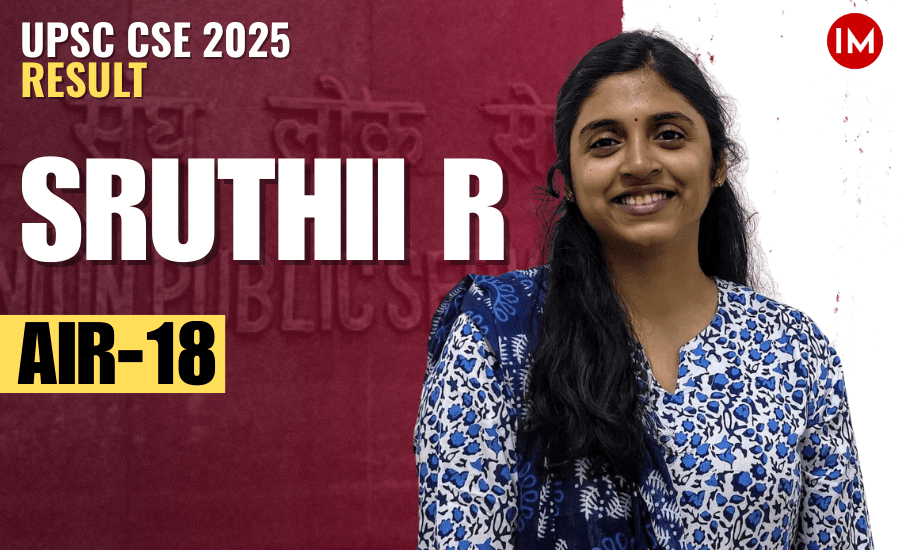
One such inspiring success story is that of Sruthii R, an engineering graduate from Coimbatore, Tamil Nadu, who secured AIR 18 in the UPSC Civil Services Examination 2025 in her third attempt. Her journey reflects careful planning, consistent learning, and the confidence to continue working even when early attempts did not go as expected.
From leaving a secure job to preparing for one of India’s toughest examinations, Sruthii’s story highlights how focused effort and a thoughtful preparation strategy can lead to success.
EARLY LIFE AND EDUCATIONAL BACKGROUND
Sruthii hails from Coimbatore in Tamil Nadu, a city known for its educational institutions and strong academic culture. She completed her graduation in Electronics and Communication Engineering from Hindustan College of Engineering and Technology, Coimbatore.
Education played a central role in her upbringing. Her father works as a principal in a private college, and her mother is a homemaker. Growing up in a family that valued education encouraged Sruthii to pursue academic excellence from an early age.
After completing her engineering degree, she briefly took up a job. However, the idea of joining the civil services had already begun to form during her college years.
DISCOVERING THE PATH TO CIVIL SERVICES
“During the pandemic, I spent time exploring different career options and realised that public administration was the field where I could contribute meaningfully,” Sruthii shared in an exclusive interview with Indian Masterminds.
As she researched more about public administration and grassroots development, she realised that civil services offered an opportunity to contribute directly to society.
With this clarity, she decided to leave her job and dedicate herself fully to UPSC preparation.
THIRD ATTEMPT BRINGS SUCCESS
In her first two attempts, she was unable to clear the preliminary stage. However, instead of taking a break from preparation, she continued studying with a focus on mains subjects, optional papers, and answer writing.
This approach helped her build a strong foundation.
“Even when prelims did not work out earlier, I continued preparing for mains so that I would already be ready whenever the opportunity came,” she explains.
In her third attempt, she cleared the preliminary examination for the first time, performed well in mains, and successfully reached the personality test stage. Her consistent preparation ultimately helped her secure a place in the final merit list.
A RESULT DAY SHE WILL ALWAYS REMEMBER
The moment when UPSC results are announced is unforgettable for most aspirants. For Sruthii, the experience happened in a rather unexpected place.
She was travelling in a train when the results were declared.
“I remember opening the PDF in the train, zooming into the list, and suddenly spotting my name on the first page. It was an incredibly joyful moment for me and my family,” she recalls.
That moment marked the end of years of preparation and the beginning of a new chapter in public service.
COACHING AND SELF-STUDY
Sruthii’s preparation combined structured coaching with independent study.
She initially moved to Delhi and joined the foundation course in one of the coaching, where she spent nearly two years building conceptual clarity across subjects.
Later, she returned to Coimbatore due to personal circumstances and continued preparing independently.
After clearing prelims, she joined the Naan Mudhalvan Nangal Scheme, a state-supported initiative that provides accommodation, food, and academic guidance to UPSC aspirants preparing for mains.
The program also supported her interview preparation before she travelled to Delhi for mock interviews.
BUILDING AN EFFECTIVE PREPARATION STRATEGY
Sruthii focused on building clarity in subjects rather than using too many study resources.
For mains preparation, she prioritised her optional subject because it carries significant weight in the final score. She used the morning hours to revise concepts and refine her notes.
Answer writing was another key component of her preparation.
“Regular answer writing helped me organise my thoughts clearly and improve the way I presented arguments within limited time,” she says.
She also enriched her answers with diagrams, maps, data points, and examples gathered from newspapers and toppers’ answer copies.
THE ROLE OF PREVIOUS YEARS’ QUESTION PAPER
For the preliminary examination, Sruthii relied heavily on analysing previous year questions.
Instead of simply reading them, she studied patterns from the last decade to understand which topics appeared frequently.
She printed the question papers, wrote notes directly on them, and revised those annotated papers multiple times.
“Previous year questions help you understand the direction of the examination and guide your preparation more effectively,” she explains.
To make revision faster, she prepared short topic-wise sheets that allowed her to review important concepts quickly without revisiting entire textbooks.
AN INTERESTING INTERVIEW EXPERIENCE
Sruthii describes her interview with the UPSC board as friendly and engaging.
Several questions were based on her hobbies. One of them was Silambam, a traditional martial art from Tamil Nadu. She holds a world record in the discipline recognised by the Cholan Book of World Records.
The panel asked whether she would still practise Silambam if there had been no covid.
Her response highlighted her genuine interest.
“Yes, I would still practise Silambam because it is something I truly enjoy and value,” she said.
Another hobby mentioned in her Detailed Application Form was caring for dogs, which led to a light-hearted exchange with the interview board.
LESSONS FROM HER UPSC JOURNEY
Reflecting on her preparation journey, Sruthii believes patience played a crucial role in helping her stay focused.
The examination requires sustained effort over a long period, and candidates often need time to refine their strategy and improve their performance.
“Progress in this examination happens gradually, so trusting your preparation becomes very important,” she reflects.
ADVICE FOR FUTURE ASPIRANTS
Sruthii encourages aspirants to adopt an active learning approach rather than passive reading.
She believes that aspirants should follow a simple preparation cycle: read the material carefully, recall what they have studied, revise it regularly, and repeat the process to strengthen their understanding.
She also emphasises that preparation for the civil services is not only about completing the syllabus but also about maintaining the right mindset throughout the journey.
“UPSC preparation is as much about building the right mindset as it is about studying the subjects,” she says.
With thoughtful preparation, disciplined revision, and confidence in her approach, Sruthii R’s journey shows how consistent effort can eventually lead to success in the highly competitive examination conducted by the Union Public Service Commission.