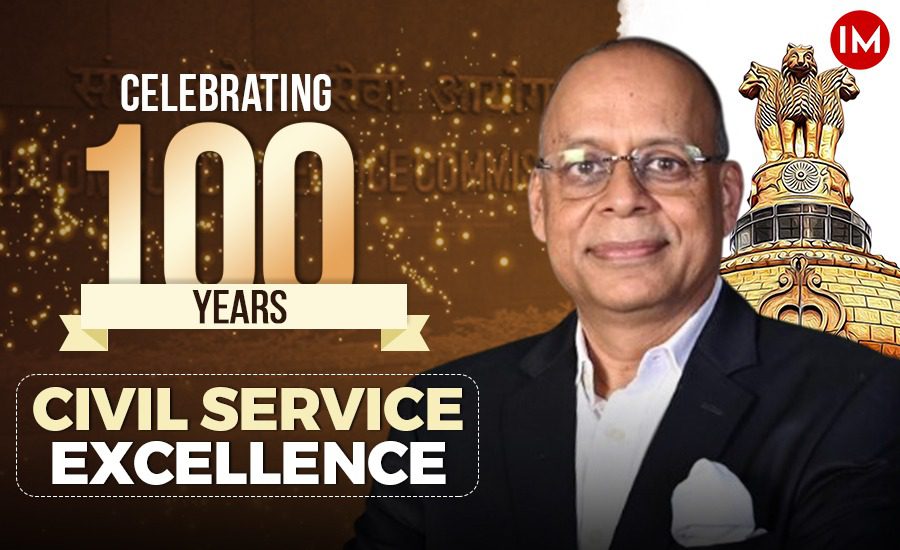
As India is celebrating 75th year of its Republic, a defining moment in the democratic journey, the Union Public Service Commission (UPSC) stands at a milestone, entering into its 100th year of establishment. The Public Service Commissions (PSCs) were envisioned by our forefathers as Constitutional bodies, guardian of meritocracy in civil services, who shoulder the immense task of governance in a diverse and the biggest democracy in the world. Accordingly UPSC was entrusted a pivotal role the areas of recruiting, promoting and disciplining officials of the Central Civil Services. The story of its evolution therefore, over the period of last one century, is not just an institutional chronicle, but a reflection of India’s deep faith in fairness, trust and integrity.
The idea of an independent Commission to oversee recruitment into the higher civil services found its strongest voice way before the making of the Constitution, itself. The Lee Commission report (1924) stated “Wherever democratic institutions exist, experience has shown that to secure an efficient Civil Service it is essential to protect it so far as possible or personal influences and to give it that position of stability and security which is vital to its successful working as the impartial and efficient instrument by which Governments, of whatever political complexion, may give effect to their policies” Thereafter, leaders of the Constituent Assembly, too supported the idea of independent PSCs, arguing that while governments change, the machinery of administration should remain impartial, professional, and anchored in constitutional morality. It was argued with great conviction that recruitment into the civil services could not be left entirely to the discretion of the executive, for such an arrangement risked politicisation and erosion of public trust.
The founding fathers, therefore, enshrined in Part XIV of the Constitution, Articles 315 to 323, a special status for the Union and State PSCs. This was done to safeguard their independence and autonomy, and to ensure that recruitment, promotions and disciplinary matters would be free from fear or favour. It is a testament to their vision that the institution, has been standing tall, for its principles of Merit, Trust and Integrity.
Though open competitive examination for recruitment was introduced in 1850’s, those examinations were held in London and conducted by the British Civil Service Commission. Competitive examination for Indian Civil Service preceded that for British Civil Service by many years. These overseas examinations put the Indian aspirants at a significant disadvantage. However, despite hardships, some Indians made their entry into the ICS and significantly contributed to India’s freedom struggle movement. SatyendraNath Tagore (1863) the first Indian to enter ICS, R C Dutt (1869), SurendraNath Banerjee (1869) and others were few early entrants. The persistent demand by Indian leadership for simultaneous examination in England and India fell on deaf ears of the rulers. Though the demographic balance titled after the World War I, civil services remained an instrument of colonial policy.
However the first mention of independent Public Service Commission in India, found its mention in the Government of India Act, 1919, which was then established in October 1926, as the Public Service Commission, following the recommendations of the Lee Commission of 1924. Headed initially by Sir Ross Barker, the body had limited functions and was a cautious experiment under colonial rule. In 1935, it was reconstituted as the Federal Public Service Commission, a step forward in giving Indians a larger role in administration. With the birth of the Republic in 1950, it acquired its present constitutional status as the UPSC. This historical evolution reflects not just administrative continuity, but also the growing confidence in India’s own democratic institutions. From conducting a small number of examinations in its early years, UPSC today manages a vast and varied portfolio ranging from the prestigious Civil Services Examination to specialised services such as Engineering, Forest, Medical and Statistical and other services. Its scope has expanded with the Republic itself, but its core mandate remains unchanged to recruit the finest talent for public service.
If the history of UPSC is its foundation, the principles of trust, integrity and fairness are its pillars. Over the decades, millions of aspirants have placed their faith in the Commission, assured that success or failure depends solely on their merit. This trust is not an accident. It has been built painstakingly through transparency in procedure, impartiality in evaluation, and an uncompromising stance against malpractice. The sanctity of examinations, from the setting of question papers to their secure conduct across the country, is guarded with utmost rigour. The confidentiality is at the core of its processes. This has led to what the institution is today, winning the heart and trust of the Nation. Integrity, meanwhile, has meant protecting the institution from political or external pressures, maintaining confidentiality, and ensuring that those who succeed are genuinely among the most competent. Fairness has meant providing equal opportunity to candidates from every background, urban or rural, privileged or underprivileged, fluent in English or not. In a country as diverse as ours, where inequalities persist, the fact that UPSC examinations are regarded as a true “level playing field” is itself one of independent India’s proudest achievements. This philosophy finds echo in the timeless wisdom of the Bhagavad Gītā, where Lord Krishna says: “तस्मादसक्तः सततं कार्यं कर्म समाचर। असक्तो ह्याचरन्कर्म परमाप्नोति पूरुषः।।“ (Tasmadsakt statam karyam karma Samachar. Asakto haracharkarm paramapnoti purushah.)” — or in other words without attachment, constantly perform your duty as it ought to be done; for by performing action without attachment, one attains the Supreme. The UPSC embodies this principle in spirit: it performs its duty with rigour and fairness, without attachment to outcomes.
The UPSC recruitment process has evolved with times. There have been changes in the examination patterns: the introduction of the Civil Services Preliminary Examination in 1979; the restructuring of the syllabi periodically; the introduction of an Ethics paper and the Civil Services Aptitude Test among others. Each of these reforms were brought in after lot of debate and deliberations, so that civil service officers selected are not only knowledgeable, but also equipped with the skills and integrity demanded by contemporary governance.
At the heart of UPSC’s recruitment journey are the thousands of aspiring youngsters who come forward year after year, driven by dedication, perseverance, and a dream to serve the nation. Once dominated by a select few from elite urban centres, today the Civil Services Examination attracts candidates from nearly every district of India, including the remotest and most underprivileged regions. This extraordinary diversity reflects the true spirit of the ‘Indian Dream’—the aspiration that talent, hard work, and commitment can open the doors of opportunity to all. UPSC salutes these courageous aspirants and remains committed to reaching every corner of the country, ensuring that every aspiring citizen has the chance to contribute to the nation’s service and progress.
UPSC takes immense pride in conducting world’s biggest and most complex competitive examination- the Civil Service Examination, with remarkable precision and consistency year after year. Starting with nearly 10–12 lakh applicants for the preliminary exam, candidates for the mains exam have the option of choosing from among 48 subjects and writing their answers in English or any of the 22 languages recognized under the Constitution of India. UPSC then evaluates these multiple-subject candidates into a single merit-based ranking—a feat unique in scale and sophistication anywhere in the world. The logistics of the Civil Services examinations are truly extraordinary. The Preliminary examination is held across more than 2,500 venues nationwide. For the Mains examination, the task becomes an intricate challenge: ensuring that each candidate at different centres across the country receives the question paper for the subject they have chosen. This complexity is further compounded by the special arrangements made for differently-abled candidates, including the provision of scribes, while visually impaired candidates are provided question papers in larger fonts. After the exam, answer sheets are evaluated anonymously by top experts in the 48 disciplines, with proficiency in the language in which the answers are written. All of this is completed within a strict annual timeline, without disruption—even during events such as the COVID-19 pandemic or natural calamities. This seamless, time-bound orchestration typifies India—its ability to manage complexity and diversity with efficiency, fairness, and equity.
As we celebrate a century of UPSC, it is equally fitting to honour the unsung heroes behind its remarkable success—the paper-setters and evaluators who form the faceless backbone of the Commission. These are some of the finest academics and experts in the country, each a master in their own discipline, yet they serve with quiet dedication, without seeking recognition or limelight. Their meticulous work, impartial judgment, and unwavering commitment to excellence have been the bedrock of UPSC’s ability to conduct a fair, transparent, and robust selection process—one that has earned the trust of the nation and stood the test of time. I personally thank each one of them for their selfless service, which ensures that the dreams and aspirations of thousands of candidates are judged with fairness, rigor, and integrity.
Over the years what has remained constant for UPSC is the purpose: to select meritorious candidates who will serve India with dedication and punish fairly those who are found delinquent in their duties. Across decades, UPSC has given the nation civil servants who have administered districts during crises, managed the economy through reforms, overseen infrastructure and environmental challenges, and contributed in countless invisible ways to nation-building. Their work touches every Indian, even if the hand behind the service remains unseen. That continuity of purpose, to serve the people of India, as the ‘Sevak’, by selecting those most capable, is what defines the UPSC legacy. With Hon’ble Prime Minister as the ‘Pradhan Sevak’ the civil service is honoured to be the ‘Sevaks’ of the People of this country.
As the Commission enters its centenary year, this moment calls not just for celebration, but for reflection. The centenary is an opportunity to honour the past, celebrate the present, and put the vision for the next century. As India marches towards reclaiming old glory as a leading light of the world, the challenges emanating from global competition and technology advancements are disrupting existing models of governance. As an institution, UPSC will continuously strive and adapt to these changes to remain current and stay the beacon of fairness and opportunity in Indian democracy .
UPSC has already geared up and therefore, initiated many reforms. Our new online application portal, while facilitating ease of candidates application process, the newly introduced face recognition technology will ensure zero frauds in the exam process. Our reforms with exam, recruitment processes are in line with the changing needs of time. While we are looking for the selected candidates, we are also helping those participating in our process. The PRATIBHA Setu initiative, is facilitating employment opportunities for those who reach the final Personality Test stage but are unable to make it in the final list. PRATIBHA Setu has already benefitted many. UPSC proposes use of AI, for its efficient and effective working, without compromising on the integrity of the processes and practices.
As Chairman along with my fellow members of the Commission, celebrating the Centenary year at UPSC, we all feel humbled and inspired, both, by the strength of our legacy and the faith reposed in the institution by the society at large. We reaffirm our resolve to uphold and carry forward this gold standard of integrity, fairness and excellence, ensuring that UPSC continues to serve the nation with the same trust and distinction in the years to come.
(Ajay Kumar is a 1985 batch IAS officer who currently serves as the Chairperson of the Union Public Service Commission (UPSC)