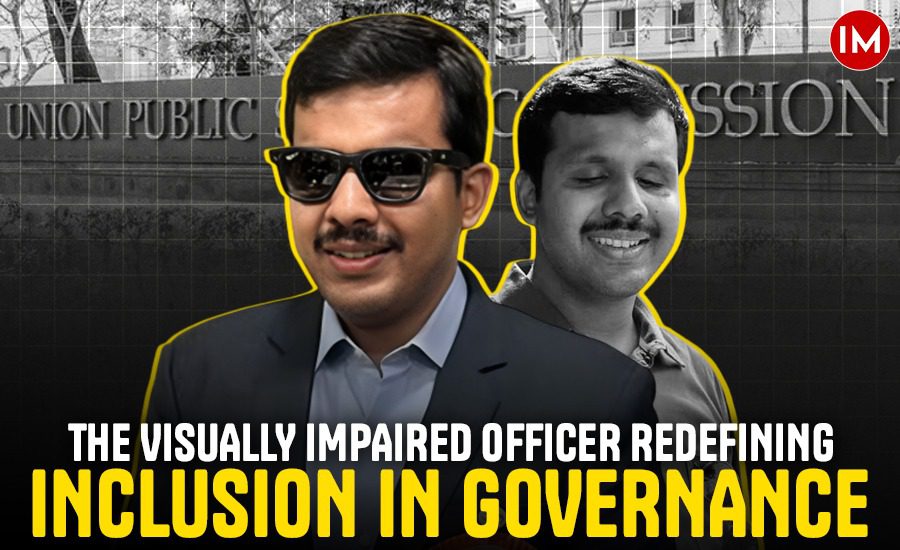
In the quiet administrative corridors of Tamil Nadu’s Mayiladuthurai district, Additional Collector IAS Gokul S stands out — not because of a title or position, but because of the path he took to get there. A 2021 batch IAS officer (Tamil Nadu Cadre) who cleared the UPSC Civil Services Examination 2020 with All India Rank 357, Gokul has been visually impaired since childhood. Yet, that has never defined his limitations — only his determination to redefine what’s possible. In an exclusive video interview with Indian Masterminds, Gokul shared his journey and work in detail.
WATCH THE INTERVIEW HERE.
Gokul didn’t grow up dreaming of becoming a civil servant. “I was not one of those children who aspired to join the services from an early age,” he says candidly. In fact, he once saw bureaucrats as people who came in the way of good ideas. It was only during the devastating Kerala floods of 2018 that his perspective changed.
While pursuing his post-graduation, Gokul was part of a core volunteer team coordinating relief efforts in a district unaffected by the floods. “I saw firsthand how officers worked — how their decisions could mean the difference between life and death,” he recalls. That experience opened his eyes to the immense potential of the civil services. “It showed me how much change one person in that position could make if they wanted to.”
A JOURNEY THROUGH CHALLENGES
Gokul’s story, however, began much earlier — in classrooms that weren’t designed for someone like him. When he chose to study bioscience in school, he became only the second visually impaired student in the country to do so under the CBSE board. “Nobody knew how to conduct practical exams for a blind student,” he remembers. His family had to approach the Supreme Court to secure permission for him to appear for the exams.
What followed was a remarkable victory — Gokul scored over 95%, earned a certificate of merit, and ranked among the top 50 students in physics across India. “It proved that the problem was never with capability — it was with accessibility,” he says.
Even when the system made things harder, he refused to step back. “I was taught that if something limits your options, you must find a way around it,” he says. That mindset has stayed with him — through his education, his UPSC journey, and even now, as an administrator.
Preparing for one of the country’s toughest exams with visual impairment was no small feat. He used screen reader software to study digital textbooks and online newspapers. “I wrote all my university exams on a computer without a scribe,” he says. For the actual UPSC exam, he petitioned the Commission to allow visually impaired candidates to use computers. The approval came — though just after his own attempt — benefiting future aspirants.
His first attempt, in 2018, was almost unplanned. He had not even checked his prelims result until a friend called him, convinced he’d seen Gokul’s name on the list. “I didn’t believe it until I checked myself,” he laughs. With just 64 days before the mains, he prepared intensely — and cleared the exam, securing a post in a lower service. His second attempt brought him the IAS.
CHANGING SYSTEMS FROM WITHIN
Today, as Additional Collector of Mayiladuthurai, Gokul’s work reflects the same principle that shaped his life — inclusion. Among his most impactful initiatives are skill training and employment programmes for differently-abled individuals and an innovative wig-making project that transformed the lives of women once engaged in low-paying, hazardous work.
In his earlier posting, he trained around 150 differently-abled individuals in collaboration with industry and skill councils. “Training alone isn’t enough,” he explains. “We also help them get employed. I tell them they should not be passive beneficiaries of government support, but active taxpayers contributing to the economy.”
The results were tangible — dozens of trainees found jobs in local factories, earning steady incomes and new dignity. In his current district, Gokul is tailoring similar efforts to local needs, focusing on mushroom cultivation and value addition in agriculture. “We train them, but we also handhold them afterward to ensure they actually sustain employment,” he says.
His wig-making initiative began in a small Tamil Nadu town, where women were traditionally employed as beedi rollers — work that paid poorly and harmed their health. On a field visit, Gokul discovered a couple running a small unit that made wigs from human hair — a product in high demand overseas.
“We realised that Indian hair, especially temple hair, is very valuable internationally,” he says. Partnering with the couple, Gokul helped train beedi workers in wig-making using funds from government programs. Women were encouraged to collect hair, even from home, and self-help groups managed the collection and payments. “Something they used to throw away became a source of income,” he says. Today, that initiative employs over 400 women and has become a thriving local industry.
A THOUGHTFUL PERSPECTIVE ON SERVICE
Ask him how his view of civil services has evolved, and Gokul smiles. “Earlier I thought officers just sat on chairs and stopped things from happening. Now I understand how many perspectives you must consider before making a decision,” he reflects. “A good idea alone doesn’t work — it has to be practical, inclusive, and grounded.”
His honesty extends to advice for UPSC aspirants. “Understand the job before you prepare for it,” he says. “This isn’t everyone’s cup of tea. It’s not a 9-to-5 desk job. You’re managing people, expectations, and crises — often at once.” Yet, he admits, the 20% of the job that allows you to truly make a difference makes it all worthwhile.
It’s almost 7:30 p.m. when Gokul ends his day, still in the office, still planning. His life is a story not just of success but of systems being reimagined — one inclusive decision at a time. For him, disability was never a hindrance; it was a different lens through which to view the world — and change it.