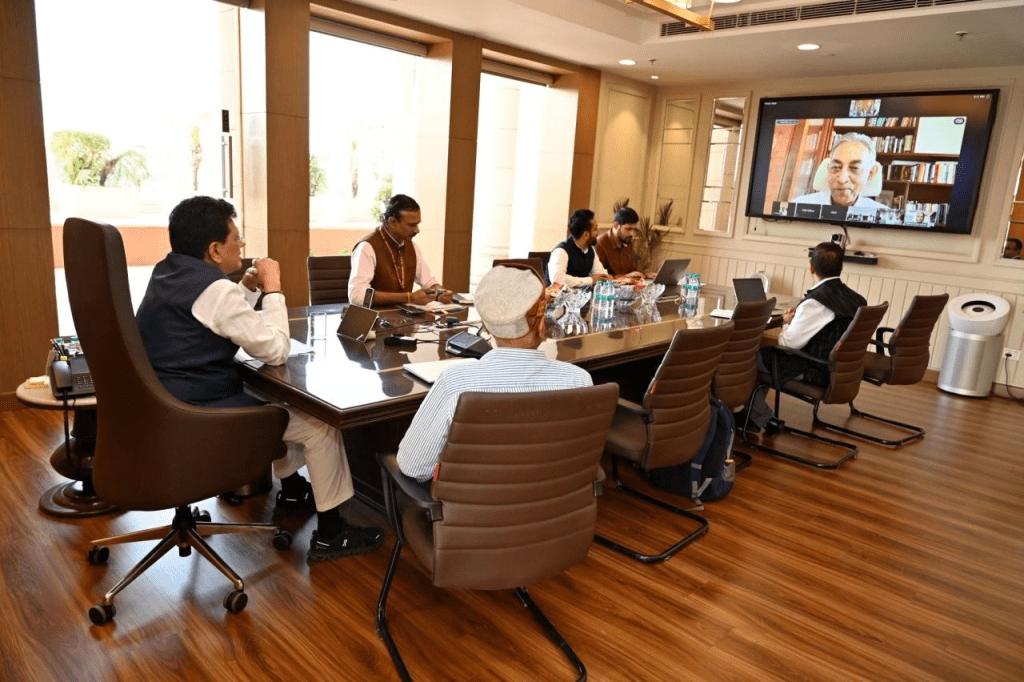
New Delhi: Union Minister of Commerce and Industry Piyush Goyal has chaired a high-level review of Startup India Fund of Funds (FoF) 1.0 and 2.0, reaffirming the Government’s commitment to strengthening India’s startup ecosystem through large-scale capital support, institutional reforms and greater private sector participation.
The review assumes special significance as the Government has recently notified the ₹10,000 crore Startup India Fund of Funds 2.0, a major initiative aimed at mobilising venture and growth capital for deep-tech, innovation-led and manufacturing startups across the country.
Government Focuses on Deep-Tech and Manufacturing Startups
During the meeting, Piyush Goyal emphasized the need to accelerate funding for startups working in critical and emerging sectors, including deep technology, advanced manufacturing and innovation-driven enterprises.
The discussions also highlighted the importance of ensuring that startups in Tier 2 and Tier 3 cities gain better access to institutional capital, helping entrepreneurship expand beyond established metropolitan centres.
The review explored strategies to:
- Strengthen institutional support for startups
- Mobilise long-term venture capital
- Encourage greater industry participation
- Prioritise strategic sectors crucial to India’s technological advancement
- Promote inclusive growth across smaller cities and towns
Read also: India to Establish Space Labs in Universities as Space Startups Cross 400 and Investment Hits $600 Million
What Is Startup India Fund of Funds 2.0?
Startup India Fund of Funds 2.0 builds on the success of the original Fund of Funds for Startups (FFS 1.0), launched in 2016 under the Startup India Action Plan.
The new scheme has a corpus of ₹10,000 crore and is designed to provide commitments to eligible SEBI-registered Alternative Investment Funds (AIFs), which will then invest in startups recognised by the Central Government.
The scheme will be implemented over the 16th and 17th Finance Commission cycles and is expected to significantly expand the availability of venture and growth capital in India.
Priority Sectors Under FoF 2.0
The Government has indicated that Startup India FoF 2.0 will prioritise:
- Deep-tech startups
- Technology-driven manufacturing ventures
- Innovative product companies
- Early growth-stage startups backed by smaller AIFs
- Sector-agnostic startups with transformational economic potential
This strategic focus aligns with India’s goal of achieving technological self-reliance and building globally competitive innovation capabilities.
Robust Governance and Oversight Framework
To ensure transparency and professional management, the scheme will be governed by a multi-layered institutional structure.
Venture Capital Investment Committee (VCIC)
A committee comprising experienced stakeholders from the startup and investment ecosystem will evaluate and select eligible AIFs.
Empowered Committee (EC)
An oversight body will monitor implementation and assess the performance of the scheme.
Co-Investment Provisions
The framework also allows for co-investment by Government and institutional investors under an umbrella structure with governance safeguards.
SIDBI to Operationalise the Scheme
Small Industries Development Bank of India (SIDBI) has been designated as the primary implementation agency for Startup India Fund of Funds 2.0.
The Government has also proposed appointing an additional domestic implementation agency to further strengthen execution and outreach.
Expected Impact on India’s Startup Ecosystem
Policymakers believe the ₹10,000 crore fund will play a transformative role in India’s innovation-led growth journey by:
- Crowding in private capital
- Improving funding access for emerging ventures
- Strengthening domestic manufacturing capabilities
- Creating high-quality jobs
- Supporting globally competitive technologies and products
The initiative is expected to enhance economic resilience and reinforce India’s position as a global innovation and startup hub.
Aligned with Viksit Bharat @ 2047
The Startup India Fund of Funds 2.0 is closely aligned with the Government’s long-term vision of Viksit Bharat @ 2047.
By empowering entrepreneurs and expanding access to growth capital, the scheme seeks to unlock the full potential of India’s rapidly evolving startup ecosystem and accelerate innovation-driven economic development.
Read also: India and GCC Take Major Step Towards Free Trade Agreement, Sign ToR to Launch FTA Negotiations