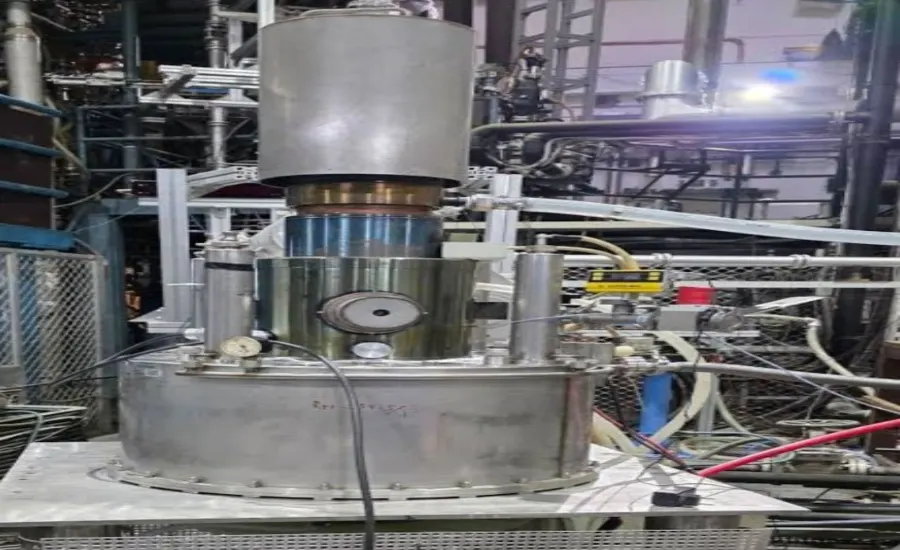
New Delhi: India has achieved a major milestone in fusion science with the successful commissioning of the 82.6 GHz Gyrotron at the SST-1 Tokamak facility of the Institute for Plasma Research in Gujarat.
The advanced system has been integrated with India’s flagship superconducting fusion reactor experiment, strengthening the country’s capabilities in plasma heating and long-duration fusion research.
The achievement was announced by IPR and marks another important step in India’s journey toward future clean fusion energy.
What Is The 82.6 GHz Gyrotron
A Gyrotron is a high-power microwave device used to heat plasma inside fusion reactors. The newly commissioned 82.6 GHz Gyrotron delivers up to 400 kW of radio-frequency power and plays a key role in Electron Cyclotron Resonance Heating (ECRH), a technology used to raise plasma temperatures to extremely high levels required for fusion reactions.
Read also: India Auctions 56 Critical Mineral Blocks in Major Push to Secure EV and Clean Energy Supply Chains
Why Plasma Heating Matters
Fusion reactors need plasma to reach temperatures of millions of degrees Celsius. Advanced heating systems such as Gyrotrons help scientists maintain stable plasma conditions, improve reactor performance, and conduct long-duration experiments that are critical for future fusion power generation.
What Is SST-1 Tokamak
SST-1, or Steady State Superconducting Tokamak-1, is India’s first superconducting tokamak and is operated by the Institute for Plasma Research in Gandhinagar, Gujarat. The facility was developed to study long-duration plasma confinement and technologies needed for future fusion power plants.
A Key Part Of India’s Fusion Program
SST-1 serves as a major research platform supporting India’s broader fusion energy ambitions and its participation in the international ITER project. The facility helps Indian scientists develop technologies required for next-generation fusion reactors.
How Was The New 82.6 GHz Gyrotron Integrated
According to official information, the 82.6 GHz Gyrotron was mounted and integrated with SST-1 using a 20-meter transmission line.
Engineers completed high-voltage testing, alignment procedures, cooling integration, and electrical connections before the final commissioning phase. The system demonstrated stable operation during testing and successfully delivered microwave power for plasma heating experiments.
Plasma Heating At Multiple Harmonics
One of the key advantages of the new system is its ability to operate at both fundamental and second harmonics. This expands the range of plasma heating experiments that can be conducted inside SST-1 and improves research flexibility for scientists studying fusion plasma behavior.
Major Experimental Results
During recent SST-1 campaigns, the 82.6 GHz system was successfully used for plasma pre-ionisation and heating. Researchers operated SST-1 at a toroidal magnetic field of around 2.8 Tesla using power levels between 150 kW and 300 kW. The experiments helped achieve plasma breakdown and stable heating conditions.
Improved Research Capabilities
The integration allows researchers to conduct advanced Electron Cyclotron Resonance Heating experiments. It also supports studies related to plasma control, current drive, and long-pulse operation, which are essential for future commercial fusion reactors.
Why Is 82.6 GHz Gyrotron Commissing Important For India
The successful deployment demonstrates India’s growing expertise in high-power microwave systems, superconducting magnet integration, and plasma control technologies. These capabilities are critical for building future fusion energy systems and supporting international collaborations.
Supporting Future Clean Energy Goals
Fusion energy is considered one of the most promising future energy sources because it can generate large amounts of electricity with low carbon emissions and limited long-term radioactive waste. Advancements at SST-1 bring India closer to mastering technologies needed for practical fusion power generation.
India’s Growing Role In Global Fusion Research
India has emerged as an important contributor to global fusion research through SST-1, ADITYA-U, and its participation in ITER. The commissioning of the 82.6 GHz Gyrotron further strengthens the country’s position in advanced plasma science and fusion technology development.
What Comes Next
Scientists at IPR are expected to use the new Gyrotron for more advanced plasma heating experiments and long-duration fusion studies.
The data generated from these experiments will support future reactor designs and help India develop technologies for next-generation fusion energy systems.
As global interest in clean energy grows, the success of the 82.6 GHz Gyrotron project highlights India’s commitment to becoming a major player in fusion science and technology.
Read also: What is India Carbon Credit Trading Scheme, Presented at WTO Trade and Environment Week 2026
FAQs
SST-1 is India’s first superconducting tokamak located at the Institute for Plasma Research in Gujarat. It is designed for long-duration plasma experiments and fusion research.
The 82.6 GHz Gyrotron is a high-power microwave system used to heat plasma inside fusion reactors. It helps scientists achieve the temperatures needed for nuclear fusion experiments.
The system improves plasma heating capabilities, supports advanced fusion experiments, and strengthens India’s expertise in fusion energy technologies.