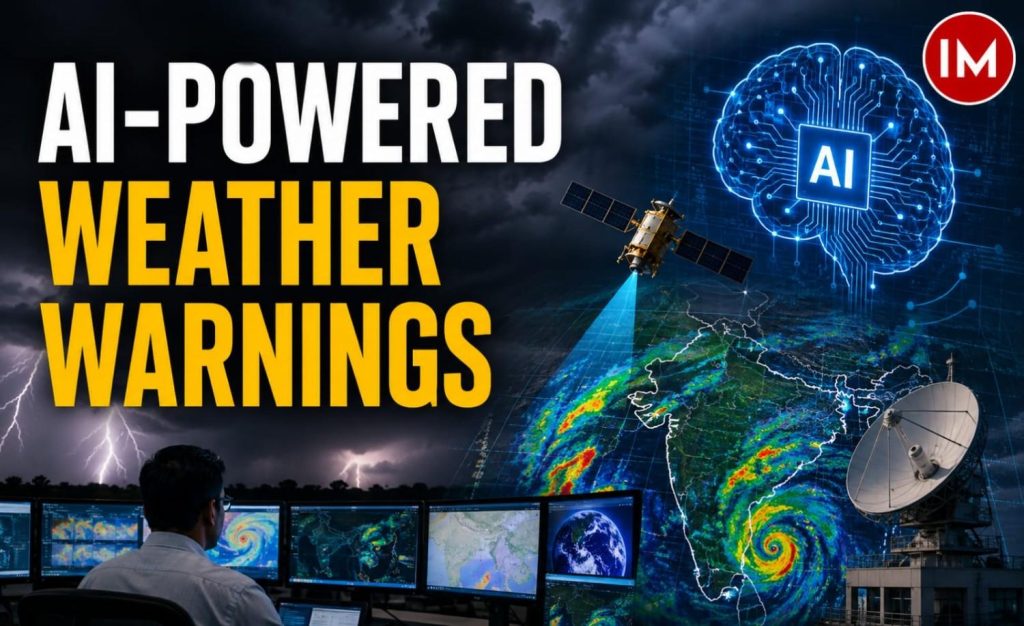
New Delhi: The Government of India is expanding the use of Artificial Intelligence (AI), Machine Learning (ML) and Big Data to improve weather forecasting and early warning systems for extreme weather events. The information was provided by Minister of State (Independent Charge) for Earth Sciences Dr Jitendra Singh in a written reply in the Lok Sabha on Wednesday.
The National Centre for Medium Range Weather Forecasting (NCMRWF) is integrating AI/ML-based forecast guidance with conventional Numerical Weather Prediction, Earth System modelling, ensemble prediction systems, data assimilation and High Performance Computing. The resulting guidance is being used by the India Meteorological Department (IMD) to strengthen forecasts for weather extremes.
AI and Conventional Forecasting Systems to Work Together
Under Mission Mausam, AI/ML and data-driven methods form a major component of the government’s next-generation weather forecasting strategy.
AI systems are being developed to complement, rather than replace, conventional Numerical Weather Prediction systems. Their applications include:
- Accelerating forecast generation.
- Improving forecast accuracy.
- Correcting systematic biases in forecasts.
- Producing high-resolution weather predictions.
- Generating probabilistic guidance for extreme weather events.
- Improving early warning and disaster preparedness.
AI/ML-derived data products have also been incorporated into India’s GIS-based Multi-Hazard Early Warning Decision Support System.
National AI-Based Early Warning Platform in Development
The government is working towards an integrated National AI-based Early Warning Platform that will bring together multiple sources of environmental and weather information.
The proposed platform will integrate:
- Satellite observations.
- Doppler Weather Radar data.
- In-situ weather observations.
- Automatic Weather Stations.
- Oceanic and river observations.
- Physics-based weather and climate models.
- AI-based forecasting systems.
The system is intended to generate Impact-Based Forecasts and Risk-Based Warnings, with the objective of improving forecast accuracy and increasing warning lead time for disaster preparedness and risk reduction.
Key AI Initiatives Underway
Several AI and ML-based projects are currently being developed or tested by government weather agencies and their research partners.
These include:
- AI-based rainfall forecasting: A Convolutional Neural Network (CNN)-based model has been developed to correct biases in rainfall forecasts generated by the Bharat Forecast System.
- High-resolution rainfall modelling: A deep-learning model called meteoGAN has been successfully tested for rainfall downscaling in the Delhi-NCR region at a spatial resolution of 300 metres, using ground observations and CHIRPS data.
- Seven-day forecasts: An AI-based medium-range forecasting model has been developed to generate daily forecasts for up to seven days using ERA5 reanalysis data.
- Lightning forecasting: AI/ML techniques are being applied to improve lightning prediction.
- Experimental AI weather forecasts: NCMRWF is generating experimental machine-learning forecasts using pretrained AI weather-prediction models and sharing them with IMD for evaluation against the operational Mithuna Global Numerical Weather Prediction System.
AI-Enabled Advisories Reach 5.28 Crore Farmers
AI is also being used to convert weather forecasts into more localised information for farmers.
During the 2026 southwest monsoon season, an AI/ML hybrid blended model was used to generate localized agronomic monsoon-onset advisories. Using the system, SMS advisories were sent to approximately 5.28 crore farmers across 15 States and one Union Territory.
The government is also developing MausamVani, a Retrieval-Augmented Generation-based application designed to convert real-time weather forecasts into localized advisories in regional languages.
Regional-Language Weather Services Expanded
AI-enabled multilingual tools, including Bhashini, are being leveraged to support regional-language dissemination. Another LLM-based application, MausamGPT, is under development to generate concise multilingual summaries of weather forecasts, impact-based warnings and climate outlooks.
Weather information is currently disseminated through multiple channels, including:
- Mobile applications
- SMS
- Television
- Radio
- Websites
- Social media platforms
The dissemination system also involves coordination between Central and State government agencies, disaster-management authorities and media organisations.
Dedicated AI Centres and Research Partnerships
The Indian Institute of Tropical Meteorology (IITM), Pune, has established a dedicated AI/ML Centre and Virtual Centre for developing AI and deep-learning applications for weather and climate services.
IMD has also created a dedicated AI/ML research group and conducts specialised training and refresher courses for its officials.
Research collaborations have been established through MoUs with institutions and organisations including:
- IIT Kharagpur
- IIIT Allahabad
- IIIT Vadodara
- Ashoka University
- Google Asia Pacific Ltd.
- Bharat Electronics Limited (BEL)
The government is also conducting specialised training programmes, workshops and annual refresher courses on AI and ML for IMD personnel.
AI Systems Still Under Evaluation
The government said short- to medium-range forecast accuracy has improved with the CNN-based bias-correction model, but most AI/ML systems remain under evaluation. No separate assessment has yet measured their independent impact on reducing losses of life, property and livelihoods.
Read Also: Artificial Intelligence Needs Human Judgment, Not Blind Trust