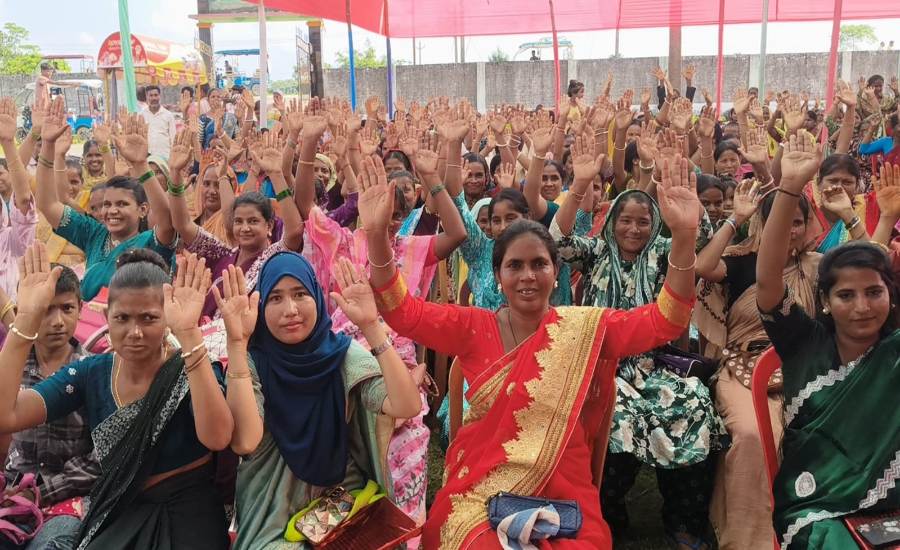
Patna: More than 6,700 women associated with Bihar’s JEEViKA programme are taking formal banking services to villages across the state, helping rural residents access transactions without depending entirely on conventional bank branches.
The Bank Sakhi network now covers all 38 districts, 531 blocks and 4,688 panchayats. As many as 6,771 Bank Sakhis are currently working across Bihar, of whom 6,735 have received certification from the Indian Institute of Banking and Finance (IIBF).
Working with micro-ATMs and other digital banking devices, these women act as a local link between banks and rural communities. Their work has helped bring banking closer to people who may face difficulties travelling to bank branches because of distance, time or limited access to formal financial services.
Over 14 Lakh Bank Accounts Opened
The expansion of the Bank Sakhi model has also contributed to wider access to formal banking services in rural Bihar.
Through Bank Sakhis, 14,33,293 bank accounts have been opened so far. The transactions facilitated through the network have crossed ₹23,200 crore, highlighting the scale at which these women are now participating in the state’s rural financial ecosystem.
The model operates through women linked with JEEViKA’s self-help group network. After receiving training in banking and financial services, they work as Business Correspondent Agents (BCAs), providing basic banking facilities within their local communities.
This local presence is particularly important for people who find regular visits to bank branches difficult. Instead of travelling long distances for routine transactions, residents can access several services closer to their homes.
Read Also: Bihar’s Solar Surge: Rooftop Panel Installations Jump Four-Fold in Just Eight Months
Women Make Up 67% of Bank Sakhi Customers
One of the notable outcomes of the initiative is the growing participation of women in banking services.
Around 67 per cent of customers visiting Bank Sakhi centres are women. The presence of a familiar woman from the same community has helped make banking more approachable for many rural women.
The Bank Sakhis are facilitating services such as savings and withdrawals while also helping residents become more familiar with formal financial systems. Their role extends beyond routine transactions as they connect people with wider financial and social security services.
The network is also proving useful for senior citizens, persons with disabilities and pensioners, for whom travelling to a bank branch can often be difficult.
Bank Sakhis Emerge as Rural Women Entrepreneurs
The initiative has created an additional source of income for thousands of rural women. Bank Sakhis have collectively earned around ₹57.95 crore in commission so far.
This has given the women an opportunity to participate directly in the delivery of financial services while earning an income within their communities.
The experience also reflects how self-help group members can move beyond savings and credit activities and take on larger economic roles. With training, certification and institutional support, Bank Sakhis are becoming local financial service providers and entrepreneurs.
Financial Awareness Goes Beyond Banking Transactions
The impact of the Bank Sakhi model can also be seen in the adoption of financial products and social security schemes.
According to the survey data, after becoming Bank Sakhis, 48.81 per cent of women adopted insurance, while 41.67 per cent accessed loan facilities and 31.75 per cent adopted pension schemes.
These figures indicate that the network is helping improve awareness of financial products beyond basic banking transactions. By operating within villages, Bank Sakhis can explain available services and help rural women connect with formal financial institutions and social security mechanisms.
The initiative therefore combines financial inclusion with women’s economic participation, creating a model in which the service provider and the community both benefit.
JEEViKA Women Become Agents of Rural Change
The Bank Sakhi initiative is part of the broader effort under JEEViKA to strengthen women’s participation in Bihar’s rural economy. The programme has created opportunities for women associated with self-help groups to take on new responsibilities and develop income-generating skills.
Rural Development and Information & Public Relations Minister Shravan Kumar said the Bank Sakhi model reflects the vision of empowering women to become self-reliant and economically stronger.
He said the more than 6,700 Bank Sakhis have demonstrated that rural women can play an important role in the financial system when they receive opportunities, training and institutional support.
The initiative also shows how community-based models can address practical gaps in public service delivery. Instead of relying only on large physical infrastructure, banking access can be strengthened by building a network of trained local women who understand the needs of their communities.
With thousands of certified Bank Sakhis already operating across Bihar, the model is expanding financial inclusion while creating livelihood opportunities for rural women. Its wider significance lies in bringing banking, social security and financial awareness closer to households while positioning women themselves as important participants in rural economic development.
Read Also: SJVN Marks Commercial Operation of 660 MW Unit-II at 1,320 MW Buxar Thermal Power Project in Bihar