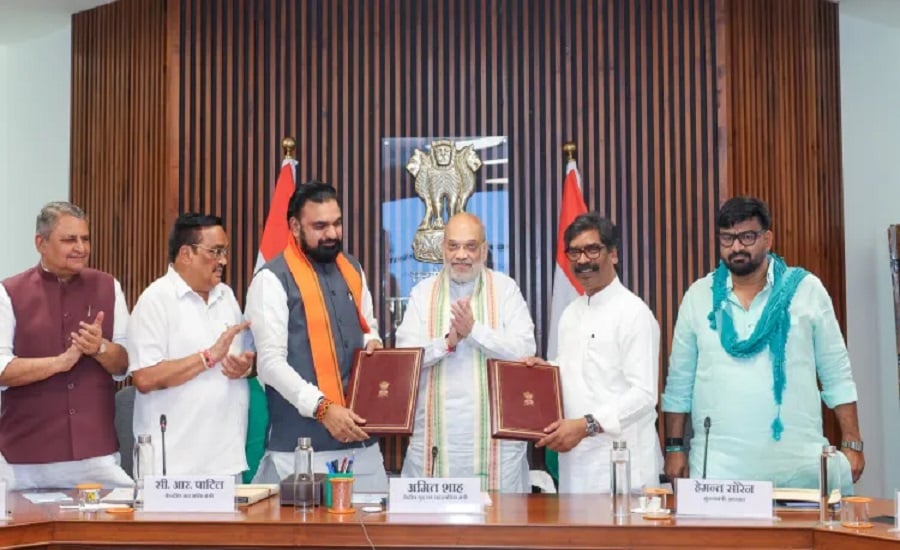
New Delhi: In a major development for inter-state water management in eastern India, Bihar and Jharkhand have signed an MoU on the sharing of Son River (or Sone river) waters, resolving a dispute that had remained pending for nearly 25 years.
The agreement was signed in New Delhi in the presence of Union Home and Cooperation Minister Amit Shah, Bihar Chief Minister Samrat Choudhary, Jharkhand Chief Minister Hemant Soren, Union Jal Shakti Minister C. R. Patil, the Bihar Deputy Chief Minister, the Union Home Secretary and senior officials from the Centre and both states.
Bihar to Get 5.75 MAF, Jharkhand 2.0 MAF Under New Agreement
The dispute dates back to the formation of Jharkhand in November 2000, when the state was carved out of undivided Bihar.
Under the 1973 Bansagar Agreement, undivided Bihar had been allocated 7.75 million acre-feet (MAF) of water. However, the manner in which this allocation would be divided between Bihar and Jharkhand remained unresolved after the state’s bifurcation.
The new agreement settles the allocation as follows:
- Bihar: 5.75 MAF
- Jharkhand: 2.0 MAF
- Total allocation: 7.75 MAF
The settlement is expected to remove long-standing technical and administrative hurdles related to the utilisation of Son River water.
Read also: Bihar Plans to Expand Financial Support for Women Clearing Competitive Exam Prelims
Agreement to Facilitate Irrigation and Indrapuri Reservoir Project
The resolution is also expected to pave the way for major irrigation and water-management projects, including the proposed Indrapuri Reservoir Project.
The availability of a clearly defined water-sharing arrangement could help both states plan and implement irrigation infrastructure more effectively.
The agreement is expected to support:
- Expansion of irrigation facilities
- Better water availability for agriculture
- Improved drinking water supply
- Development of water infrastructure in water-stressed areas
Son Water Agreement to Benefit Farmers and Rural Population
The agreement is expected to benefit a large population across several districts of Bihar and Jharkhand, particularly areas facing water shortages and limited rainfall.
Bihar
The districts expected to benefit include:
- Bhojpur
- Buxar
- Rohtas
- Kaimur
- Aurangabad
- Arwal
- Gaya
- Patna
Improved water availability is expected to support both irrigation and drinking water requirements across these areas.
Jharkhand
In Jharkhand, the agreement is expected to benefit Palamu, Garhwa and adjoining drought-prone and low-rainfall areas.
Farmers in these regions are expected to gain improved access to irrigation, while water availability for rural communities could also improve.
Amit Shah Calls Pact an Example of ‘Team Bharat’
Amit Shah described the agreement as an example of Prime Minister Narendra Modi’s ‘Team Bharat’ approach and cooperative federalism.
He emphasised that states may have separate identities and interests, but national and public-interest issues can be resolved when states work together through dialogue.
Shah said the agreement demonstrates that long-pending issues can be resolved when states come together as part of a cooperative federal framework.
The Chief Ministers of Bihar and Jharkhand also expressed appreciation to Prime Minister Narendra Modi and Home Minister Amit Shah for facilitating the resolution of the decades-old issue.
Inter-State Council Mechanism Used to Resolve Water Disputes
The Son River agreement is part of a broader effort to resolve long-pending inter-state issues through dialogue and institutional mechanisms.
According to the information released, four major inter-state water-related agreements have been concluded in 2026 so far.
- 31 August 2026 – Bihar & Jharkhand
- Project: Son River Water Sharing
- Key Development: 25-year-old dispute resolved; Bihar gets 5.75 MAF and Jharkhand 2.0 MAF.
- 7 July 2026 – Gujarat, Madhya Pradesh, Maharashtra & Rajasthan
- Project: Narmada Award / Sardar Sarovar Project
- Key Development: One-Time Settlement to resolve pending cost-sharing dues.
- 29 June 2026 – Haryana & Rajasthan
- Project: Yamuna Water Project
- Key Development: 580 MCM of water to reach Rajasthan’s dry areas through three underground pipelines.
- 16 June 2026 – Himachal Pradesh, Uttarakhand, Delhi, Uttar Pradesh, Haryana & Rajasthan
- Project: Kishau Multipurpose Dam Project
- Key Development: Agreement to advance the multipurpose water project.
The government has highlighted these agreements as part of efforts to strengthen cooperative federalism, agricultural development, rural infrastructure and water security.
Focus on Water Security and Agricultural Development
The Bihar-Jharkhand Son River water-sharing agreement is significant not only for resolving a long-standing inter-state dispute but also for its potential impact on agriculture and rural development.
A clear allocation of water between the two states could enable better planning of irrigation projects and improve water availability in regions that frequently face drought-like conditions.
The agreement is therefore expected to provide a framework for greater cooperation between Bihar and Jharkhand on water management, irrigation and drinking water supply.
A Long-Pending Inter-State Dispute Comes to an End
The settlement of the Son River water-sharing issue marks an important milestone in Centre-state and inter-state cooperation.
After nearly 25 years of uncertainty following the creation of Jharkhand, Bihar and Jharkhand now have a defined framework for sharing the 7.75 MAF allocation originally made to undivided Bihar under the 1973 Bansagar Agreement.
The agreement could help unlock pending water infrastructure projects and provide a stronger foundation for irrigation, drinking water supply and regional water security in both states.
Read also: Jharkhand Reviews Jal Jeevan Mission Plans, Focuses on Rural Water Supply Operations