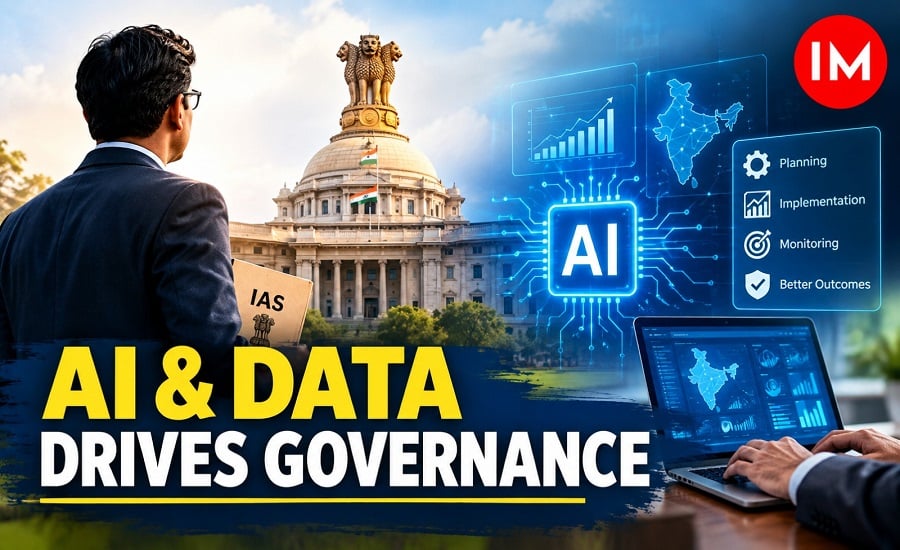
New Delhi: The Centre’s current administrative agenda is placing greater emphasis on artificial intelligence, data-driven decision-making, infrastructure implementation and measurable reform outcomes, signalling a broader focus on how government initiatives are delivered and monitored.
The approach is particularly relevant for senior IAS officers serving as Chief Secretaries, Additional Chief Secretaries and Principal Secretaries, who play a key role in translating policy priorities into implementation at the state and departmental levels.
Rather than focusing only on the announcement or creation of new schemes, the emerging governance framework places greater importance on execution, measurable targets, technology-enabled monitoring and demonstrable outcomes.
AI and Data at the Centre of Governance
Artificial intelligence and data analytics are increasingly becoming tools for government decision-making.
For senior administrators, this means using available data to identify gaps, monitor the progress of programmes, assess infrastructure requirements and support evidence-based policy decisions.
The broader objective is to make administrative decisions more responsive to real-time information rather than relying entirely on conventional reporting systems.
For IAS officers heading major departments, technology can also help integrate information from different government agencies and create dashboards through which progress can be tracked against defined indicators.
From Scheme Announcements to Implementation
A key feature of the approach is the emphasis on implementation.
Government programmes require coordination between departments, district administrations, local bodies and field agencies. Senior officers are therefore expected to ensure that policy decisions translate into projects and services on the ground.
This places greater emphasis on identifying bottlenecks, fixing timelines and monitoring whether approved projects are actually progressing.
Infrastructure implementation is another important component of this approach. Roads, public buildings, water systems, urban infrastructure and other government projects require continuous monitoring of timelines, expenditure and physical progress.
Measurable Reform Action Points
The focus on measurable outcomes also changes how administrative priorities can be translated into action.
Instead of broad objectives alone, departments can define specific indicators, timelines and milestones against which implementation can be reviewed.
For senior IAS officers, such an approach can provide a framework for regularly assessing whether departmental priorities are producing measurable results.
Data can be used to establish baselines, identify performance gaps and track changes over time. This also allows departments to identify areas where interventions may need to be modified.
Why Senior IAS Officers Have a Key Role
Chief Secretaries, Additional Chief Secretaries and Principal Secretaries occupy positions at the intersection of policy formulation, inter-departmental coordination and implementation.
They oversee large administrative structures and are responsible for ensuring that decisions taken at the government level are communicated and implemented through the machinery below them.
The adoption of AI and data-driven systems therefore has implications not only for individual departments but also for the way senior officers monitor administration.
Technology-enabled review mechanisms can potentially allow senior officers to track multiple projects and programmes simultaneously, while data-based indicators can provide a common framework for assessing progress.
Infrastructure and Delivery Become Core Priorities
The administrative emphasis is also linked to faster and more accountable infrastructure implementation.
Large public projects frequently involve multiple departments, agencies, approvals and implementation stages. Delays can occur because of land, procurement, clearances, funding or coordination issues.
A data-driven monitoring framework can help administrators identify such bottlenecks and assign specific action points to the concerned agencies.
This shifts attention from simply approving projects to tracking whether they are completed within the intended timelines and whether they deliver the expected public benefit.
A Changing Role for the IAS
The changing governance environment is also expanding the technological and analytical requirements of public administration.
Senior officers increasingly need to work with digital platforms, government datasets, dashboards and technology-based monitoring systems alongside conventional administrative processes.
For the IAS, this means that administrative leadership is increasingly connected with the ability to interpret data, coordinate across departments and convert policy objectives into measurable implementation plans.
The broader emphasis is on creating a governance cycle in which policies are designed using available evidence, implemented through clearly defined action points and subsequently assessed using measurable outcomes.
Focus on Outcomes and Accountability
The emerging approach does not necessarily replace government schemes with technology. Instead, AI and data-driven systems can serve as tools for improving the planning, implementation and monitoring of existing government programmes.
For senior IAS officers, the emphasis on measurable reforms means that administrative priorities can increasingly be linked to specific targets and implementation milestones.
As governments adopt more digital tools and generate larger volumes of administrative data, the ability to use that information effectively is likely to become an increasingly important part of senior-level governance and public administration.
The broader shift is therefore from announcing initiatives to demonstrating implementation, from fragmented information to integrated data, and from broad objectives to measurable action points.