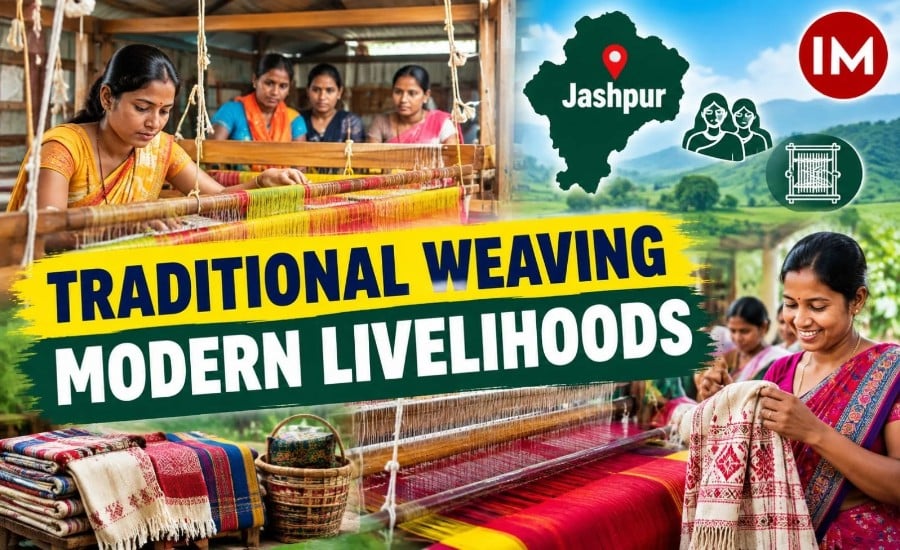
Raipur: A traditional weaving practice preserved in households across Jashpur, Chhattisgarh, is being connected with modern textile skills and production opportunities through an initiative at Gholeng village.
Around 35–40 rural families and women associated with Self-Help Groups (SHGs) are undergoing training in handloom and textile-related skills. The programme combines skill development with production, with participants learning to create shawls, sarees and other utility products.
From Traditional Skills to Market-Ready Products
The initiative focuses on adapting traditional weaving skills to contemporary requirements by introducing participants to:
- Modern textile technology and machinery
- Contemporary designs
- Product quality and standards
- Production techniques
- Market requirements and product demand
Read Also: Chhattisgarh to Train 83 Master Trainers Across 27 KVKs for Agriculture-Based Jobs
The approach seeks to connect training with actual production rather than limiting the programme to classroom-based skill development.
Aditya Birla Group, District Administration Among Partners
The Gholeng initiative is being taken forward through collaboration involving the Aditya Birla Group, Jashpur district administration, Bihan and the Textile Skill Sector Council.
A proposed handloom training and production centre is expected to provide traditional weaving families with access to modern machinery and technical support, with attention to product quality, design, testing and market access.
Women’s SHGs at the Centre of the Initiative
Women associated with SHGs are a key focus of the programme, with training linked to production of textile products.
The initiative also seeks to strengthen the connection between traditional skills, group-based production and wider markets, while developing textile-related skills among people in the district.
Chhattisgarh Expands Focus on Handloom and Kosa
The Gholeng initiative comes amid broader efforts to strengthen Chhattisgarh’s handloom sector. The state has also promoted its traditional textile identity through ‘Koshal Fab’, a premium handloom brand launched by Chief Minister Vishnu Deo Sai, along with a catalogue and Handloom Inventory Management Software.
Chhattisgarh’s handloom traditions include kosa and tussar silk, as well as cotton handloom clusters across several districts. The Union government has previously noted that the state’s handloom sector supports a substantial rural workforce, including many women.
For Jashpur, the Gholeng initiative places traditional weaving alongside modern skills and production systems, creating a local model that connects heritage, skill development and textile enterprise.
Read Also: Chhattisgarh Targets 1,300 Hectares for Turmeric Cultivation with ₹6.20 Crore Budget in 2026-27