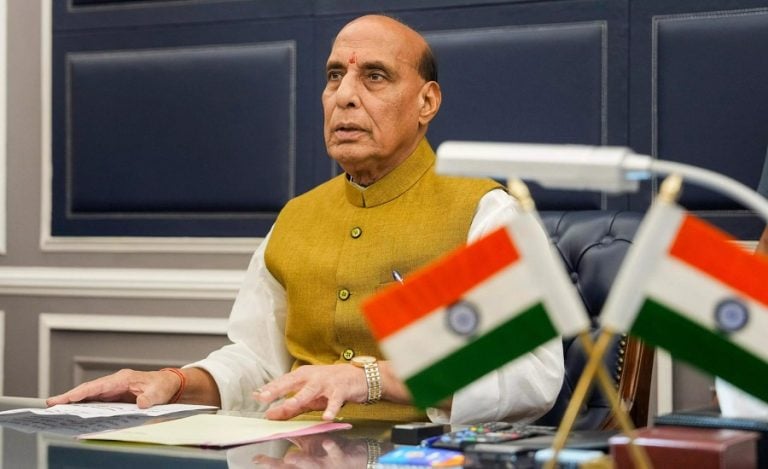
New Delhi: The Defence Acquisition Council (DAC), chaired by Defence Minister Rajnath Singh, has accorded Acceptance of Necessity (AoN) to various capital acquisition proposals for the Indian Armed Forces worth approximately ₹1.10 lakh crore.
The approvals cover new equipment and capability upgrades for the Indian Army, Indian Navy and Indian Air Force.
A key feature of the approvals is the government’s emphasis on domestic defence manufacturing. According to the Ministry of Defence, around 98% of the approved acquisitions will be sourced from Indian industry.
The move is expected to strengthen indigenous defence production and support India’s efforts towards greater self-reliance in defence manufacturing.
What Does the DAC Approval Mean?
An Acceptance of Necessity (AoN) is the first formal administrative clearance in India’s defence procurement process.
The approval establishes the requirement for the proposed equipment and allows the acquisition process to move forward. However, an AoN does not amount to the award of a contract.
The proposals will undergo further stages, including:
- Tendering
- Technical evaluation
- Commercial negotiations
- Final approval
- Contract award
- Production and induction
Therefore, the eventual value of contracts could differ from the estimated ₹1.10 lakh crore following price discovery and commercial negotiations.
Read also: India-Sri Lanka Defence Ties Set for Fresh Push During Rajnath Singh’s Three-Day Visit
Indian Army to Get CBRN Vehicles, Helicopters and Mobility Systems
For the Indian Army, the DAC approved several proposals aimed at strengthening operational mobility, battlefield support and the ability to operate across challenging terrain.
The approved systems include:
- Chemical, Biological, Radiological and Nuclear (CBRN) reconnaissance vehicles
- High Mobility Vehicles
- Self-Propelled Mechanical Mine Layers
- Advanced Light Helicopters (ALHs)
- Trawl Tanks
- Sarvatra Bridge Systems
CBRN Reconnaissance Vehicles to Detect Hazardous Contamination
The proposed CBRN reconnaissance vehicles will help the Army detect, identify and monitor areas contaminated by chemical, biological, radiological or nuclear agents.
The vehicles will also be capable of marking affected areas, helping troops maintain greater situational awareness while operating in contaminated environments.
High Mobility Vehicles and Mine Layers to Strengthen Army Operations
The High Mobility Vehicles are expected to improve the movement of personnel, equipment and supplies in difficult terrain.
The Self-Propelled Mechanical Mine Layers will provide the Army with faster and more responsive mine-laying capabilities, particularly in challenging operational environments.
Together, these systems are intended to enhance the Army’s mobility and operational flexibility.
Advanced Light Helicopters Approved for Army and Air Force
The DAC also cleared the procurement of Advanced Light Helicopters (ALHs) for the Army and Air Force.
The helicopters are intended to undertake complex missions across varied terrains and operational conditions, strengthening the armed forces’ ability to respond to diverse operational requirements.
Trawl Tanks and Sarvatra Bridge Systems to Support Battlefield Mobility
The Army will also acquire Trawl Tanks and Sarvatra Bridge Systems to support fighting formations during operations.
Trawl tanks are designed to help clear routes through minefields, while the Sarvatra Bridge System can facilitate rapid construction of mobile bridges.
The two systems will provide composite crossing capabilities to formations operating across:
- Minefields
- Canals
- Streams
- Other terrain obstacles
Navy Gets Approval for Arudhra Radars and Marine Gas Turbines
For the Indian Navy, the DAC approved the acquisition of Arudhra Radars and the design, development and subsequent procurement of Marine Gas Turbines (MGTs).
The approvals are aimed at strengthening naval surveillance and propulsion capabilities while promoting indigenous development of critical defence technologies.
Arudhra Radars to Replace Existing Surveillance Systems
The Arudhra Radars will replace existing Air Route Surveillance Radars at various naval air stations.
The systems are expected to strengthen the Navy’s ability to monitor aircraft movements and surrounding airspace.
Indigenous Marine Gas Turbines to Reduce Import Dependence
The DAC also approved the design, development and subsequent procurement of indigenous Marine Gas Turbines.
Marine gas turbines are critical components of the propulsion systems used by several classes of warships.
The indigenous development programme is aimed at reducing the Navy’s dependence on foreign suppliers and building domestic capabilities in the development and production of critical propulsion technologies.
The Ministry has not disclosed the proposed number of turbines or the development timeline.
Air Force to Strengthen Fighter, Transport and Helicopter Capabilities
For the Indian Air Force, the DAC cleared several proposals aimed at enhancing the war-fighting capabilities of fighter aircraft, transport aircraft and helicopters.
The approvals also include systems designed to strengthen the IAF’s electronic warfare and secure-access capabilities.
Ground-Based Multi-Purpose Jammers to Boost Electronic Warfare
The DAC approved the procurement of Ground-Based Multi-Purpose Jammers (GBMPJ) for the Air Force.
The systems will provide electronic warfare capabilities to detect and disrupt adversary radar operations through effective jamming.
The capability is expected to strengthen the IAF’s ability to operate in environments where electronic warfare plays an important role.
Defence Forces Secure Access Card System Approved
The DAC also cleared the installation of the Defence Forces Secure Access Card (DEFSAC) system.
The system is intended to replace existing paper-based identity cards, passes and permits with interoperable Radio Frequency Identification (RFID)-based smart cards.
The Ministry has not disclosed further details regarding the cost, deployment schedule or full scope of the system.
98% Domestic Procurement to Boost Indian Defence Industry
With around 98% of the approved procurements planned from Indian industry, the DAC decisions are expected to provide a significant boost to India’s domestic defence manufacturing ecosystem.
The high domestic procurement share could create a substantial potential order pipeline for:
- Defence public sector undertakings
- Indian private defence manufacturers
- Indigenous technology developers
- Defence equipment suppliers
However, the Ministry has not disclosed the quantities, individual project costs, procurement categories or likely vendors for the approved proposals.
Procurement Timeline Will Depend on Further Stages
The ₹1.10 lakh crore figure represents the estimated value of proposals receiving AoN and should not be treated as the final contract value.
The actual contracts and induction schedules will depend on factors such as:
- Price discovery
- Commercial negotiations
- Tendering
- Technical trials and evaluation
- Production capacity
- Delivery schedules
- Final contractual approvals
The DAC’s latest approvals nevertheless mark a significant step in the government’s continuing focus on strengthening the capabilities of the three armed services while promoting Make in India and defence self-reliance.