New Delhi: DRDO Femto-Tesla Atomic Magnetometer project has received a major boost as the Defence Research and Development Organisation (DRDO) and TIFR Hyderabad have started a collaboration to develop an ultra-sensitive quantum sensor. The project aims to detect extremely weak magnetic fields at the femto-Tesla level, which could significantly improve India’s defence surveillance, navigation, submarine detection, and geophysical exploration capabilities. The initiative also supports India’s National Quantum Mission and efforts to build indigenous advanced technologies.
DRDO And TIFR Hyderabad Launch Advanced Quantum Sensing Project
The Defence Research and Development Organisation’s Young Scientists’ Laboratory for Quantum Technology (DYSL-QT) has partnered with Tata Institute of Fundamental Research (TIFR) Hyderabad to develop a next-generation atomic magnetometer.
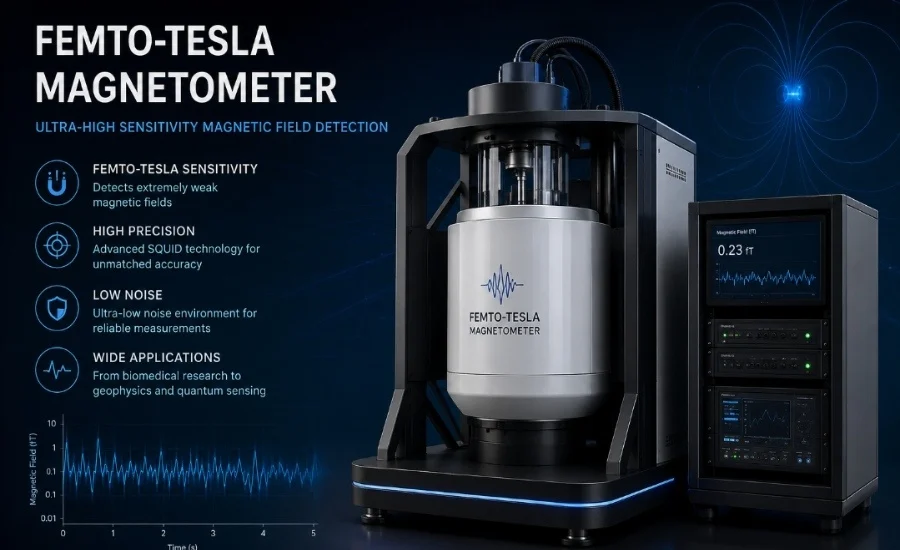
The project focuses on achieving magnetic field detection at the femto-Tesla scale, making it one of the most sensitive quantum sensing technologies under development in India.
What Is A Femto-Tesla Atomic Magnetometer
An atomic magnetometer is a highly sensitive instrument that measures extremely small magnetic fields using the quantum properties of atoms.
The new system uses optically pumped atomic vapours and laser-based diagnostics to detect tiny magnetic variations with extraordinary precision. This allows scientists to measure magnetic fields far weaker than conventional sensors can detect.
Why is Femto-Tesla Detection Important
Current room-temperature systems operate mainly in the pico-Tesla range. The new project aims to improve sensitivity further into the femto-Tesla domain, enabling detection of magnetic signals that were previously difficult to identify.
Key Defence Applications Of The Femto-Tesla Atomic Magnetometer
The advanced sensor could help detect submarines by identifying extremely small magnetic disturbances underwater. This capability may improve maritime surveillance and underwater security operations.
Navigation In GPS-Denied Environments
Military platforms often operate in areas where GPS signals are unavailable or intentionally blocked. The magnetometer could provide an alternative navigation solution by accurately measuring Earth’s magnetic field.
Detection Of Concealed Metallic Objects
The technology may also be used for identifying hidden metallic structures, improving surveillance and security operations.
What are the Benefits of Femto-Tesla Atomic Magnetometer
The sensor can help identify underground mineral deposits by detecting subtle changes in Earth’s magnetic field. This could improve exploration efficiency and resource mapping.
Archaeological Surveys
Researchers may use the technology to locate buried structures and historical remains without excavation. Such applications could support archaeological discoveries across India and beyond.
Monitoring Tectonic Activity
The system may also assist scientists in studying tectonic movements and geological changes with greater precision.
How The Quantum Sensor Works
The technology aligns atomic spins using laser light. Scientists then observe how these spins respond to external magnetic fields, allowing extremely accurate magnetic measurements.
Quantum-Level Precision
Because the sensor operates using quantum states of atoms, it can achieve sensitivity levels far beyond many conventional magnetometers. This makes it suitable for strategic defence and scientific applications requiring ultra-high accuracy.
Supporting India’s National Quantum Mission
The collaboration aligns with India’s broader National Quantum Mission and ongoing efforts to strengthen indigenous quantum technologies. The project complements work in quantum communication, atomic clocks, and quantum gyroscopes, helping India build advanced sovereign technological capabilities.
Strategic Importance For India
The partnership combines TIFR Hyderabad’s expertise in atomic physics and quantum optics with DRDO’s defence-focused research and development capabilities. Officials expect the collaboration to produce a prototype that can be integrated into India’s defence and scientific infrastructure in the future.
Read also: India Launches National Supercomputing Mission 2.0 to Empower HPC, AI, and Quantum Convergence
FAQs
The project aims to improve India’s defence, navigation, surveillance, geophysical exploration, and scientific research capabilities through advanced quantum sensing.
A femto-Tesla atomic magnetometer is an ultra-sensitive quantum sensor that measures extremely weak magnetic fields using atomic and laser-based technologies.
The sensor can support submarine detection, GPS-independent navigation, and identification of concealed metallic objects, improving military situational awareness.