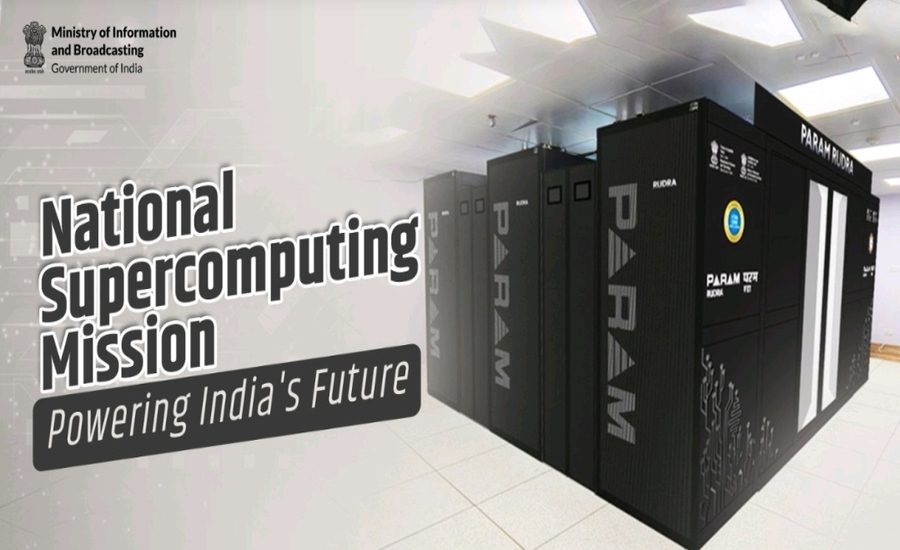
New Delhi: India has officially launched the second phase of its National Supercomputing Mission (NSM 2.0), charting an ambitious roadmap that integrates high-performance computing (HPC) with artificial intelligence (AI) and quantum technologies to achieve exascale computing capabilities — computing power at the scale of 10¹⁸ calculations per second. The announcement was made at Supercomputing India 2025, a flagship event held at MIT–MAHE Bengaluru, drawing participation from policymakers, technology leaders, academia, and industry partners.
This strategic initiative marks a transformational moment in India’s technological evolution, positioning the country to compete with global leaders in next-generation computing infrastructure while fostering self-reliant innovation in critical digital technologies.
Background of National Supercomputing Mission 2.0
The National Supercomputing Mission (NSM) was initially launched in 2015 with the goal of creating a robust supercomputing ecosystem across India — deploying high-performance computing infrastructure and making it broadly accessible to researchers, academia, and industry for advanced scientific simulations and innovation.
Under its first phase, NSM successfully deployed 37 indigenous supercomputers spanning multiple institutions nationwide, delivering around 39–40 petaflops of aggregate computing power. These systems have supported institutional research, led to thousands of computer jobs, and powered applications from climate modelling to drug discovery.
While Phase 1 focused on capacity building and establishing a distributed HPC network, NSM 2.0 launched a more ambitious trajectory — aspiring to develop pre-exascale and full exascale systems and unify HPC, AI, and quantum computing under one national programme.
What Is Exascale Computing
Exascale computing refers to computational systems capable of performing one quintillion (10¹⁸) calculations per second. By comparison, petascale systems perform 10¹⁵ operations per second. The jump from petascale to exascale represents an enormous leap in precision, speed, and ability to model highly complex systems.
Need of Exascale Computing
- Advanced scientific simulations (e.g., climate change, astrophysics),
- Large-scale AI model training and deep learning workloads,
- Drug discovery and genomics studies,
- National defence research and simulations,
- Very high-resolution weather and disaster prediction models,
- Secure cryptographic functions and future quantum-safe systems.
For a populous nation like India, the transition to exascale computing powers both innovation and strategic technological autonomy.
Key Components of National Supercomputing Mission 2.0
Unified HPC, AI, and Quantum Vision
Unlike earlier iterations focused solely on HPC infrastructure, NSM 2.0 emphasizes a converged technology stack where HPC serves as a foundation for AI and quantum acceleration.
This unified architecture will enable hybrid computing workflows that combine classical high-performance systems with quantum processing and AI-driven analytics — amplifying India’s research and industrial capabilities.
The platform moves beyond standalone deployments to strategic hardware and software ecosystems:
- Indigenous CPU, GPU, and AI accelerator development, led by national research labs and industry partners.
- Enhanced HPC networking, including domestically developed interconnects and fabric technologies.
- Quantum computing integration as a co-processor or accelerator alongside HPC to unlock computational frontiers.
Pre-Exascale Milestones and Timeline
According to mission planners, NSM 2.0 aims to build pre-exascale supercomputers by around 2027–28, paving the way for full exascale systems by ~2030.
The roadmap envisions computing stacks capable of cumulative performance on the order of 2 exaflops or more — placing India among the top global supercomputing powers.
Indigenous Technology and Capacity Building
A major thrust under NSM 2.0 is self-reliance in supercomputing ecosystems. Current supercomputing systems under NSM have progressively increased Indian content, and Phase 2 aims for deeper indigenisation — from silicon design to complete system assembly and software stacks.
To support this, stakeholders have announced:
- Partnerships and Memoranda of Understanding (MoUs) with national academies, research institutes, and technical universities to develop HPC-AI labs and expand technical human capital.
- RISC-V and other homegrown ecosystems, such as the VEGA processor and custom boards for sovereign compute stacks.
The focus on domestic CPU and accelerator design aligns with broader strategies, such as semiconductor manufacturing growth and the India Semiconductor Mission, which aims to strengthen the country’s deep-tech supply chain.
Impact of National Supercomputing Mission 2.0
NSM 2.0 is expected to revolutionize India’s R&D landscape and bring HPC-AI-Quantum capabilities to multiple sectors:
Scientific and Academic Research
Universities and research institutions will gain powerful computer infrastructure to advance frontier research in genomics, astrophysics, molecular simulations, materials science, and climate studies. This democratizes access to top-tier computing resources critical for global competitiveness.
Industrial Innovation and Start-ups
Indian startups and MSMEs working in deep tech — including AI, cybersecurity, and engineering simulations — will benefit from robust HPC access, reducing barriers to innovation and fostering local solutions for global challenges.
National Security and Defence
High-performance computing has implications in defence technology modelling, secure communication systems, and mission-critical simulations. Integration with AI and quantum resistance capabilities will fortify India’s position in digital sovereignty and defence research.
Climate and Disaster Management
Supercomputers will enable high-resolution weather forecasting and disaster modelling that can simulate environmental changes at granular levels — enhancing preparedness for natural calamities and supporting long-term sustainability goals.