Gandhinagar: The Gujarat Legislative Assembly has unanimously passed the Gujarat Livestock Feed, Poultry Feed and Mineral Mixture Bill-2026, paving the way for tighter regulation of livestock feed production, storage, distribution and sale across the state.
Introduced by Animal Husbandry Minister Jitu Vaghani, the legislation aims to improve feed quality, protect livestock health and support the income of farmers dependent on dairy and animal husbandry.
New Licensing Rules for Feed Businesses
The new law will make licensing mandatory for businesses involved in the production, storage and sale of livestock feed, poultry feed and mineral mixtures.
Manufacturers will also have to comply with standards prescribed by the Bureau of Indian Standards (BIS) and the Indian Council of Agricultural Research (ICAR). The government will periodically collect and test feed samples to check quality and prevent the circulation of substandard products.
Packaging and labelling will also come under regulation. The provisions aim to prevent misleading advertisements, deceptive branding and practices that could mislead livestock farmers.
Read Also: Gujarat Expands Collectors’ Land Allotment Powers From Rs 15 Lakh to Rs 1 Crore: What Changes
Strict Action Against Adulterated Feed
The Bill introduces significant penalties for manufacturers and sellers who violate quality standards.
Substandard feed can attract a fine of up to ₹5 lakh, along with suspension of the licence for up to one year. Misleading branding can result in a fine of up to ₹5 lakh and licence suspension for up to three years.
The law takes a stricter approach to adulterated feed. If adulterated feed does not cause an animal’s death, authorities can cancel the licence, impose imprisonment of up to one year and levy a fine of up to ₹5 lakh.
If adulterated feed causes the death of an animal, the provisions allow for licence cancellation, imprisonment of 7 to 10 years and a fine of up to ₹10 lakh.
Online and Faceless Licensing Process
The government has said the new regulatory framework will not target genuine businesses. Instead, it will focus on manufacturers and traders who compromise on feed quality.
To make compliance easier for businesses, the licensing process will be conducted through an online and faceless system. The move is intended to reduce unnecessary physical interaction and harassment for industry stakeholders.
Farmers who prepare feed at home for their own livestock will remain outside the scope of the law. Feed produced specifically for research purposes will also be exempted.
Focus on Animal Health and Rural Economy
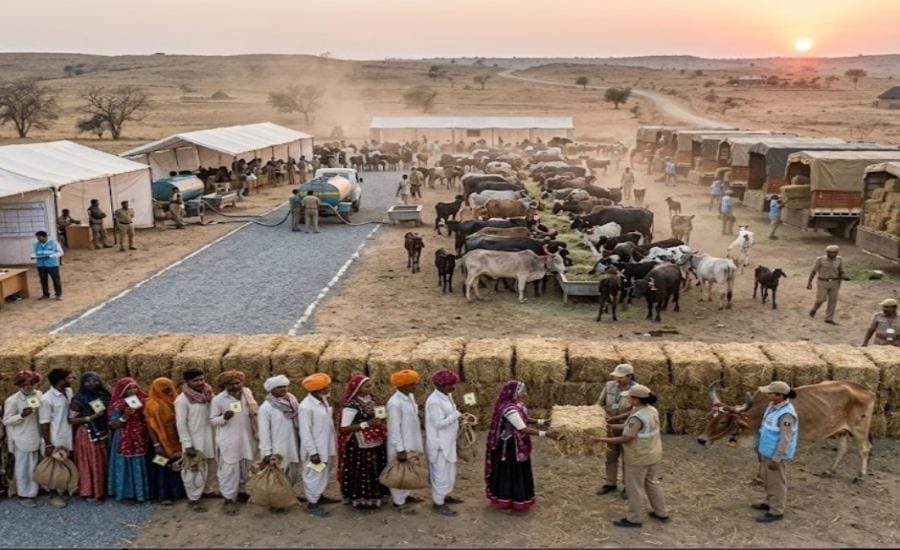
The legislation covers a large livestock population in Gujarat, including more than 106 lakh buffaloes and 96 lakh cows, along with sheep, goats and poultry.
The government expects better feed quality to contribute to healthier animals and improved milk productivity. Since livestock farming forms an important part of rural livelihoods, the impact could extend beyond animal health to household incomes and the wider rural economy.
Animal Husbandry Minister Jitu Vaghani said the legislation follows the World Health Organization’s One Health approach, which recognises the links between animal health, human health and the environment.
Bill Receives Unanimous Support
The Bill received support from members of both the ruling and opposition parties during the Assembly discussion. Members participated in the debate, offered suggestions and welcomed the legislation.
Assembly Speaker Shankar Chaudhary also offered guidance during the discussion and congratulated Chief Minister Bhupendra Patel and Animal Husbandry Minister Jitu Vaghani for bringing the legislation with a focus on animal welfare and livestock health.
The new regulatory framework is expected to bring greater accountability to Gujarat’s livestock feed market while protecting farmers from poor-quality and adulterated products.
Read Also: When ‘Atithi Devo Bhava’ Meets Tourism: Gujarat’s 270 Homestays Open Doors to Local Culture