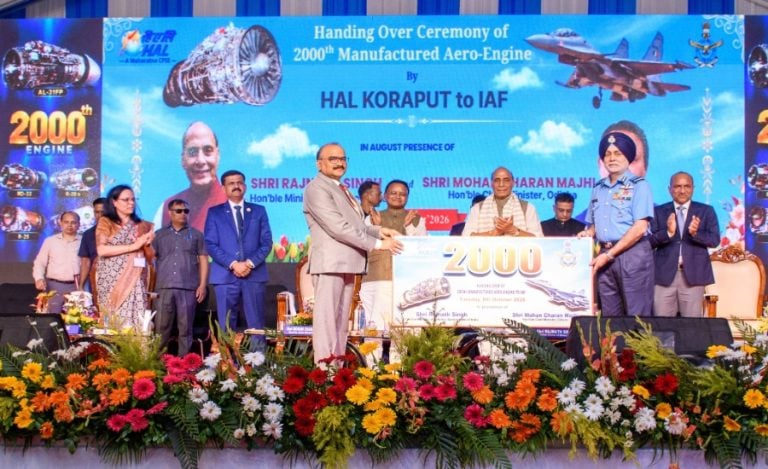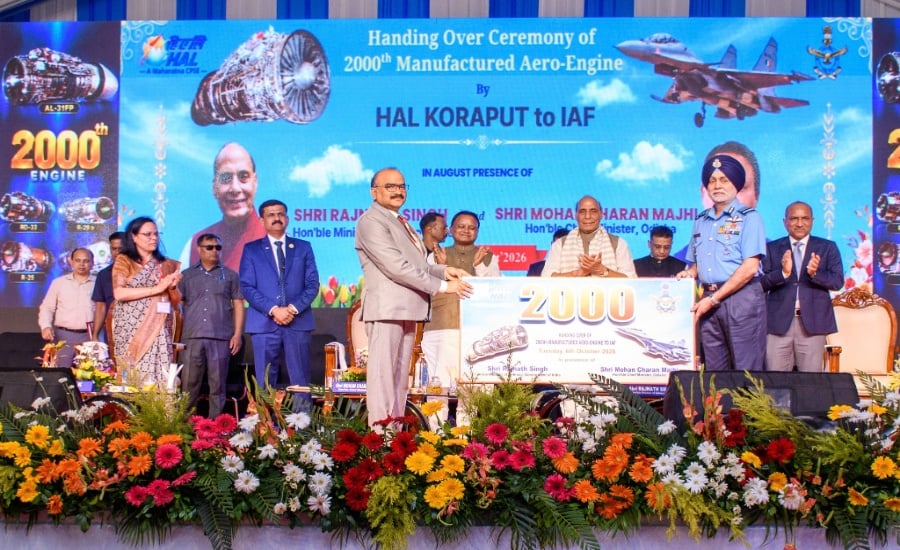
New Delhi: HAL Koraput 2,000th Aero-Engine has become a major milestone for India’s defence and aerospace sector. Hindustan Aeronautics Limited (HAL) delivered its 2,000th aero-engine from the Koraput Division in Odisha on October 6, 2026, marking nearly six decades of engine manufacturing excellence. Defence Minister Rajnath Singh attended the event and praised the contribution of HAL to India’s military strength and self-reliance goals.
The achievement highlights India’s growing capability to design, manufacture, maintain, and overhaul critical aerospace engines used in frontline military aircraft.
History Of HAL Koraput’s Aero-Engine Production
HAL’s Koraput Division was established in 1964 at Sunabeda, Odisha. Since then, it has become one of India’s most important aero-engine manufacturing facilities.
Read also: What Is DRDO’s High Altitude Platform System And Why Is The 21 Km Flight Test Important?
Over the years, the division has produced engines for several fighter aircraft, including:
- MiG-21
- MiG-27
- MiG-29
- Su-30MKI
The facility has also carried out maintenance, repair, and overhaul work on more than 9,000 aero-engines, helping keep India’s fighter fleet operational.
Why is HAL 2000th Aero-Engine Important
The delivery of the 2,000th engine is more than a production milestone. It reflects decades of engineering expertise, skilled manpower, and continuous support to the Indian Armed Forces.
According to Defence Minister Rajnath Singh, strong indigenous propulsion capabilities are essential for India’s defence preparedness and long-term self-reliance.
New Shakti Engine Production Line Announced
During the event, Rajnath Singh announced a second production line for Shakti helicopter engines at HAL Koraput. The new facility is being developed with an investment of approximately ₹218 crore. Once fully operational by 2028-29, the new line is expected to manufacture up to 100 engines every year.
What Is The Shakti Engine
The Shakti engine powers several important Indian military helicopters, including:
- Advanced Light Helicopter (ALH) Dhruv
- Light Combat Helicopter (LCH) Prachand
- Light Utility Helicopter (LUH)
Increasing Shakti engine production will support India’s expanding helicopter fleet and future defence requirements.
AL-31FP Engine Production To Increase
HAL also announced plans to increase annual production of the AL-31FP engine, which powers the Su-30MKI fighter aircraft. Production capacity is expected to rise from 30 engines per year to 50 engines per year through an investment of around ₹335 crore. This expansion supports the Indian Air Force’s requirements following a government order for additional engines for the Su-30MKI fleet.
HAL 2000th Aero-Engine: Focus On Indigenous Aero-Engine Development
During his address, Rajnath Singh emphasized the need to strengthen India’s complete aero-engine ecosystem, including:
- Research and development
- Design
- Testing
- Manufacturing
- Maintenance
He also highlighted the importance of developing indigenous high-thrust engines for future projects such as the Advanced Medium Combat Aircraft (AMCA).
Experts consider aero-engine technology one of the most complex areas of aerospace engineering. Building domestic capability in this field is seen as a key step toward reducing dependence on foreign suppliers.
Read also: Expert Analysis of MIDHANI GE Aerospace S400 Approval and Its Importance for India’s Defence Sector
FAQs
The new Shakti engine production line is a ₹218 crore project at HAL Koraput that will increase annual production capacity to up to 100 helicopter engines by 2028-29.
The milestone marks six decades of aero-engine manufacturing at HAL Koraput and highlights India’s growing capability in defence aerospace technology and engine production.
HAL Koraput has produced engines for MiG-21, MiG-27, MiG-29, and Su-30MKI fighter aircraft, while Shakti engines power helicopters such as Dhruv, Prachand, and the Light Utility Helicopter.