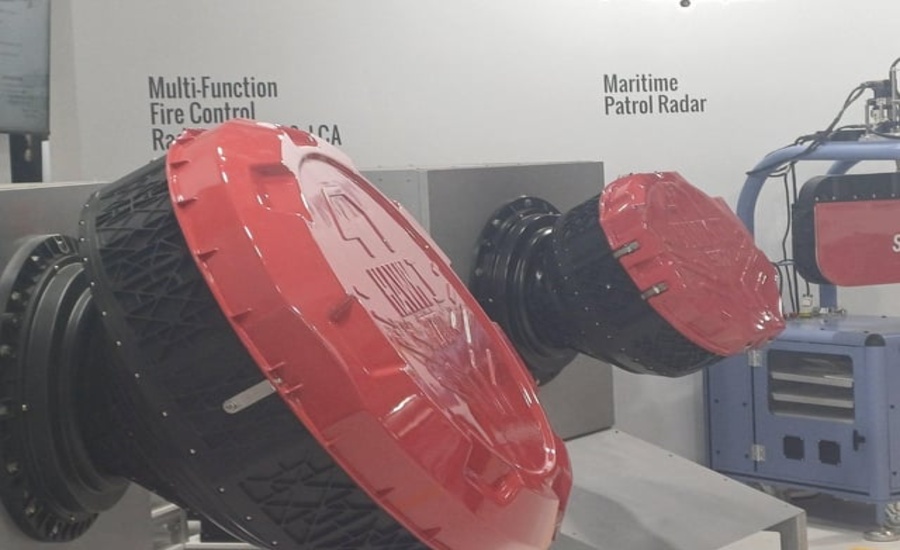
New Delhi: Hawk-I 900 GaN AESA Radar is a new indigenous fighter radar prototype developed by Chennai-based Data Patterns. Designed for the Indian Air Force’s MiG-29, MiG-29K and LCA Tejas Mk1/Mk1A fighters, the radar uses advanced Gallium Nitride (GaN) technology with 876 Transmit/Receive Modules (TRMs). It promises better target detection, multi-target tracking, improved electronic warfare capability and reduced dependence on imported defence equipment. The radar is currently in the prototype stage and is yet to enter operational service.
Data Patterns Unveils Hawk-I 900 GaN AESA Radar Prototype
India’s defence technology sector has taken another important step toward self-reliance. Chennai-based Data Patterns (India) Ltd. has introduced the Hawk-I 900 GaN AESA Radar, a next-generation Active Electronically Scanned Array (AESA) radar developed for Indian fighter aircraft.
The radar has been specially designed for aircraft with limited nose space, making it suitable for the MiG-29, MiG-29K, LCA Tejas Mk1 and Tejas Mk1A.
Its development highlights the growing role of India’s private defence industry in building advanced military technologies.
What Is the Hawk-I 900 GaN AESA Radar
The Hawk-I 900 is a modern X-band AESA radar that uses approximately 876 Gallium Nitride (GaN) Transmit/Receive Modules (TRMs). Unlike older mechanically scanned radars, AESA radars can electronically move their radar beam without moving the antenna, allowing much faster target detection and tracking.
GaN technology also improves radar performance by generating more power while producing less heat.
Why Does India Need a New Fighter Radar
Many Indian Air Force MiG-29 fighters still use older radar systems that were developed decades ago.
These legacy radars have limited processing power compared to modern AESA systems and may face higher maintenance requirements as the aircraft continue serving into the next decade.
An indigenous AESA radar like the Hawk-I 900 could help modernise these aircraft while reducing India’s dependence on imported defence equipment. It can also support future upgrades for the Tejas fighter fleet.
What are the Features of Hawk-I 900 GaN AESA Radar
The new radar offers several advanced capabilities.
Advanced GaN Technology
The radar uses Gallium Nitride semiconductor technology. This improves power output, cooling efficiency, reliability and overall radar performance.
Around 876 GaN TRMs
The Hawk-I 900 includes nearly 876 Transmit/Receive Modules, giving it strong radar performance in a compact size.
Wide Field of View
The radar combines mechanical movement with electronic beam steering. This allows pilots to scan a much larger area during combat missions.
Multi-Target Tracking
The system can detect and track multiple airborne targets at the same time. This helps pilots engage several threats during complex combat situations.
Air-to-Air and Air-to-Ground Operations
The radar supports both fighter interception and ground attack missions. This makes it suitable for multirole combat aircraft.
Electronic Warfare Capability
The radar includes Low Probability of Intercept (LPI) features. These features make it harder for enemy sensors to detect the radar while it is operating.
Long Detection Range
Available information suggests the radar may detect fighter-sized aircraft at distances of more than 150 kilometres, depending on target size, altitude and operational conditions.
Aircraft Compatible with Hawk-I 900
The radar has been designed for several Indian combat aircraft, including:
- MiG-29
- MiG-29UPG
- MiG-29K
- LCA Tejas Mk1
- LCA Tejas Mk1A
Its compact size makes installation easier than many larger fighter radars.
How Hawk-I 900 GaN AESA Radar Benefits the Indian Air Force
If inducted into service, the Hawk-I 900 could provide several important benefits.
- Better situational awareness for pilots
- Faster target detection and tracking
- Improved resistance against enemy electronic jamming
- Better air combat capability
- Stronger air-to-ground mission performance
- Reduced dependence on imported radar systems
- Support for India’s Atmanirbhar Bharat defence programme
- Longer operational life for upgraded fighter aircraft
Hawk-I 900 GaN AESA Radar vs Older Fighter Radars
Compared with conventional mechanically scanned radars, AESA technology offers many advantages.
| Feature | Older Radar | Hawk-I 900 GaN AESA Radar |
| Technology | Mechanically Scanned | AESA with GaN |
| Target Tracking | Limited | Multiple targets simultaneously |
| Reliability | Lower | Higher |
| Power Efficiency | Moderate | Better |
| Heat Generation | Higher | Lower |
| Electronic Warfare Resistance | Limited | Improved |
| Maintenance | Higher | Lower |
Read also: What Is DRDO’s SMART Anti-Submarine Weapon? Final Trials and 2031 Navy Induction Explained