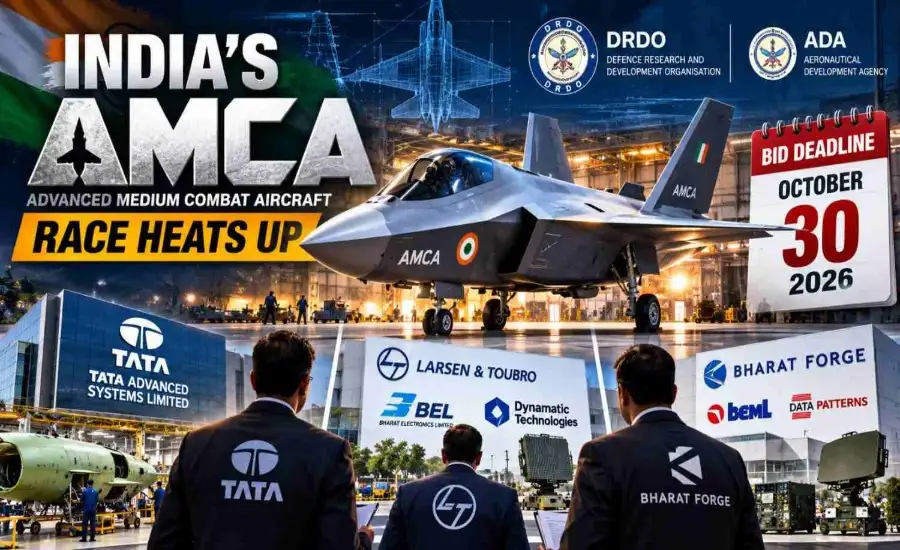
New Delhi: Indian AMCA programme has entered a crucial stage, with Tata Advanced Systems, a consortium led by Larsen & Toubro (L&T), and a team led by Bharat Forge preparing bids for the development of India’s indigenous fifth-generation stealth fighter.
The deadline for submitting proposals has been extended to October 30, 2026, with the bids scheduled to open on October 31. The ₹15,000 crore prototype development programme aims to strengthen India’s defence manufacturing capabilities and create a second major fighter aircraft production line outside Hindustan Aeronautics Limited (HAL).
Indian AMCA Programme Enters A Critical Phase
The Ministry of Defence issued the Request for Proposal (RFP) for the AMCA programme in May 2026, inviting three shortlisted private-sector bidders to compete for the development and production of the aircraft’s prototypes.
Read also: Inside HAL’s Plan To Manufacture Russia’s Most Advanced Fighter In India
The programme is being managed by the Aeronautical Development Agency (ADA), which operates under the Defence Research and Development Organisation (DRDO).
The selected company or consortium will work with ADA to turn the aircraft’s design into flying prototypes and support its development and testing.
The project represents an important change in India’s defence manufacturing strategy. Instead of depending mainly on a single government-owned manufacturer, the government is opening a major fighter aircraft development programme to competition among Indian industry groups.
According to the reported tender schedule, bids must be submitted by October 30, 2026. Technical bids are expected to be opened the following day, followed by a detailed evaluation of the proposals.
The final selection will depend on factors such as technical capability, manufacturing capacity, project execution plans and commercial viability.
What Is The Indian AMCA Programme
The Advanced Medium Combat Aircraft is India’s planned indigenous fifth-generation fighter aircraft. It is being developed to provide the Indian Air Force (IAF) with advanced combat capabilities and reduce dependence on foreign military aircraft technology.
The proposed aircraft is expected to feature stealth technology, advanced avionics, modern sensors and internal weapons bays. These systems are intended to improve its ability to operate in heavily defended airspace.
Stealth technology helps reduce an aircraft’s radar signature, making it more difficult for enemy radar systems to detect and track. However, stealth does not make an aircraft completely invisible.
The AMCA is also expected to support advanced electronic systems and network-based combat operations. The programme has an estimated prototype development budget of ₹15,000 crore, approved by the government in 2024.
The selected development partner is expected to manufacture five flying prototypes and one structural test aircraft at a new facility in Puttaparthi, Andhra Pradesh.
The Three Contenders For Indian AMCA Programme
The competition brings together companies with different strengths in aerospace manufacturing, defence electronics, aircraft structures and systems integration.
1. Tata Advanced Systems Limited (TASL)
Tata Advanced Systems Limited is competing independently for the AMCA development contract.
The company has developed a strong presence in aerospace manufacturing and defence production. Its existing work includes the C-295 military transport aircraft programme, undertaken in partnership with Airbus. Tata also manufactures aircraft structures and fuselage sections for major aerospace companies.
These capabilities could help the company establish the industrial infrastructure required for the AMCA prototype programme.
Key Advantage: Tata’s established aerospace manufacturing experience and a single-company decision-making structure could simplify project management and coordination.
Key Challenge: Developing a complete advanced fighter aircraft requires capabilities beyond aircraft assembly and structural manufacturing. Tata would need to demonstrate that its proposed team and partners can support the programme’s complex avionics, systems integration and testing requirements.
2. L&T, BEL And Dynamatic Technologies Consortium
The second contender brings together Larsen & Toubro, Bharat Electronics Limited (BEL) and Dynamatic Technologies. Each company contributes a different set of industrial capabilities.
L&T has experience in complex engineering, defence systems and large-scale project integration. BEL is a major Indian defence electronics company with expertise in military electronic systems.
Dynamatic Technologies contributes aerospace manufacturing capabilities, including the production of aircraft structures and precision-engineered components.
Together, the three companies could offer a broad industrial base covering aircraft structures, electronics and engineering integration.
Key Advantage: The consortium combines defence engineering, electronics and aerospace manufacturing under one partnership.
Key Challenge: Managing a large fighter aircraft development programme through three separate companies could create coordination and integration challenges. The consortium would need clear responsibilities, effective programme management and a reliable supply chain.
3. Bharat Forge, BEML And Data Patterns Consortium
The third contender is led by Bharat Forge and includes Bharat Earth Movers Limited (BEML) and Data Patterns.
Bharat Forge, part of the Kalyani Group, has extensive experience in precision engineering, metal manufacturing and defence-related production.
BEML brings experience in heavy engineering and manufacturing, while Data Patterns contributes specialised capabilities in defence electronics, radar systems, electronic warfare and avionics.
The combination could provide a strong manufacturing base supported by knowledge of advanced electronic systems.
Key Advantage: The consortium combines heavy manufacturing, precision engineering and defence electronics, potentially supporting the development of an integrated domestic supply chain.
Key Challenge: Manufacturing an advanced fighter aircraft requires specialised knowledge of aircraft structures, aerodynamics, composite materials and final assembly. The consortium would need to demonstrate sufficient capability in these areas or establish the necessary partnerships and facilities.
Why HAL Is Missing From The Indian AMCA Programme Shortlist
Hindustan Aeronautics Limited has traditionally played a central role in India’s military aircraft manufacturing industry.
The state-owned company has been involved in several major aircraft programmes, including the Tejas light combat aircraft. However, HAL was not included among the shortlisted bidders for the initial AMCA prototype development contract.
Reports have linked its exclusion to the initial technical evaluation and concerns about meeting the tender’s requirements. Its existing workload has also been discussed in reporting about the competition.
The absence of HAL does not mean that the company has been permanently excluded from the wider AMCA programme.
The prototype development competition is a separate stage from the future production and manufacturing requirements of the aircraft. HAL could potentially participate in later stages, subject to the government’s procurement decisions and applicable tender conditions.
The selection of a private-sector development partner is intended to expand India’s aerospace manufacturing base and create another industrial route for producing advanced combat aircraft.
Strict Guidelines And Future Timelines
The AMCA programme has demanding technical and operational requirements. The selected partner will need to establish the manufacturing infrastructure, engineering teams and production systems required to support the development programme.
According to the reported tender conditions, the winning bidder must establish a new Indian-majority-owned corporate entity within three months of receiving the contract. The reported rules also restrict foreign direct investment, apart from specified passive institutional investments.
The project schedule is equally ambitious.
The maiden prototype flight is targeted within 30 months of contract signing. The five flying prototypes are expected to complete a combined 1,800 test flights over the following 84 months, according to the reported programme requirements.
These flights would help engineers evaluate the aircraft’s flight characteristics, systems performance, safety and overall design.
The programme’s success will depend on whether the selected partner can meet the deadlines while satisfying the required technical and safety standards.
AMCA Mk1 And Mk2: Engine Plans
The AMCA programme is expected to develop different versions of the fighter aircraft.
The initial AMCA Mk1 is planned to use the American GE F414 engine. The engine is part of the propulsion plan for the first version of the aircraft.
The later AMCA Mk2 is expected to use a more powerful engine developed through cooperation involving India’s Gas Turbine Research Establishment (GTRE) and France’s Safran.
The proposed engine programme is intended to support India’s long-term goal of developing greater domestic capability in advanced military aircraft propulsion. However, engine development, aircraft integration and flight testing remain major engineering challenges. The final configuration and timelines will depend on the progress of the programme.
Why The Indian AMCA Programme Is Important
The AMCA programme is more than a fighter aircraft manufacturing contract. It is also an effort to strengthen India’s ability to design, develop, test and manufacture advanced military aircraft.
A successful programme could create new opportunities for Indian aerospace suppliers, electronics manufacturers, engineering companies and smaller defence industries. It could also help build expertise in advanced materials, aircraft systems integration, stealth-related manufacturing and flight testing.
The selection of a private-sector development partner may encourage greater competition and create an additional industrial base alongside HAL’s existing capabilities.
At the same time, the project faces significant challenges. Developing a fifth-generation fighter requires close coordination between designers, manufacturers, engine developers, electronics suppliers and flight-test teams. Meeting the schedule without compromising technical standards will be one of the programme’s biggest tests.
Read also: What Is Quantum Radar? Why Does AMCA Need to Look Beyond RF Stealth? Former DRDO Director Explains
FAQs
The Advanced Medium Combat Aircraft (AMCA) is India’s planned indigenous fifth-generation stealth fighter aircraft programme. It aims to develop an advanced combat aircraft for the Indian Air Force and strengthen domestic aerospace technology.
The three reported contenders are Tata Advanced Systems Limited, the L&T-BEL-Dynamatic Technologies consortium, and the Bharat Forge-BEML-Data Patterns consortium.
The AMCA prototype development programme has an estimated budget of ₹15,000 crore. Full-scale production is targeted for the mid-2030s, subject to successful development, testing and government decisions.