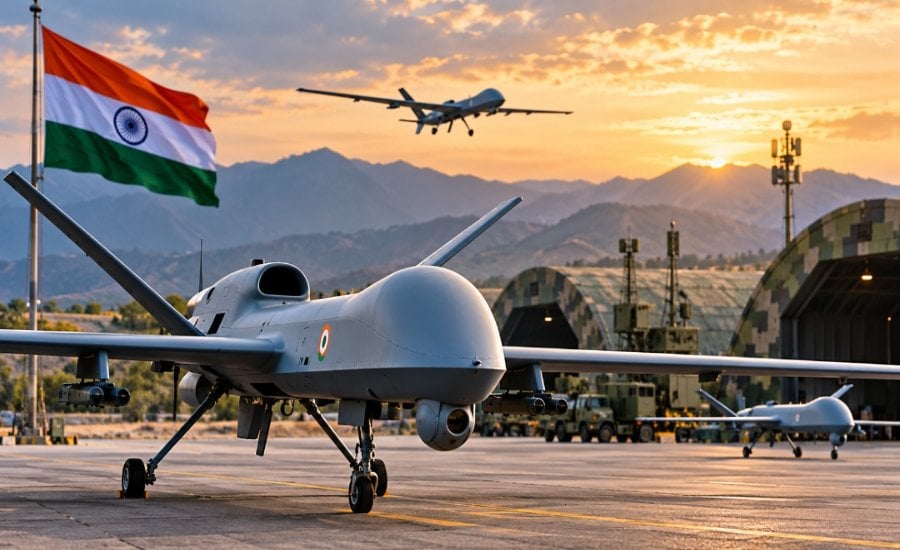
New Delhi: India is considering the use of underutilised northern airfields as backup operating bases for long-range Unmanned Aerial Vehicles (UAVs). The reported plan aims to strengthen India’s military drone operations along the sensitive borders with Pakistan and China.
By spreading drone operations across multiple locations, the Indian Armed Forces could improve operational flexibility, protect valuable unmanned aircraft, and maintain surveillance even if major airbases face disruptions.
Details of India Long-Range UAV Backup Airfields
India is reportedly examining plans to convert unused or underutilised airfields in its northern regions into backup operating bases for long-range military drones.
The proposal aims to create a wider network of airfields that can support unmanned aerial operations during military emergencies.
According to the report, the Indian Armed Forces are evaluating the possibility of using these airfields to support long-range UAV missions.
The reported initiative is part of India’s broader effort to strengthen military infrastructure and improve its ability to operate unmanned aircraft along sensitive borders. However, the report does not confirm that all identified airfields have been officially approved for conversion.
What is the Reason of Long-Range UAV Backup Airfields
Modern military drones have become important tools for surveillance, intelligence gathering, and battlefield operations.
Long-range unmanned aircraft can remain airborne for extended periods and monitor large areas without putting a pilot directly at risk. However, these aircraft require suitable infrastructure for take-off, landing, maintenance, fuel storage, communication, and ground support.
If military drones operate from only a limited number of airbases, damage to those facilities could affect their deployment. A distributed network of backup airfields could reduce this dependence and provide additional operating options during a conflict.
India Long-Range UAV Backup Airfields: Northern Airfields Could Support Operations
India’s northern regions have important strategic locations along the borders with Pakistan and China. Military forces operating in these areas require continuous surveillance to monitor movements, identify possible threats, and maintain situational awareness.
Long-range UAVs can support these missions by providing aerial observation over large areas. The reported proposal could allow military planners to operate drones from different locations instead of depending entirely on a few major airbases.
This approach could improve flexibility during emergencies and help maintain aerial surveillance when primary operating facilities are unavailable.
Distributed Drone Operations Could Improve Military Resilience
The proposed network would allow unmanned aircraft to operate from multiple airfields. Instead of concentrating all drone operations at a small number of locations, military planners could distribute aircraft and supporting infrastructure across different facilities.
This arrangement could provide additional operational flexibility. It could also help reduce the impact of disruptions at individual airbases. However, the effectiveness of such a network would depend on suitable runways, maintenance facilities, communication systems, trained personnel, and logistical support. The report does not identify a complete list of airfields selected for this proposed network.
Long-Range UAVs Require Suitable Runways And Infrastructure
Long-range military drones are different from smaller tactical drones that can be launched by hand or from compact launch systems.
Many larger unmanned aircraft require conventional runways for take-off and landing.
Their operating bases must also provide maintenance facilities, fuel, communication equipment, and trained ground crews. High Altitude Long Endurance (HALE) drones are particularly useful for missions that require extended aerial observation.
These aircraft can support intelligence, surveillance, and reconnaissance missions over large areas. The availability of suitable infrastructure is therefore an important factor in selecting backup operating locations.
Meerut Drone Base Highlights India’s Expanding UAV Infrastructure
India has already taken steps to develop dedicated infrastructure for military drones. In February 2026, reports stated that the Border Roads Organisation (BRO), under the Ministry of Defence, had begun the process of developing a dedicated drone runway and aviation base in Meerut, Uttar Pradesh.
The reported project was valued at approximately ₹406 crore. The proposed facility is planned to support High Altitude Long Endurance remotely piloted aircraft and other aviation operations.
According to the project details reported by Hindustan Times, the facility is expected to include a 2,110-metre-long runway, aircraft hangars, and supporting infrastructure.
The project demonstrates India’s growing focus on creating specialised facilities for unmanned aviation. However, the Meerut project is separate from the reported proposal to use underutilised northern airfields as backup operating bases.
India Long-Range UAV Backup Airfields: Gorakhpur And Sarsawa Have Strategic Importance
Existing military airbases in Uttar Pradesh could also play an important role in India’s long-range drone operations. Gorakhpur and Sarsawa have previously been identified in defence reporting as potential operating locations for long-endurance unmanned aircraft.
Their long runways make them suitable for aircraft that require conventional aviation infrastructure.
In May 2024, India Today reported that the Indian Air Force and Indian Army were planning to deploy MQ-9B Predator drones at these airbases. The reported deployment was intended to improve surveillance along India’s northern and northeastern borders.
These locations highlight the importance of existing military airfields in supporting India’s growing unmanned aviation capabilities. However, their identification as potential operating locations does not establish that they have been formally selected under the latest backup-airfield proposal.
Nyoma Airbase Shows India’s Focus On Forward Infrastructure
India has also been strengthening its military aviation infrastructure in eastern Ladakh. The Mudh-Nyoma airfield is located close to the Line of Actual Control (LAC), which separates Indian-controlled and Chinese-controlled areas.
The airfield has an important strategic location because it can support military operations and logistical activities in a remote region. The Border Roads Organisation has been involved in upgrading the facility.
Nyoma’s development highlights India’s efforts to improve aviation infrastructure in difficult geographical conditions. However, forward airfields also face challenges related to high altitude, weather, logistics, and security.
The development of additional operating locations could provide greater flexibility for military planners.
Read also: How The Indian Army Is Scanning Military Drones For Hidden Components And Secret Backdoors
FAQs
Defence reporting has identified locations such as Gorakhpur and Sarsawa as potential operating bases for long-range drones. However, the latest reported proposal does not confirm the complete list of selected backup airfields.
India is reportedly considering backup airfields to improve military drone operations and reduce dependence on a limited number of operating bases. The network could help maintain surveillance and operational flexibility during emergencies.
Long-range UAVs support intelligence gathering, surveillance, reconnaissance, and other military missions. High Altitude Long Endurance drones can remain airborne for extended periods and monitor large areas without directly risking a pilot.