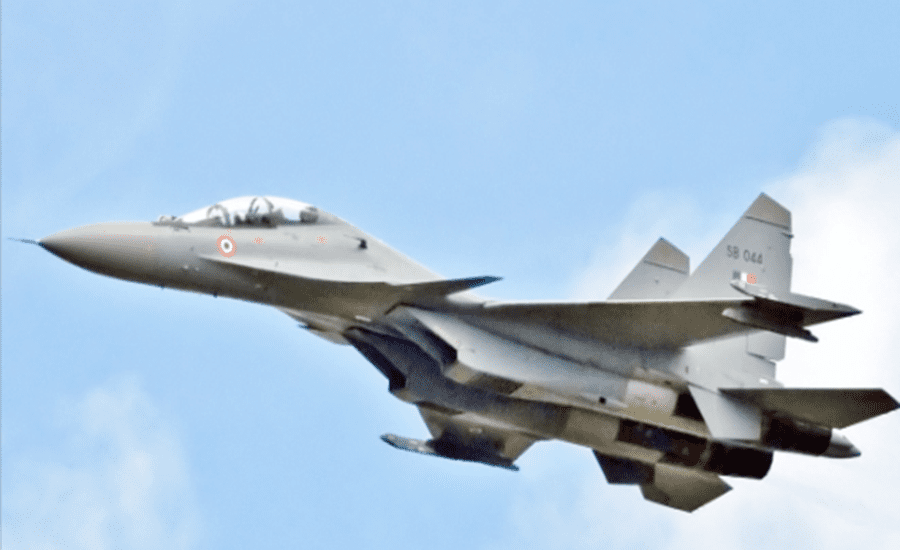
New Delhi: India is preparing a major Su-30MKI upgrade programme. The plan includes advanced indigenous radar, modern avionics and long-range weapons that could significantly improve the Indian Air Force’s (IAF) beyond-visual-range (BVR) combat capability. However, many of the ideas about turning the aircraft into a dedicated “missile truck” remain expert analysis rather than an officially announced IAF doctrine. Officially, the Super Sukhoi programme focuses on improving the aircraft’s combat performance, survivability and indigenous content.
What Is China’s J-16 Missile Truck Strategy
Recent images of China’s People’s Liberation Army Air Force (PLAAF) J-16 fighter carrying a very large number of air-to-air missiles have attracted global attention.
Read also: What is Su-30MKI Talisman EW Suite Integration Programme? How It Will Save Pilots From Crash
Defence experts describe this configuration as a “missile truck.” Instead of carrying ground-attack weapons, the aircraft is loaded mainly with long-range BVR missiles to engage multiple enemy aircraft during air combat.
The concept depends heavily on support from airborne early warning aircraft, datalinks and advanced radar networks that help the fighter engage targets beyond its own radar coverage.
Su-30MKI Upgrade Programme: Can India’s Su-30MKI Perform A Similar Role
Many defence analysts believe the Su-30MKI is naturally suited for this mission because it is one of the largest and heaviest fighters in the IAF.
The aircraft has 12 hardpoints and can carry more than 8 tonnes of weapons, allowing it to carry significantly more missiles than many lighter fighter aircraft.
Unlike smaller fighters, the Su-30MKI can carry heavy weapons while still maintaining good operational performance.
What Is The Su-30MKI Upgrade Programme
The Super Sukhoi programme is India’s planned mid-life upgrade for the Su-30MKI fleet. According to government and defence reports, the upgrade aims to improve:
Virupaksha AESA Radar
One of the biggest upgrades will be the indigenous Virupaksha Active Electronically Scanned Array (AESA) radar.
The radar is being developed by DRDO specifically for the Su-30MKI upgrade programme and was showcased during Aero India 2025.
Gallium Nitride (GaN) Technology
Virupaksha uses modern Gallium Nitride (GaN) transmit/receive modules. According to DRDO officials, the radar has around 2,400 transmit/receive modules, offering higher power, better target detection, improved resistance against electronic jamming and the ability to operate in multiple combat modes simultaneously.
Indigenous Avionics
The programme also plans to introduce:
- New mission computers
- Modern cockpit displays
- Improved electronic warfare systems
- Higher indigenous content
- Better software integration
The Ministry of Defence aims for a high level of indigenous equipment in the upgraded aircraft.
How Will Astra Missiles Improve The Su-30MKI
India is continuously expanding the Astra air-to-air missile family.
Astra Mk-1
The Astra Mk-1 has already entered service with the Indian Air Force.
Astra Mk-2
The Astra Mk-2 is under development and is expected to provide significantly longer engagement ranges than the current version.
Future Long-Range Astra Variants
India is also working on even longer-range Astra variants for future air combat requirements. Official reports mention development efforts toward missiles with substantially extended ranges.
If integrated successfully, these missiles would allow upgraded Su-30MKIs to engage enemy aircraft from much greater distances.
Su-30MKI Upgrade Programme: Why Radar Is More Important Than Carrying More Missiles
Simply carrying more missiles does not guarantee air superiority.
Modern BVR combat depends on:
- Long-range radar detection
- Secure datalink connectivity
- Electronic warfare protection
- Accurate target tracking
- Network-centric warfare
The Virupaksha radar is expected to significantly improve target detection and multi-target tracking compared with the current N011M Bars radar.
How India’s Air Defence Network Supports The Mission
The Indian Air Force is steadily strengthening its integrated air defence network. Systems such as the Integrated Air Command and Control System (IACCS), airborne warning aircraft and secure communication networks improve situational awareness across the battlefield. These capabilities are essential for effective long-range BVR operations.
Will India Officially Create A Su-30MKI Missile Truck
As of now, the Indian Air Force has not officially announced plans to convert the Su-30MKI into a dedicated “missile truck” similar to China’s J-16 concept.
The idea is based on defence analysis of what the upgraded aircraft could potentially achieve after receiving new radar, avionics and long-range missile integration.
The official Super Sukhoi programme itself focuses on improving combat capability, indigenous technology and extending the aircraft’s service life.
What Comes Next For The Super Sukhoi Programme
Government reports indicate that the first phase of the Super Sukhoi upgrade will begin with an initial batch of aircraft after necessary approvals.
The upgraded fleet is expected to remain one of the backbone fighter platforms of the Indian Air Force well into the coming decades while supporting India’s goal of greater defence self-reliance.
Read also: What is UPAB-1500 and Why Does IAF Want It on Su-30MKI? Full Explainer Inside