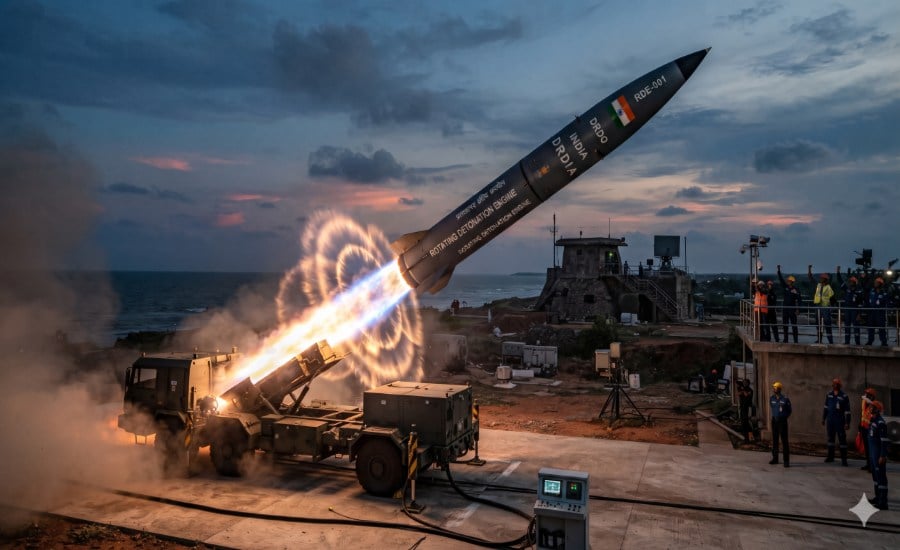
New Delhi: India’s Rotating Detonation Engine (RDE) powered supersonic missile concept could open a new chapter in the Indian Navy’s efforts to strengthen indigenous defence technology.
A report says the Navy has expressed interest in supporting the development of a naval missile using this advanced propulsion technology. The proposal is linked to India’s growing focus on defence innovation, domestic missile development and advanced propulsion systems.
Navy Explores Indian Rotating Detonation Engine Missile
According to the report, the proposed missile concept was highlighted through a technology requirement associated with the Indian Navy’s Swavlamban 2026 initiative.
Read also: All 49 Indian Navy Warships To Be Built In India: What’s Behind The 2047 Self-Reliance Goal?
The requirement focuses on assessing whether Rotating Detonation Engine technology can support the development of an indigenous supersonic naval missile.
The assessment is expected to examine the technology’s feasibility, development stage, performance advantages and suitability for future naval operations. However, the proposal should not be confused with an approved missile acquisition or an operational weapon programme.
The Ministry of Defence officially confirmed that Swavlamban 2026 took place on October 26–27 in New Delhi. The event focused on emerging technologies, indigenous defence capabilities and collaboration between the Navy, Indian industries and startups.
What Is Rotating Detonation Engine Technology
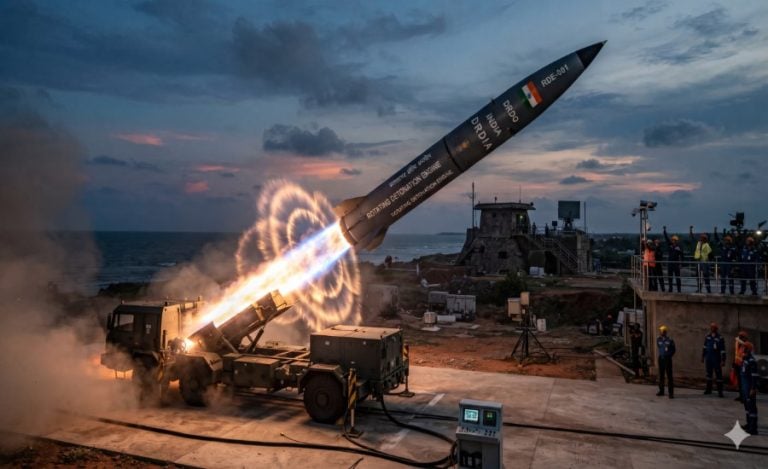
A Rotating Detonation Engine is an advanced propulsion system that uses continuously moving detonation waves to produce thrust.
Unlike conventional engines, which generally depend on subsonic combustion, an RDE uses supersonic combustion inside a specially designed combustion chamber. This technology could offer several potential advantages:
- Higher Efficiency: It could improve fuel efficiency through pressure-gain combustion.
- Compact Design: It may deliver useful thrust from a smaller engine.
- Higher Thrust Potential: It could provide better thrust performance for a similar engine size.
- Reduced Complexity: Some RDE designs can operate without conventional compressors and multiple moving components.
These potential advantages could make the technology useful for future missiles and other high-speed aerospace applications. However, actual performance benefits must be established through detailed testing and evaluation.
D-Propulse Aerospace’s Role In India’s RDE Development
Indian aerospace startup D-Propulse Aerospace is working on indigenous Rotating Detonation Engine technology.
According to the latest report, the company tested an RDE prototype at a DRDO facility in Hyderabad in July 2026.
The reported testing included five static engine tests within 24 hours. The development is significant because indigenous propulsion technology remains an important area for India’s long-term aerospace and defence ambitions.
The company is also exploring the development of air-breathing RDE-powered supersonic cruise missiles and Rotating Detonation Rocket Engine (RDRE)-powered small surface-to-air missiles. However, an engine ground test does not mean that a complete missile is ready for flight testing or military deployment.
How Could The Indian Rotating Detonation Engine Missile Complement BrahMos
India already operates the powerful BrahMos supersonic cruise missile, jointly developed by India and Russia.
An RDE-powered missile could potentially complement existing systems by offering a smaller and lighter alternative. A compact missile design could provide greater flexibility in deploying weapons from different naval platforms.
It could also help the Navy explore additional missile options for future warships and other maritime platforms. However, the proposed RDE-powered missile should not be considered a replacement for BrahMos.
BrahMos is an established weapon system, while the RDE-powered missile remains an early-stage development concept.
D-Propulse’s Development Timeline
The report also highlights the company’s development targets for its future propulsion systems.
According to the report, D-Propulse aims to offer its air-breathing RDE-powered supersonic cruise missile for user trials by the end of 2029.
The company is separately targeting the middle of 2028 for offering its RDRE-powered micro surface-to-air missile. These are company development targets, not officially announced Indian Navy induction dates.
The systems would still need to complete the required development, testing and evaluation before any possible military deployment.
Swavlamban 2026 Strengthens India’s Defence Innovation Push
The Indian Navy’s Swavlamban initiative has become an important platform for encouraging indigenous defence development.
The fifth edition, Swavlamban 2026, was organised under the theme Strength & Power Through Innovation and Indigenisation.
The Ministry of Defence confirmed that the event brought together defence organisations, startups, MSMEs, industries and academic institutions.
The event also saw the release of the Swavlamban 5.0 document and a Compendium on Technology Imperatives.
These documents support the Navy’s efforts to identify future technological requirements and encourage Indian companies to develop indigenous solutions.
The broader objective is to reduce dependence on foreign technologies and strengthen India’s domestic defence manufacturing ecosystem.
Read also: How Does Indigenous Air Independent Propulsion System Will Make Indian Navy Submarines Invincible
FAQs
D-Propulse Aerospace, an Indian aerospace startup, is developing indigenous Rotating Detonation Engine technology and exploring its application in future missiles.
It is a proposed indigenous supersonic naval missile concept that would use Rotating Detonation Engine technology to generate thrust through supersonic combustion.
According to the reported company development timeline, D-Propulse aims to offer its RDE-powered supersonic cruise missile for user trials by the end of 2029. This is a development target, not a confirmed Indian Navy induction date.