New Delhi: The Indian Air Force (IAF) has issued a Request for Information (RFI) for 500 indigenous fixed-wing expendable ISR drones, marking a major step towards strengthening India’s domestic drone manufacturing and airborne intelligence capabilities.
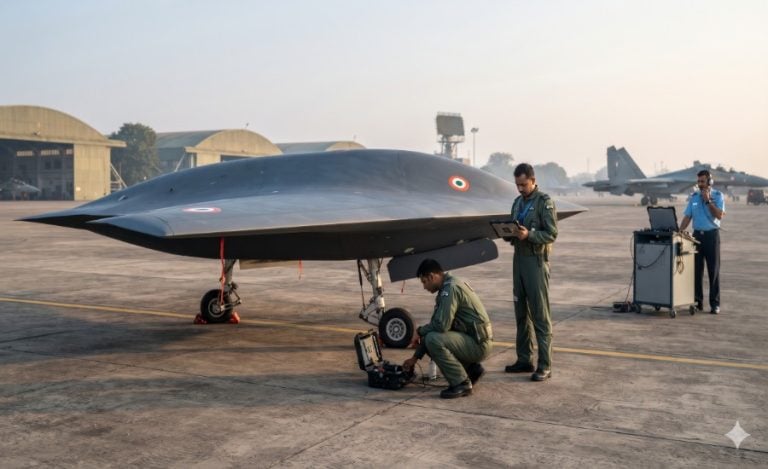
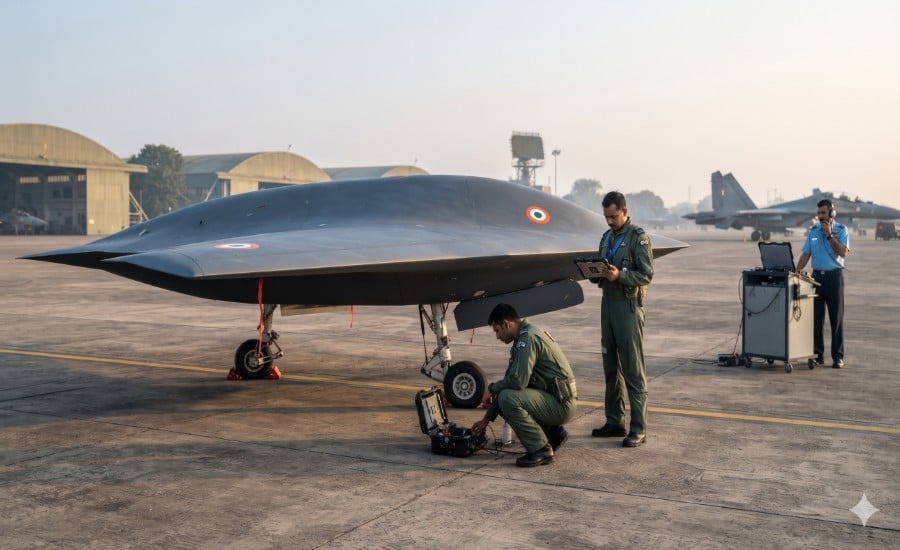
The proposed unmanned aerial systems (UAS) will feature low radar visibility, advanced day-and-night surveillance sensors and electronic intelligence capabilities. The project aims to provide the IAF with advanced surveillance platforms that can operate in challenging environments without depending on conventional runways.
Details of IAF 500 Indigenous ISR Drones Deal
According to the Indian Air Force’s procurement notice, the Directorate of Plans at Air Headquarters issued the RFI on November 18, 2026.
Read also: What Is CIKVS Patent-5? And What Makes It Different from Existing Naval Defence Systems
The requirement covers 500 fixed-wing Intelligence, Surveillance and Reconnaissance (ISR) unmanned aerial systems. The procurement is aimed at strengthening India’s ability to monitor sensitive areas and collect intelligence using domestically developed drone technology.
The RFI has been published under reference number RFI_EISRUAS_ASR_IAF_18NOV26. Interested companies have been invited to submit their responses by January 12, 2027.
IAF 500 Indigenous ISR Drones Deal: Required Features
The IAF has specified demanding flight performance requirements for the proposed drones.
Each platform must provide at least six hours of flight endurance and operate at a range exceeding 200 kilometres. It must also achieve a minimum service ceiling of 25,000 feet.
The required speed range is 80 to 200 kmph, with an ideal cruising speed of approximately 120 kmph.
These capabilities will allow the drones to conduct longer surveillance missions over large areas while operating from forward locations.
Runway-Independent Operations And Rapid Deployment
One of the important requirements is the ability to operate without conventional runway infrastructure.
The drones must support runway-independent launch operations, giving the IAF greater flexibility to deploy them from forward operating locations.
The RFI also specifies a turnaround time of less than 10 minutes between missions.
Interestingly, although the platforms are classified as expendable systems, the IAF requires them to be reusable. This approach can support repeated missions while reducing the need to replace the entire aircraft after every operation.
Low Radar Signature To Improve Survivability
The proposed ISR drones must have a Radar Cross Section (RCS) of less than 0.25 square metres.
RCS measures how detectable an aircraft or drone is to radar systems. A lower radar cross-section can make detection more difficult, although actual detectability also depends on radar frequency, viewing angle and operating conditions.
This requirement indicates that the IAF wants platforms with reduced radar visibility for operations in contested environments.
Advanced EO/IR Sensors For Day And Night Surveillance
The IAF is also seeking advanced Electro-Optical and Infrared (EO/IR) sensor systems.
The drones must carry gimballed EO/IR payloads, which can provide visual and thermal surveillance during both daytime and nighttime operations.
These sensors can help operators observe ground activity, monitor important locations and collect intelligence without sending crewed aircraft into potentially dangerous areas.
The combination of EO and IR technology will improve the platform’s ability to gather information under different lighting conditions.
2-18 GHz Electronic Intelligence Capability
Another major feature is the Electronic Support Measures (ESM) system.
The IAF requires a broadband ESM receiver capable of operating across the 2 GHz to 18 GHz frequency range.
This system will help detect and collect electronic emissions from radar and other electronic systems. Such information can support the identification and monitoring of electronic activity in an operational area.
The combination of EO/IR surveillance and ESM capabilities will allow the drones to collect both visual intelligence and electronic intelligence during missions.
GNSS-Denied Operations And Secure Communication
Modern military operations can involve electronic warfare activities that disrupt satellite navigation signals.
To address this challenge, the IAF wants the proposed drones to operate in GNSS-denied environments, where satellite navigation signals such as GPS or NavIC may be unavailable or disrupted. The platforms must also support two communication methods:
- Line-of-Sight (LOS): Communication between the drone and ground control station within the available communication range.
- Satellite Communication (SATCOM): Communication through satellite networks for operations requiring beyond-line-of-sight connectivity.
For information security, the RFI specifies AES-256 encryption and an onboard kill switch. These features are intended to protect sensitive mission information and technology if a drone is compromised or captured.
IAF 500 Indigenous ISR Drones Deal: 90% Fleet Availability Under OEM Support
The IAF is also focusing on maintenance and long-term operational availability. Under the proposed arrangement, the Original Equipment Manufacturer (OEM) will be responsible for storage and maintenance of the drone fleet.
The selected manufacturer must ensure at least 90% fleet serviceability.
This means the IAF wants a reliable support system that keeps most of the procured drones ready for operational deployment rather than allowing a large number of platforms to remain unavailable because of maintenance issues.
What is the Importance of IAF 500 Indigenous ISR Drones Deal
The proposed 500-drone programme could strengthen the IAF’s ability to conduct persistent surveillance and collect electronic intelligence across important operational areas.
The combination of long endurance, low radar signature, advanced sensors and GNSS-denied operations reflects the growing importance of unmanned systems in modern warfare.
It could also reduce the need to expose expensive crewed aircraft and pilots to certain high-risk reconnaissance missions.
More importantly, the programme creates an opportunity for Indian defence manufacturers to develop advanced unmanned platforms and reduce dependence on foreign technologies.
If successfully implemented, the project could become an important addition to India’s indigenous military aviation capabilities.
Read also:India is Developing Moving Air Defence System That Can Neutralize Any Aerial Threat
FAQs
The proposed drones must have a minimum endurance of six hours and an operational range exceeding 200 kilometres. They must also operate at a minimum service ceiling of 25,000 feet.
The Indian Air Force has issued an RFI for 500 indigenous fixed-wing expendable Intelligence, Surveillance and Reconnaissance (ISR) unmanned aerial systems.
The drones are expected to feature low radar cross-section technology, gimballed EO/IR sensors, 2-18 GHz Electronic Support Measures, GNSS-denied operation, LOS and SATCOM communication, AES-256 encryption and an onboard kill switch.