New Delhi: India’s indigenous Tejas Mk2 fighter jet programme has faced another timeline change, with its maiden flight now expected in September 2027. Former Indian Air Force (IAF) Chief Air Chief Marshal (Retd.) RKS Bhadauria has highlighted landing gear, also known as undercarriage, integration challenges as an important reason behind the delay.
His comments have brought fresh attention to the technical difficulties facing Hindustan Aeronautics Limited (HAL) and the Aeronautical Development Agency (ADA) as they work to develop India’s next-generation medium-weight fighter aircraft.
Why Is The Tejas MK2 Fighter Jet First Flight Delayed
The Tejas Mk2 was earlier expected to make its first flight in 2026. However, the development schedule has moved to 2027 because of technical and integration challenges.
Read also: Tejas Mk2 Fighter Jet Programme Faces Reality Check As Ex-IAF Vice Chief Warns Of Future Challenges
According to Bhadauria’s recent remarks, problems related to the aircraft’s landing gear have contributed to the delay.
The undercarriage is an important part of any fighter aircraft. It supports the aircraft’s weight, absorbs landing forces and helps maintain stability during take-off and landing.
For a modern fighter jet, the landing gear must also work properly with the aircraft’s structure, hydraulic systems and other important components.
Any technical issue in this system can require additional engineering work, design changes and ground testing before the aircraft receives permission to fly. However, the exact engineering fault has not been publicly explained in detail. Therefore, it would be incorrect to assume that the aircraft has suffered a major structural failure.
September 2027 Now The Expected Tejas MK2 Fighter Jet First Flight Target
The revised timeline indicates that the first Tejas Mk2 prototype could be rolled out around March 2027, followed by its maiden flight in September 2027.
This timeline is broadly consistent with the September 2027 target discussed by Defence Secretary Rajesh Kumar Singh in recent programme updates.
The prototype must complete several important checks before its first flight.
These include structural inspections, hydraulic system testing, engine integration, flight-control system validation and ground trials.
The aircraft will also need the required technical and airworthiness clearances before entering the flight-testing phase. The actual first-flight date will depend on the successful completion of these activities.
How AI Could Help Speed Up The Tejas Mk2 Programme
Bhadauria has also highlighted the potential use of Artificial Intelligence (AI) to improve development and testing activities.
AI-based tools can help engineers analyse large amounts of technical data, improve simulations and identify possible problems during the development process.
These technologies may help reduce the time required for certain planning and analysis activities. However, AI cannot replace physical aircraft testing, engineering inspections or mandatory safety certifications. HAL and ADA will still need to complete all essential ground and flight evaluations before the Tejas Mk2 can enter the sky.
Tejas Mk2: A More Advanced Fighter Than Tejas Mk1A
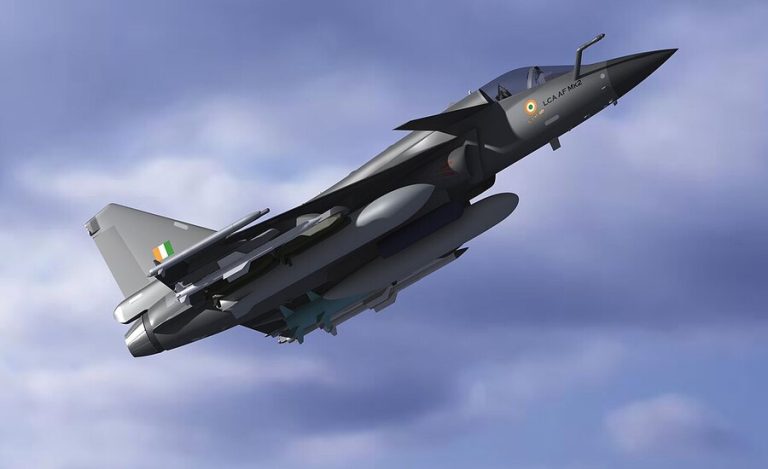
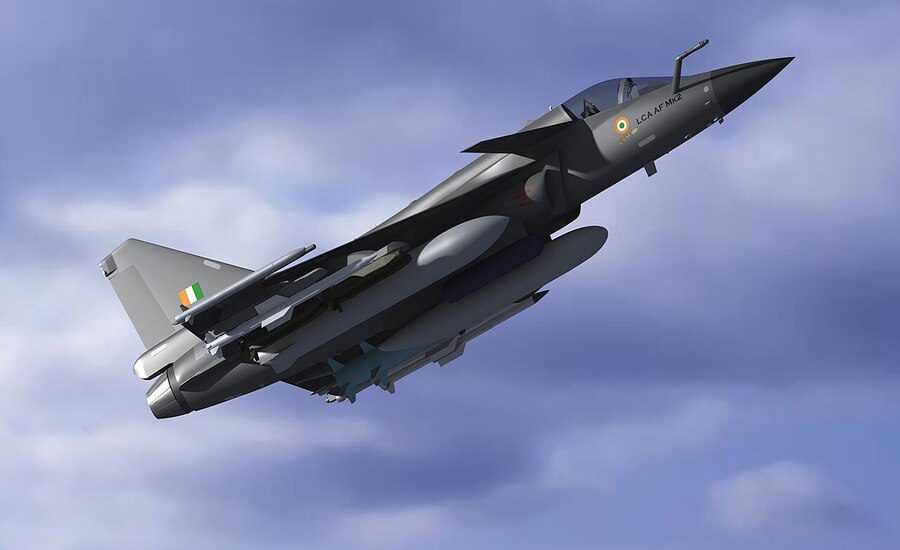
The Light Combat Aircraft (LCA) Tejas Mk2 is being developed as a more powerful and capable fighter than the existing Tejas Mk1 and Mk1A variants.
Unlike the earlier versions, the Mk2 will have a larger airframe, increased internal fuel capacity and a more powerful engine. Some of its major planned features include:
- Engine: General Electric F414-INS6 afterburning turbofan.
- Engine Thrust: Approximately 98 kN with afterburner.
- Configuration: Canard-delta wing design.
- Radar: Indigenous Uttam Active Electronically Scanned Array (AESA) radar is planned.
- Aircraft Category: Medium-weight, 4.5-generation fighter.
- Mission: Air defence, air superiority and ground attack operations.
The GE F414 engine is expected to provide more power than the GE F404 engine used in the Tejas Mk1 and Mk1A.
The larger airframe and additional fuel capacity are also expected to improve the aircraft’s operational range and weapons-carrying capability.
What Is The Role Of HAL And ADA In The Tejas Mk2 Project
The Tejas Mk2 programme is being developed through cooperation between two major Indian aerospace organisations.
Hindustan Aeronautics Limited (HAL) is responsible for aircraft manufacturing and major integration activities. The Aeronautical Development Agency (ADA), under the Defence Research and Development Organisation (DRDO), leads the aircraft’s design and development programme.
Both organisations must work together to complete the prototype, integrate different systems and prepare the aircraft for testing.
The project also depends on contributions from India’s private aerospace industry and other technology partners. The Indian government has repeatedly highlighted the importance of domestic aircraft development and manufacturing to reduce dependence on foreign defence suppliers.
Why Is The Tejas Mk2 Important For The Indian Air Force
The Tejas Mk2 is an important part of India’s long-term fighter modernisation plans.
The Indian Air Force needs modern fighter aircraft to strengthen its operational capabilities and gradually replace several ageing aircraft fleets.
The Mk2 is expected to complement the Tejas Mk1A while providing greater range, improved performance and increased weapons-carrying capability.
The aircraft is also important for India’s domestic aerospace industry because its development will support the growth of indigenous technologies, engineering expertise and manufacturing capabilities. However, the fighter must successfully complete its development and testing programme before it can enter operational service.
Read also: Explained: Why India Is Indigenising Parts Used in Tejas, Su-30MKI and T-90 Tanks
FAQs
Former IAF Chief RKS Bhadauria has identified landing gear integration challenges as an important reason behind the delay. Other engineering and system integration activities must also be completed before the aircraft can fly.
The Tejas Mk2 is currently expected to make its maiden flight in September 2027. The timeline will depend on prototype integration, ground testing and the required technical clearances.
The Tejas Mk2 will be powered by the American General Electric F414-INS6 afterburning turbofan engine, which is expected to produce approximately 98 kN of thrust with afterburner.