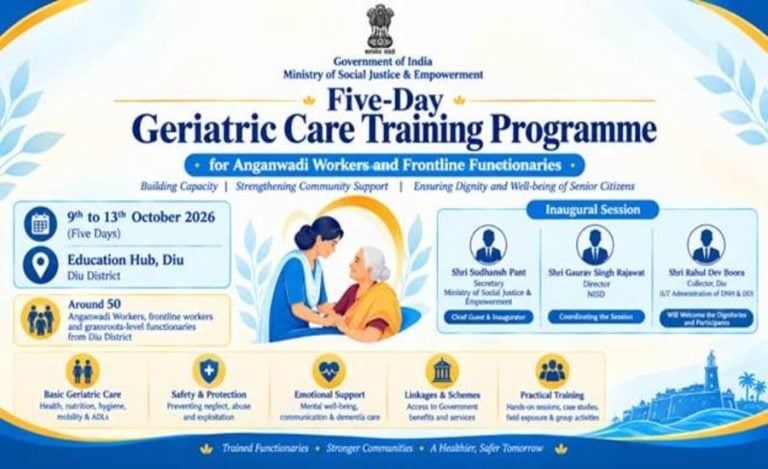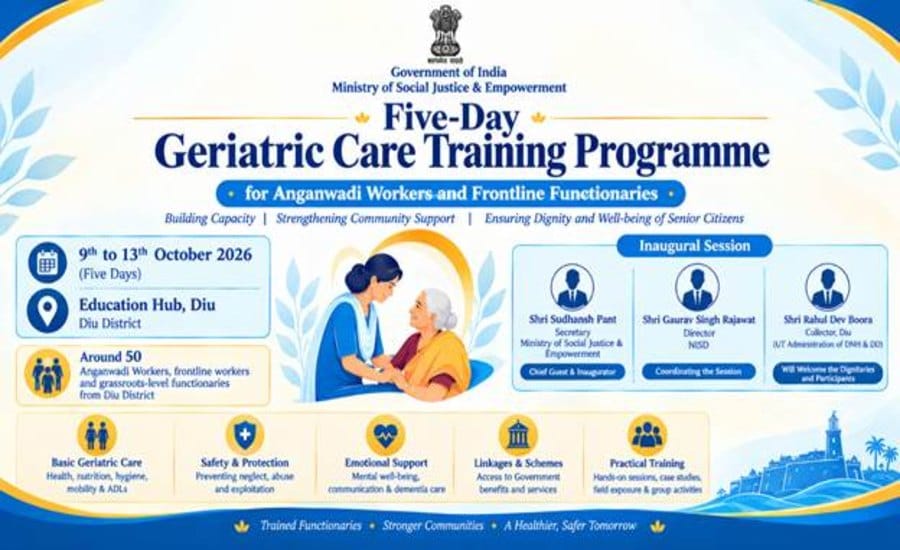
Diu: The National Institute of Social Defence (NISD), under the Ministry of Social Justice & Empowerment, will organise a five-day geriatric care training programme in Diu from October 9 to build a stronger community-level support system for senior citizens.
The programme is being organised in collaboration with the Office of the Collector, Diu, under the Union Territory Administration of Dadra and Nagar Haveli and Daman and Diu. Around 50 Anganwadi workers, frontline workers and grassroots-level functionaries are expected to participate.
Secretary, Ministry of Social Justice & Empowerment, Sudhansh Pant, will inaugurate the programme at the Education Hub, Diu, and administer the Pledge for Welfare of Senior Citizens. NISD Director Gaurav Singh Rajawat will coordinate the inaugural session, while Diu Collector Rahul Dev Boora will welcome the dignitaries and participants.
Building Local Capacity for Elderly Care
The training aims to create a pool of trained and sensitised frontline workers who can support older persons within their communities.
The focus goes beyond basic caregiving. Participants will learn how to identify emerging care needs at an early stage, help senior citizens access government schemes and services, provide basic support and facilitate referrals when specialised assistance is required.
This community-based approach is particularly relevant for elderly persons who live alone, have limited family support or need assistance with routine Activities of Daily Living (ADLs).
Frontline workers often remain among the first points of contact for families and vulnerable community members. Strengthening their skills can therefore help identify problems earlier and connect senior citizens with appropriate services.
Focus on Dignity, Safety and Well-Being
The programme will cover the physical, psychological, emotional and social aspects of ageing. Participants will also learn practical approaches to ensure that elderly persons receive care with safety, dignity and respect.
Training areas will include the ageing process, changing needs of senior citizens, their rights and well-being, and the role of families, communities and frontline caregivers.
Participants will also receive practical guidance on:
- Basic geriatric care and assistance with routine activities
- Personal hygiene, nutrition and hydration
- Medication-related support
- Mobility assistance and safe transfer techniques
- Fall prevention and home safety
- Basic first aid and emergency response
- Communication and psychosocial support
- Loneliness, social isolation and emotional well-being
- Dementia awareness and basic caregiving
The programme will also emphasise privacy, dignity, respectful communication and compassionate care.
Focus on Neglect, Abuse and Exploitation
A significant part of the training will address the prevention, identification and reporting of neglect, abuse and exploitation of senior citizens.
Frontline functionaries will be sensitised to signs that may indicate that an older person requires additional assistance or protection. The programme will also strengthen their understanding of when and how to facilitate appropriate referrals.
This is important for senior citizens who may have limited mobility, live alone or depend heavily on others for everyday activities.
By improving awareness among workers at the grassroots level, the programme seeks to create an early support mechanism rather than waiting for problems to become more serious.
Connecting Seniors With Government Support
The training will also familiarise participants with government schemes, programmes, institutional mechanisms and support services available for senior citizens.
The objective is to enable frontline workers to help eligible elderly persons understand and access relevant benefits and services.
This can strengthen the last-mile delivery of welfare measures, particularly for senior citizens who may face difficulties navigating government systems on their own.
The programme will encourage coordination between frontline workers, the District Administration and other service providers so that elderly persons can receive more timely support.
Practical and Field-Based Learning
Rather than relying only on classroom lectures, the five-day programme will combine interactive sessions, demonstrations, practical exercises, case studies and field-oriented examples.
Group activities and experience-sharing sessions will allow participants to connect the training with situations they encounter in their communities. Question-and-answer sessions will further help workers understand how to respond to different care requirements.
Practical exposure to basic caregiving techniques will form an important part of the programme, with the emphasis on turning knowledge into useful community-level support.
The training has also been contextualised to address the specific circumstances and needs of senior citizens in Diu District.
NISD and Diu Administration Join Hands
The programme is being coordinated jointly by NISD and the Office of the Collector, Diu.
Asha Sharma, Course Coordinator, and Ritu Dandriyal, Junior Consultant, from the Senior Citizen Division of NISD, have been deputed to conduct the programme.
The Deputy Director (Training) and Head of the Senior Citizen Division, NISD, is coordinating the programme with the Diu administration and other stakeholders to manage its academic, administrative and logistical arrangements.
NISD has also been conducting capacity-building programmes in geriatric care and related areas as part of its continuing efforts to develop trained human resources for the care, welfare and protection of senior citizens.
Expected Impact on Senior Citizen Support
The five-day training is expected to create a pool of around 50 trained frontline functionaries in Diu District.
These workers will be better equipped to provide basic care, identify early signs of health, mobility, cognitive and psychosocial concerns, and facilitate appropriate referrals.
The programme is also expected to improve awareness of government support mechanisms and strengthen community-level assistance for older persons who live alone or have limited family support.
More broadly, the initiative reflects the growing need for local support systems as communities respond to the changing needs of an ageing population.
By placing trained personnel closer to senior citizens, Diu aims to strengthen a care ecosystem built around dignity, safety, independence, social inclusion and quality of life.
The collaboration between NISD, the Ministry of Social Justice & Empowerment and the Diu administration highlights the importance of coordinated grassroots action in senior citizen welfare. Building the capacity of frontline workers can help make elderly care more accessible, responsive and community-based.
Read also: India’s Steel Production Reaches 85.1 Million Tonnes in H1 FY 2026-27, Consumption Rises 7.5%