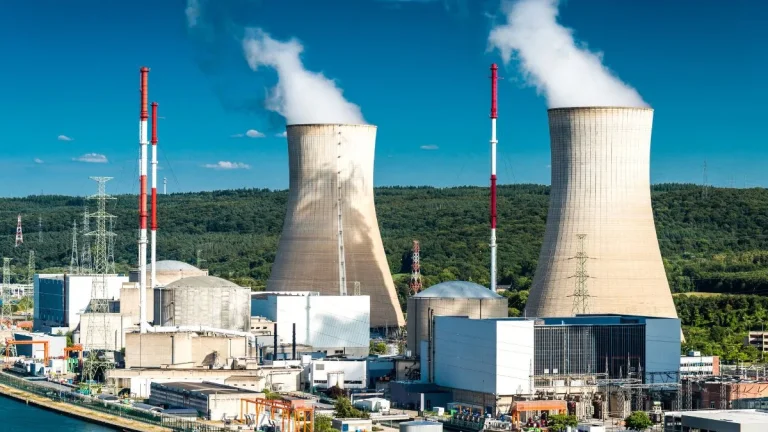
New Delhi: Nuclear energy mission for Viksit Bharat is India’s long-term plan to expand clean energy and reduce carbon emissions. The Government of India has informed Parliament that it aims to increase the country’s nuclear power capacity to 100 GW by 2047. The mission also focuses on developing indigenous Small Modular Reactors (SMRs), encouraging private sector participation, and ensuring world-class nuclear safety. The information was shared by the Ministry of Atomic Energy through an official reply in the Lok Sabha.
What is the Nuclear Energy Mission for Viksit Bharat
The Nuclear Energy Mission (NEM) was announced in the Union Budget 2025-26. Its main goal is to help India become a Viksit Bharat (Developed India) by 2047 while supporting the country’s Net Zero emissions target by 2070.
The mission will increase clean electricity generation, improve India’s energy security, reduce dependence on fossil fuels, and support future technologies such as hydrogen production.
What are the Objectives of the Nuclear Energy Mission
The Government has set several major targets under the mission.
- Achieve 100 GW nuclear power capacity by 2047
- Develop five indigenous Small Modular Reactors (SMRs) by 2033
- Increase clean and reliable electricity generation
- Support India’s Net Zero target by 2070
- Promote indigenous nuclear technology
- Increase private sector participation in nuclear energy
India to Develop Five Indigenous Small Modular Reactors by 2033
The Government has announced that at least five indigenous Small Modular Reactors (SMRs) will become operational by 2033. These compact nuclear reactors are expected to provide clean, safe and reliable electricity while requiring less land and investment than traditional large nuclear power plants.
According to the Bhabha Atomic Research Centre (BARC), three indigenous reactor designs are currently under development.
1. Bharat Small Modular Reactor (BSMR-200)
- Capacity: 220 MWe
- Based on Pressurised Water Reactor (PWR) technology
- Designed completely in India
2. Small Modular Reactor (SMR-55)
- Capacity: 55 MWe
- Indigenous Pressurised Water Reactor design
3. High Temperature Gas Cooled Reactor (HTGCR)
- Capacity: Up to 5 MWth
- Designed mainly for hydrogen production
- Uses advanced nuclear heat technology
Current Status of India’s SMR Projects
The Government informed Parliament that all three reactor projects are making steady progress.
Bharat Small Modular Reactor (BSMR-200)
The project has already achieved several important milestones.
- Engineering and construction have received in-principle approval.
- Administrative and financial approval has been cleared by the Atomic Energy Commission.
- Tarapur, Maharashtra has been selected as the project site.
Small Modular Reactor (SMR-55)
Progress on the SMR-55 project includes:
- Engineering approval received.
- Tarapur approved as the reactor site.
High Temperature Gas Cooled Reactor (HTGCR)
Development work is also progressing.
- Engineering approval has been received.
- Proposed site is BARC, Visakhapatnam (Vizag).
- Environmental Terms of Reference (ToR) have been approved by the Ministry of Environment, Forest and Climate Change.
SHANTI Act 2025 Opens India’s Nuclear Sector to Private Companies
A major step under the mission is the SHANTI Act, 2025. The Act allows greater participation of private companies in India’s nuclear sector. Private companies can now contribute to:
- Nuclear technology research
- Reactor development
- Indigenous manufacturing
- Technology partnerships
- Research and Development (R&D)
The Act also strengthens the Atomic Energy Regulatory Board (AERB) by giving it statutory powers to independently regulate India’s nuclear sector.
India’s Nuclear Power Roadmap Till 2047 Under Nuclear Energy Mission
India currently has around 8.78 GW of installed nuclear power capacity. The Government has prepared a phased roadmap for expansion.
By 2031-32
India’s nuclear capacity is expected to increase to around 22 GW.
After 2032
Another 32 GW of capacity will be added through NPCIL, mainly using:
- Pressurised Heavy Water Reactors (PHWR)
- Light Water Reactors (LWR)
By 2047
The remaining 46 GW is expected through:
- Public Sector Enterprises
- State Governments
- Private Companies
- Joint Ventures
Together, these projects will help India achieve the 100 GW nuclear power target.
Nuclear Safety Remains the Government’s Top Priority
The Government has said that safety is the highest priority in every nuclear power project. Indian nuclear plants are designed with multiple safety systems, including:
- Defence-in-depth safety design
- Multiple backup systems
- Radiation shielding
- Continuous monitoring
- Independent regulatory inspections
The Government also said that radioactive waste is treated, stored and disposed of under strict AERB safety guidelines.
Environmental monitoring is regularly carried out by BARC’s Environmental Survey Laboratories to ensure public and environmental safety.
Why is the Nuclear Energy Mission Important
The Nuclear Energy Mission is expected to bring several long-term benefits for India. These include:
- More clean electricity
- Lower carbon emissions
- Better energy security
- Faster economic growth
- Support for hydrogen production
- More employment opportunities
- Growth of indigenous nuclear technology
- Increased private investment
The mission is also expected to reduce India’s dependence on imported fossil fuels and strengthen the country’s clean energy future.
Read also: Explained: How India’s World’s First Nuclear-Powered Hydrogen Plant Could Change Clean Energy