New Delhi: India and Japan have taken another major step toward the Chandrayaan-5 mission, a joint Moon exploration project that will study the Moon’s south pole. The mission brings together the Indian Space Research Organisation (ISRO) and the Japan Aerospace Exploration Agency (JAXA) to search for water ice and learn more about the Moon’s surface using advanced technology.
Chandrayaan-5 Mission: ISRO And JAXA Hold Key Technical Meeting
ISRO and JAXA recently held a high-level Technical Interface Meeting (TIM) in Bengaluru to review the progress of Chandrayaan-5, also known as the Lunar Polar Exploration (LUPEX) mission. The meeting included senior scientists and engineers from both space agencies. They discussed important technical systems needed to ensure the mission works smoothly from launch to landing.
Read also: How Close Is India to Sending Astronauts to Space? ISRO Shares Big Gaganyaan Mission Update
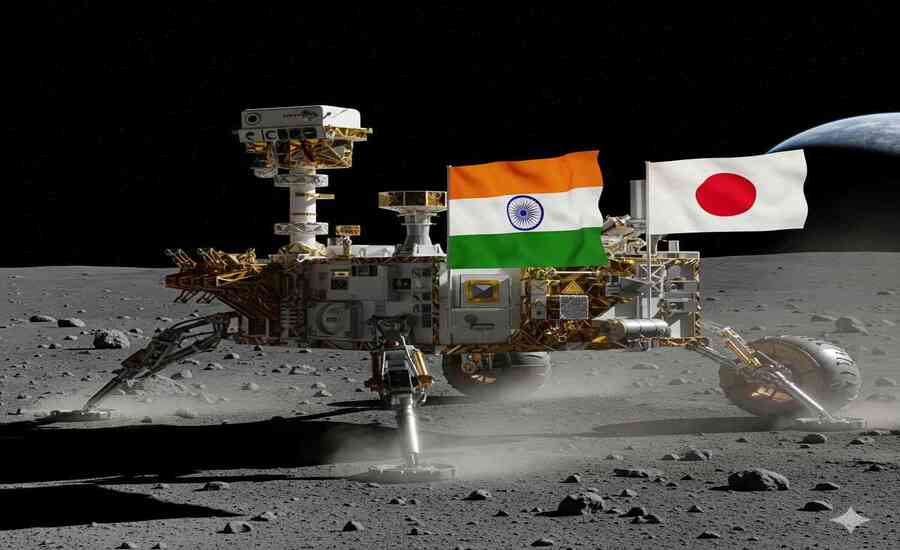
Chandrayaan-5 Mission: India Will Build The Lander, Japan Will Build The Rover
Under the mission plan:
- ISRO will design and build the lunar lander.
- JAXA will provide the advanced lunar rover.
- The rover will travel across the Moon’s surface after landing.
- Scientific instruments from ISRO, JAXA, ESA, and NASA will study lunar soil and water ice.
Chandrayaan-5 Mission: Main Focus Is The Moon’s South Pole
The Chandrayaan-5 mission will explore the Moon’s south polar region, especially Permanently Shadowed Regions (PSRs). Scientists believe these dark areas may contain frozen water ice that has remained untouched for billions of years. Finding and studying this water is important because it could support future human missions by providing drinking water, oxygen, and even rocket fuel.
Teams Finalise Critical Mission Systems
During the technical meeting, experts reviewed several important mission systems. These included communication between the lander and rover, power transfer, interface compatibility, mission timelines, landing site planning, and overall mission coordination. The goal is to ensure every system works perfectly once the spacecraft reaches the Moon.
Launch Planned On Japan’s H3-24L Rocket
According to ISRO, the mission will be launched aboard JAXA’s H3-24L launch vehicle. The Government of India approved the Chandrayaan-5/LUPEX mission on 10 March 2025, allowing the project to move into full-scale development. The launch is currently expected around 2027–2028, although the exact date will depend on mission readiness.
Why Chandrayaan-5 Mission Is Important
Chandrayaan-5 is much more than another Moon mission. It strengthens India-Japan space cooperation, advances lunar science, and supports long-term plans for human exploration of the Moon. The mission also builds on the success of Chandrayaan-3 and supports India’s broader roadmap for future lunar exploration, including Chandrayaan-4 and eventually human Moon missions.