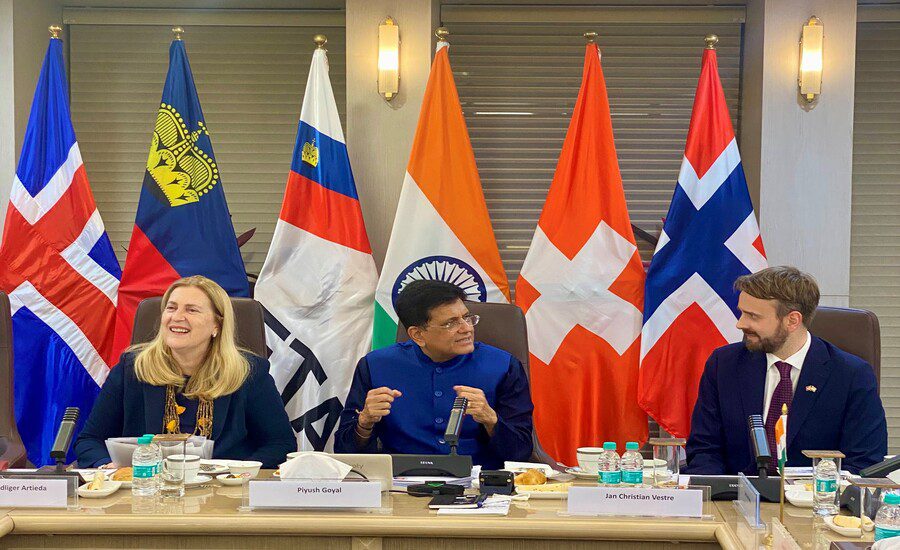
The India-European Free Trade Association (EFTA) Trade and Economic Partnership Agreement (TEPA) officially came into force on October 1, 2025, marking a watershed moment in India’s trade policy and economic diplomacy.
This groundbreaking agreement represents India’s first Free Trade Agreement with four developed European nations—Switzerland, Norway, Iceland, and Liechtenstein—signed on March 10, 2024, in New Delhi.
India-EFTA Trade Pact: Unprecedented Investment Commitment
What sets TEPA apart from previous trade agreements is its binding commitment on investment and job creation. The four EFTA states have pledged to increase foreign direct investment in India by $50 billion within the first 10 years, followed by an additional $50 billion over the next five years .
This $100 billion investment commitment is expected to generate one million direct jobs across manufacturing, innovation, research, and service sectors.
Commerce Minister Piyush Goyal has hailed the agreement as a defining moment that aligns with India’s Atmanirbhar Bharat vision while opening doors to high-quality European investments.
India-EFTA Investment Desk: Single-Window Platform
To streamline the investment process, a dedicated India-EFTA Desk has been operational since February 2025.
This single-window platform focuses on sectors including renewable energy, life sciences, engineering, digital transformation, and promotes joint ventures and SME collaborations.
Unlike portfolio inflows, these are long-term, capacity-building investments aimed at strengthening India’s manufacturing ecosystem and forging deeper linkages between India’s skilled workforce and Europe’s technology ecosystems.
India-EFTA Trade Pact: Balanced Market Access Strategy
EFTA has offered tariff concessions on 92.2% of tariff lines, covering 99.6% of India’s exports to EFTA, while India has extended access on 82.7% of tariff lines, accounting for 95.3% of EFTA exports.
India-EFTA Trade Pact protects India’s sensitive sectors. Dairy, soya, coal, pharmaceuticals, medical devices, and select food products remain on the exclusion list.
For products under flagship programmes like Make in India and the Production Linked Incentive (PLI) Scheme, tariff reductions are phased over 5-10 years.
India-EFTA Trade Pact: Services Sector Gets Major Boost
With services contributing over 55% to India’s Gross Value Added, TEPA opens significant opportunities.
India has made commitments in 105 sub-sectors, while EFTA’s offers cover 128 from Switzerland, 114 from Norway, 110 from Iceland, and 107 from Liechtenstein . Key Indian strengths like IT and business services, education, media, cultural, and professional services will benefit substantially.
A defining element is the inclusion of Mutual Recognition Agreements (MRAs) in professions like nursing, chartered accountancy, and architecture, enabling smoother professional mobility for Indian talent.
India-EFTA Trade Pact: Sector-Wise Opportunities
There are the following sectors which will get a boost from the India-EFTA trade pact;
Agriculture & Food Processing: Indian exporters of guar gum, processed vegetables, basmati rice, pulses, fruits, and grapes will gain substantially. Switzerland has eliminated tariffs up to 127.5 CHF/100 kg on food preparations, while fresh grapes now enjoy zero duty after previous tariffs of 272 CHF/100 kg.
Coffee and Tea: EFTA countries together import $175 million worth of coffee, nearly 3% of global trade, with zero duty on all coffee lines under TEPA (pib) . For tea, India’s average export realization rose to $6.77/kg in 2024-25, up from $5.93/kg the previous year.
Marine Products: Norway has exempted duties of up to 13.16% on fish and shrimp feed. Iceland has eliminated tariffs up to 10% on frozen, prepared, and preserved shrimps, prawns, squid, and cuttlefish. Switzerland offers zero duty on fats and oils of fish.
Electronics and Manufacturing: The $100 billion investment commitment provides a strategic springboard for India’s electronics sector, particularly for MSMEs and OEMs looking to scale globally.
Switzerland’s focus on medical electronics, Norway’s emphasis on EV components and battery management systems, and Iceland’s demand for compact medical devices open new export avenues.
Engineering Goods: Engineering goods exports to EFTA stood at $315 million in FY 2024-25, up 18% year-on-year.
The agreement expands market access for electric machinery, copper products, energy-efficient systems, and precision engineering.
Chemicals and Plastics: EFTA has granted zero or reduced tariffs on 95% of India’s chemical exports, cutting pre-FTA duties of up to 54% (pib) . Exports are projected to grow from $49 million to $65-70 million.
IPR and Innovation Framework: TEPA’s Intellectual Property Rights provisions reaffirm commitments under TRIPS while preserving India’s flexibility on public health and generics. India’s safeguards against patent evergreening protect affordable access to medicines, making TEPA a model of trust-driven cooperation between innovation and inclusion.
Sustainability at Core: The agreement emphasizes sustainable development, inclusive growth, social progress, and environmental protection. It fosters transparency, efficiency, and consistency in trade procedures while advancing Make in India objectives.
Strategic Significance of India-EFTA Trade Pact
For India, TEPA is more than a trade pact—it’s an instrument of strategic trust with like-minded economies that value transparency, rule-based trade, and innovation.
It demonstrates India’s mature approach to trade liberalization, protecting domestic interests while projecting India as a reliable partner in global supply chains.
Read also: India AI Mission GPUs: 38,000 GPUs at ₹65/Hour and Indigenous LLM by December 2025
By opening doors to investment, employment, technology, and sustainability, TEPA captures the essence of a modern economic partnership—ambitious, balanced, and forward-looking.
The agreement’s implementation will be closely monitored by both sides, with periodic reviews to ensure commitments are met and opportunities maximized for businesses and workers on both sides.