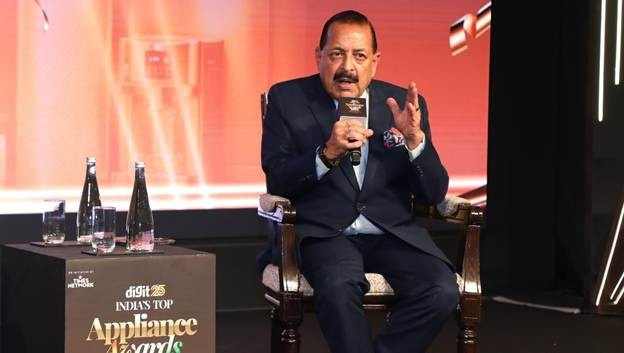
New Delhi: India is positioning itself to play a significant role in the next phase of global industrial transformation, which Union Minister of State (Independent Charge) for Science & Technology and Earth Sciences, Jitendra Singh, said is likely to be driven by biotechnology and artificial intelligence (AI).
India to Play Key Role in Next Industry Revolution
Speaking at a media conclave, Singh said India had been late in benefiting from the previous IT-driven industrial revolution but is now better placed to participate in emerging technology sectors.
“India will be an essential player in the next industrial revolution which will be biotechnology and AI driven.”
Read Also: India’s Space Economy Set to Reach USD 45 Billion in Next Decade: Dr Jitendra Singh
The interaction brought together technology developers, industry leaders and other stakeholders and focused on India’s technological growth, manufacturing, innovation and increasing private-sector participation.
India Builds Policy Framework for Emerging Technologies
Singh highlighted India’s policy initiatives in emerging technology sectors, including:
- BioE3 policy for biotechnology
- National Quantum Mission
- India AI Mission
- Expansion of India’s space sector
- Greater private-sector participation in emerging sectors
He said India is among the few countries with a dedicated biotechnology policy and noted that biotechnology is expected to have an increasing role in medical science, agriculture and food production.

The government’s BioE3 initiative — Biotechnology for Economy, Employment and Environment — is aimed at strengthening India’s biotechnology ecosystem.
Space Economy Grows to $9 Billion
Singh also highlighted the transformation of India’s space sector following the opening of the sector to private participation in 2020.
According to the Minister, India’s space economy, which was earlier almost negligible, has grown to around $9 billion and is projected to reach $40–45 billion within the next eight to nine years.
He pointed to the emergence of Indian space start-ups as an example of the sector’s transformation, including companies developing rockets and achieving unicorn status.
Singh also cited India’s Chandrayaan programme and its detection of evidence of water molecules on the Moon as an example of India’s contribution to global scientific knowledge.
From Technology Follower to Global Participant
The Minister said India’s technological journey has changed significantly, with the country now competing against global benchmarks in several areas.
He attributed this transition to India’s scientific and human resources combined with policy changes that have created an enabling environment for innovation and private-sector participation.
Private Sector Key to India’s 2047 Vision
Singh said the government is increasingly opening sectors that were earlier largely outside the scope of private enterprise.
He cited the opening of the space sector in 2020 and the government’s move towards greater private participation in the nuclear sector as examples of policy changes intended to unlock domestic capabilities.
The Minister said India has limited time to prepare for the opportunities linked to the 2047 vision, adding that every sector will need to evolve and industry will have to develop capabilities in emerging areas.
Technology Expands Access to Education
Singh also highlighted the role of digital technology in widening access to education, particularly for young people outside major metropolitan centres.
He recalled his interaction with a student from a financially constrained family who had cleared the IIT-JEE examination using digital learning resources, citing it as an example of technology expanding access to educational opportunities.
He also pointed to the growth of India’s start-up ecosystem, saying innovation is increasingly emerging from smaller towns and cities, rather than being confined to major metropolitan centres.
Government Pushes Administrative Reforms
The Minister also spoke about government efforts to remove outdated laws and procedures.
He said nearly 2,000 obsolete laws have been removed, including provisions that had continued despite changes in society and governance.
Among the reforms he highlighted were changes concerning:
- Family pension rights for single daughters
- Nomination rights for women government employees
- Pension provisions for families of employees who die before completing 10 years of service
- Removal of the requirement for gazetted officer attestation for many documents
Singh said such reforms reflected greater trust in citizens and young people.
Government-Industry Partnership Needed
Singh called for closer cooperation between the government and private sector to support India’s technological and economic ambitions.
He said the earlier scepticism between government and industry needs to be replaced by mutual learning, collaboration and greater synergy.
The Minister emphasised that a “whole of government plus whole of nation” approach would be essential for India to achieve its wider developmental, technological and economic goals.