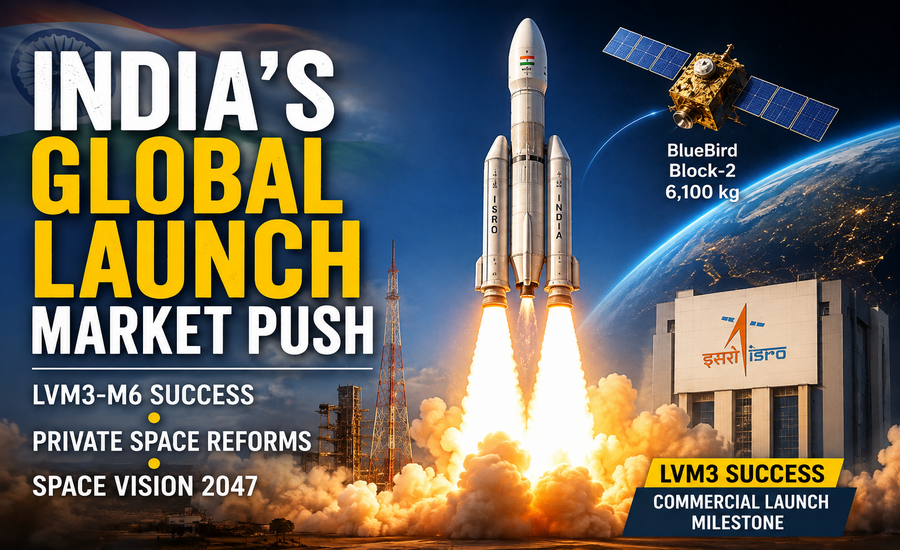
New Delhi: India is strengthening its position in the global launch market by expanding launch infrastructure, supporting private space companies and enhancing international collaborations. The government informed Parliament that the successful commercial launch of the LVM3-M6 mission has significantly boosted global confidence in India’s launch capabilities while several policy reforms are helping build a competitive space ecosystem.
The details were shared by Union Minister of State (Independent Charge) for Science & Technology and Space, Dr Jitendra Singh, in a written reply in the Rajya Sabha on Thursday.
LVM3 Mission Boosts India’s Commercial Credibility
The government said the LVM3-M6 mission successfully placed the 6,100-kg BlueBird Block-2 communication satellite of US-based AST SpaceMobile into a 520-km Low Earth Orbit. It is the heaviest payload launched by LVM3 from Indian soil.
According to the government, the successful mission has enhanced commercial confidence in the LVM3 launch vehicle, making it one of the preferred options in the international commercial launch market.
Read Also: Gaganyaan’s First Uncrewed Mission Set for Q4 2026; Bharatiya Antariksh Station on Track for 2035
Expanding India’s Launch Infrastructure
To meet future demand and support commercial launches, the government is:
- Developing a second spaceport at Kulasekarapattinam, Tamil Nadu.
- Strengthening launch safety through a robust review and authorisation system.
- Developing Indian space standards with the Bureau of Indian Standards (BIS).
- Supporting launch vehicle development by private firms such as Skyroot, Agnikul and HAL.
Private Space Sector Gets a Major Push
The government said IN-SPACe is enabling greater private participation through multiple reforms, including:
- Liberalised FDI policy for the space sector.
- ₹1,000 crore Venture Capital Fund for space startups.
- ₹500 crore Technology Adoption Fund.
- Easier access to ISRO infrastructure, technology and mentorship.
- Skill development programmes.
- Satellite Bus as a Service (SBaaS).
- Technology transfer and testing support through the POEM platform.
- Promotion of dedicated space manufacturing clusters across states.
- Development of an indigenous Earth Observation satellite constellation under the PPP model.
Space Vision 2047
The government said international cooperation remains central to achieving Space Vision 2047, which includes human spaceflight, an Indian space station and future space exploration missions.
Efforts are also focused on expanding ground station networks, strengthening launch capabilities, integrating Indian companies into global supply chains and building strategic partnerships with other countries.
Why It Matters
With commercial launch successes, policy reforms and greater private sector participation, India is positioning itself as a reliable global provider of launch services. The government’s strategy is expected to boost high-technology manufacturing, attract investment, create skilled jobs and strengthen India’s role in the rapidly growing global space economy.
Read Also: How Close Is India to Sending Astronauts to Space? ISRO Shares Big Gaganyaan Mission Update