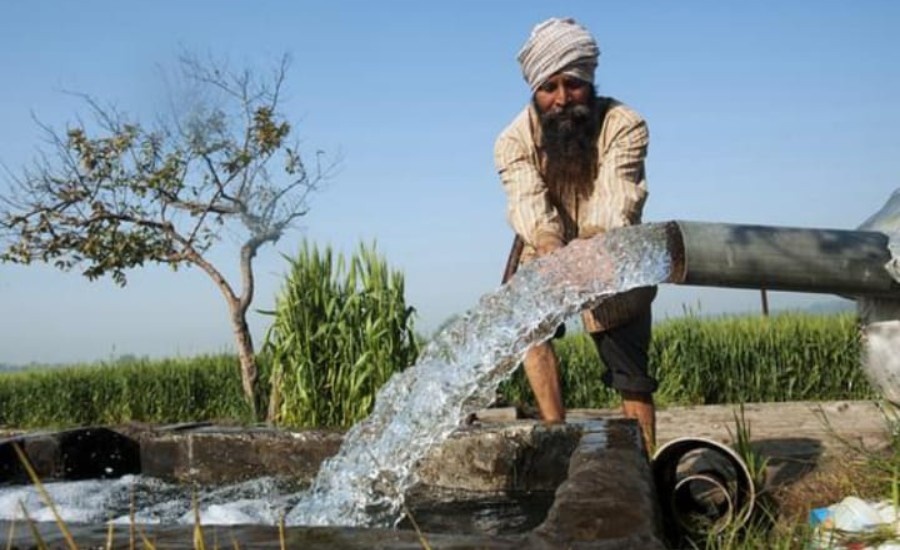
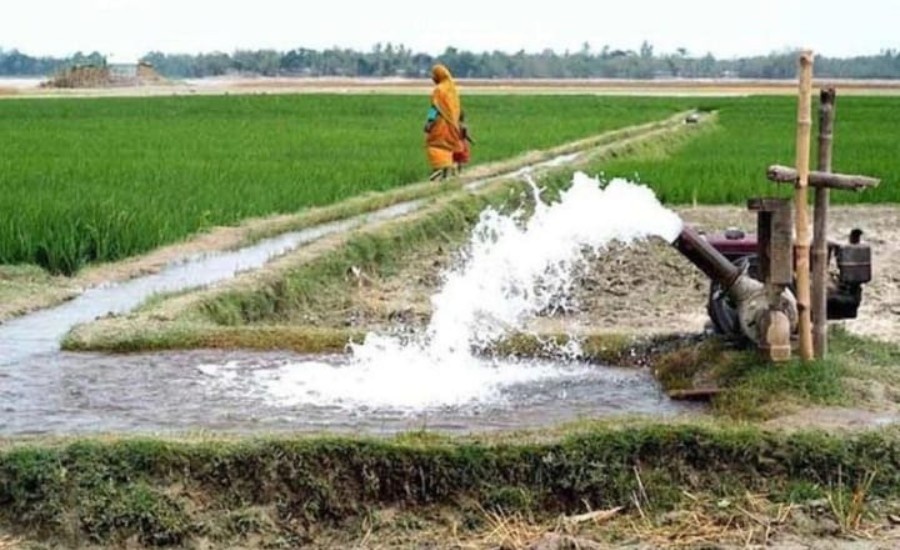
New Delhi: India extracted 247 billion cubic metres (BCM) of groundwater annually for irrigation, domestic and industrial purposes, according to the Dynamic Ground Water Resources Assessment 2025 released by the Central Ground Water Board (CGWB).
Irrigation Remains the Largest User of Groundwater
The assessment puts the country’s total annual groundwater recharge at 449 BCM, while the annual extractable groundwater resource stands at 408 BCM.
Of the total groundwater extracted:
- 215 BCM (87%) is used for irrigation.
- 28 BCM (11%) is used for domestic purposes, including drinking water.
- 4 BCM (2%) is used for industrial purposes.
The figures were provided by Union Jal Shakti Minister C. R. Patil in a written reply to a question in the Rajya Sabha.
Groundwater Extraction Stage at 60.63%
The assessment does not calculate groundwater consumption on a per-capita basis. Instead, it measures the Stage of Groundwater Extraction, which represents the ratio of annual groundwater extraction to the annual extractable groundwater resource.
At the national level, the stage of groundwater extraction stands at 60.63%.
The figure is higher than the national average in nine States and Union Territories:
- Punjab
- Rajasthan
- Haryana
- Delhi
- Puducherry
- Tamil Nadu
- Uttar Pradesh
- Chandigarh
- Karnataka
At the district level, 281 districts have a groundwater extraction stage higher than the national average.
Groundwater Generally Potable, Quality Varies Locally
According to the Annual Ground Water Quality Report 2025, groundwater in India is generally potable, while nearly 99% of monitoring stations recorded groundwater quality suitable for irrigation.
The CGWB noted that groundwater quality varies across locations and over time depending on local hydrogeological and other conditions. Since individual contaminants have different spatial distributions, the board does not rank states or districts according to overall groundwater quality.
Bihar Records Localised Contamination
The government’s data also highlighted groundwater quality concerns in Bihar, where monitoring has identified localised occurrences of salinity, fluoride and nitrate contamination.
Out of 584 groundwater samples analysed in Bihar:
- 5 samples exceeded the permissible limit for electrical conductivity.
- 39 samples exceeded the permissible limit for fluoride.
- 78 samples exceeded the permissible limit for nitrate.
The government said detailed parameter-wise groundwater quality data are available through the CGWB’s Annual Ground Water Quality Report 2025.
Groundwater Availability and Per-Capita Water
The Central Water Commission’s Assessment of Water Resources of India 2024 estimated India’s average annual per-capita water availability at 1,573.19 cubic metres in 2021.
The groundwater assessment and the per-capita water availability figure are separate measurements and should not be treated as equivalent indicators.
Government Measures to Strengthen Groundwater Management
Since water is a State subject, the primary responsibility for groundwater management, recharge, conservation and quality improvement rests with State Governments and Union Territory administrations. The Centre provides scientific, technical, policy and financial support.
Key initiatives include:
- NAQUIM: CGWB has completed aquifer mapping under the National Aquifer Mapping and Management Programme across about 25 lakh sq. km of identified mappable area, including around 90,567 sq. km in Bihar.
- NAQUIM 2.0: Between 2023–24 and 2025–26, detailed studies covered 143 areas spanning about 76,857 sq. km, including five high-resolution studies covering around 3,202.94 sq. km in Bihar.
- Arsenic-safe wells: CGWB has developed cement-sealing technology for accessing deeper arsenic-safe aquifers. 525 exploratory wells have been constructed using the technology, including 40 in Bihar.
- Jal Jeevan Mission: About 15.90 crore rural households have been provided tap-water connections nationally, including around 1.60 crore households in Bihar.
- Jal Shakti Abhiyan: More than 2 crore water conservation and artificial recharge works have been undertaken across the country, including around 5.75 lakh in Bihar.
- Jal Sanchay Jan Bhagidari: More than 1.55 crore artificial groundwater recharge and water-storage works have been constructed nationally, including around 7.26 lakh in Bihar.
- Mission Amrit Sarovar: Nearly 69,000 water bodies have been developed or rejuvenated across India, including 2,613 in Bihar.
- PMKSY: The Pradhan Mantri Krishi Sinchayee Yojana supports irrigation access, water-use efficiency, water-body restoration and groundwater recharge.
Bihar Among States Covered by Groundwater Conservation Measures
The government said groundwater monitoring data are regularly shared with states and other stakeholders to help identify contaminated areas and plan mitigation measures.
In Bihar, aquifer mapping, arsenic-safe well technology, Jal Jeevan Mission, water conservation campaigns and recharge initiatives form part of the measures being undertaken with central and state-level coordination.