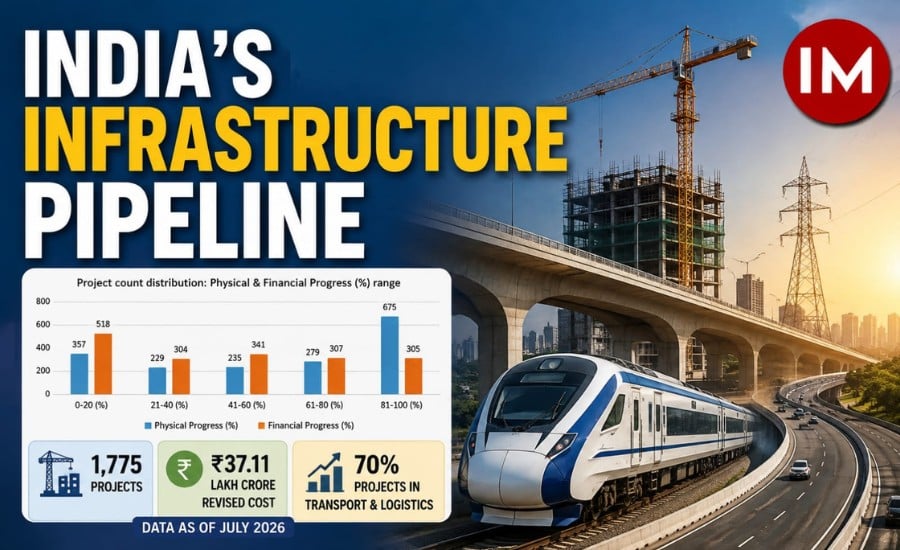
New Delhi: The Ministry of Statistics and Programme Implementation (MoSPI) is monitoring 1,775 ongoing Central Sector infrastructure projects worth a combined revised cost of ₹37.11 lakh crore through its PAIMANA-PROJ platform as of July 2026.
The projects, spread across 17 Central Ministries and Departments, have recorded cumulative expenditure of ₹19.26 lakh crore, equivalent to about 51.91% of their revised cost, according to the latest Flash Report on Central Sector Infrastructure Projects costing ₹150 crore and above.
Infrastructure Pipeline: Key Numbers
- 1,775 ongoing infrastructure projects under monitoring
- ₹37.11 lakh crore — total revised project cost
- ₹19.26 lakh crore — cumulative expenditure
- 51.91% — expenditure against revised project cost
- 675 projects — more than 80% physically complete
- 305 projects — more than 80% financially complete
- 735 Mega projects — costing ₹1,000 crore and above
- 1,040 Major projects — costing ₹150 crore to below ₹1,000 crore
Read Also: MoSPI, ISI Kolkata’s IDEAS Sign MoUs for GDP Nowcasting, Data Harmonisation Studies
The data indicates that the monitored portfolio contains projects at different stages, ranging from recently initiated works to projects nearing completion.
Transport and Logistics Dominate the Pipeline
The Transport & Logistics sector accounts for the largest share of the infrastructure pipeline.
According to the report, the sector comprises 1,246 projects, or about 70% of all projects, with a combined revised cost of ₹19.81 lakh crore, representing 53% of the total revised project cost.
Other major sectors include:
- Energy: 205 projects worth ₹10.66 lakh crore
- Water & Sanitation: 53 projects worth ₹2.05 lakh crore
- Communication: 31 projects worth ₹1.34 lakh crore
- Social & Commercial: 91 projects worth ₹0.99 lakh crore
- Others: 149 projects worth ₹2.26 lakh crore
Roads, Railways Account for Major Project Shares
Among individual ministries and departments, the Ministry of Road Transport & Highways has the largest number of projects under monitoring.
- Road Transport & Highways: 993 projects; revised cost ₹9.62 lakh crore
- Railways: 190 projects; revised cost ₹6.38 lakh crore
- Coal: 121 projects; revised cost ₹2.22 lakh crore
- Petroleum & Natural Gas: 103 projects; revised cost ₹4.23 lakh crore
- Power: 98 projects; revised cost ₹6.08 lakh crore
- Housing & Urban Affairs: 50 projects; revised cost ₹3.78 lakh crore
Water Resources, River Development & Ganga Rejuvenation: 38 projects; revised cost ₹2.01 lakh crore
Together, these figures highlight the scale of ongoing investment across transport, energy, urban development and water infrastructure.
36 New Projects Added to Monitoring in July
The PAIMANA platform added 36 projects to its monitoring system during July 2026.
The additions included:
- 16 projects from the Department of Telecommunications
- 9 from the Ministry of Steel
- 6 from the Ministry of Road Transport & Highways
- 3 from DPIIT
- 1 from the Ministry of Housing & Urban Affairs
- 1 from the Ministry of Power
Among the newly monitored projects are the Meja Thermal Power Project, Stage-II (3×800 MW), with a cost of ₹38,358 crore, and Jaipur Metro Rail Project Phase 2, estimated at ₹13,037.66 crore.
Projects Commissioned in July
Several major projects were also commissioned during July 2026.
These include:
- Srikakulam–Angul Gas Pipeline Project — ₹2,810 crore
- Aligarh–Kanpur Package I (Aligarh–Bhadwas) — ₹2,069.6 crore
- Dwarka Expressway Package III — ₹2,298.37 crore
- Transmission System for Evacuation of Power from Potential RE Zone in Khavda Area, Gujarat, Phase IV 7GW-Part E4 — ₹224.41 crore
PAIMANA-PROJ Strengthens Project Monitoring
MoSPI said its PAIMANA-PROJ platform is being used to strengthen monitoring, facilitate timely reviews and support data-driven decision-making across ministries.
The project monitoring interface was earlier known as PAIMANA. Its underlying data repository, PAIMANA-CRIP (Central Repository of Infrastructure Projects), was launched by MoSPI in July 2026.
According to the ministry, nearly 80% of the data is updated through APIs on the PAIMANA-CRIP platform.
What the Progress Data Shows
The July report shows that infrastructure projects are spread across both early and advanced implementation stages. 675 projects have crossed 80% physical progress, while 305 have crossed 80% financial completion.
The report also notes differences between physical and financial progress at various stages. In projects at the 81–100% physical progress range, physical progress is higher than financial progress, while financial progress is relatively higher during the early stages.