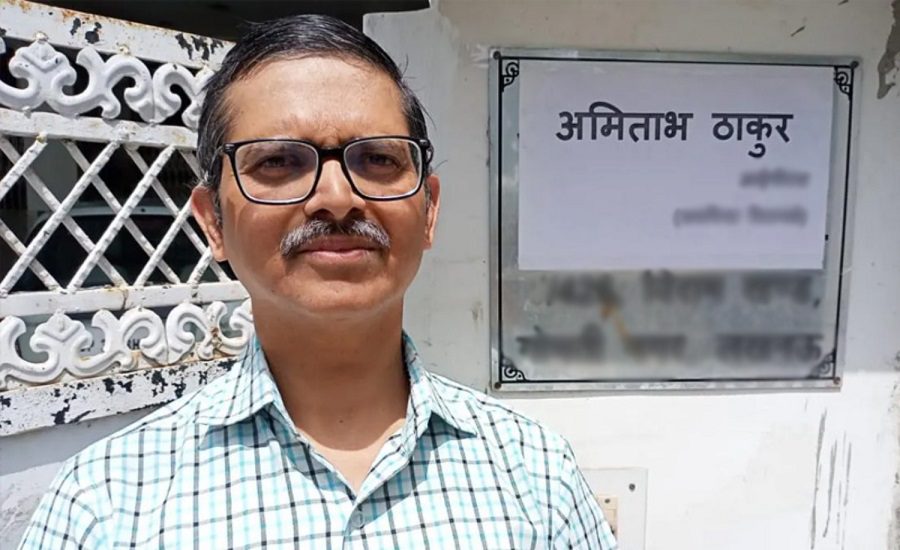
Varanasi: A local court in Varanasi on Friday remanded former Indian Police Service (IPS) officer and Azad Sena president Amitabh Thakur to 14 days’ judicial custody in connection with a defamation case filed at the Chowk Police Station, intensifying legal turmoil surrounding the veteran bureaucrat-turned-activist.
Background of Amitabh Thakur Defamation Case
Amitabh Thakur, a 1992-batch IPS officer who later founded the Azad Sena, was first taken into custody by Uttar Pradesh Police on December 10, 2025, in relation to an alleged decades-old land fraud case concerning the allotment of an industrial plot in Deoria dating back to 1999.
He was apprehended at Shahjahanpur Railway Station while traveling from Lucknow to Delhi and subsequently remanded to judicial custody in Deoria in that matter.
The defamation case stems from a complaint filed by Ambrish Singh, a resident of Varanasi and office-bearer of the Hindu Yuva Vahini, who alleged that Thakur’s video shared on social media tarnished his reputation by asserting his involvement in criminal activities.
Singh approached the court claiming that the video severely damaged his personal and social standing, prompting judicial intervention.
The case was registered at the Chowk Police Station, a jurisdiction well-known for recording complaints of high public interest and political import.
Amitabh Thakur Defamation Case: Court Hearing and Judicial Custody Order
On Friday, the case was heard before Special Chief Judicial Magistrate Rajeev Mukul Pandey, who granted the prosecution’s request for judicial remand and ordered that Thakur be sent to judicial custody for 14 days. This remand order effectively places Thakur in judicial detention while the legal proceedings continue.
Thakur’s legal counsel, Anuj Yadav, strenuously opposed the remand application. Yadav argued that the charges for which judicial custody was sought carried maximum punishment of less than seven years — the threshold below which arrest and remand are generally prohibited, referencing Supreme Court rulings to support the argument that judicial remand should not be granted in such circumstances.
However, the prosecution countered that the matter involved a cognizable offence, which under Indian law allows for police action including arrest and judicial custody — a position that ultimately swayed the court’s decision.
Security and Court Procedures
Local media reported that Thakur was produced before court amid heavy security presence, with numerous police personnel deployed in body armour. The heightened security reflected the significant public attention and sensitivities involved in the case, as well as concerns regarding law and order during high-profile judicial proceedings.
Amitabh Thakur Defamation Case: Legal Precedents and Debate on Judicial Custody
This controversy spotlights a broader legal debate in India over judicial remand in defamation and cognizable offense cases, especially where social media posts trigger legal action.
Indian law traditionally restricts arrests and remands in cases where the potential sentence does not exceed seven years unless the offence is classified as cognizable by statute. However, courts can and do exercise discretion depending on the particulars of each complaint, especially when allegations involve reputational harm and public safety concerns.
Legal analysts note that defamation cases in India often involve a complex balance between freedom of expression and an individual’s right to reputation, particularly in an era where digital platforms amplify political and social commentary. Judicial interpretation in such cases continues to evolve.