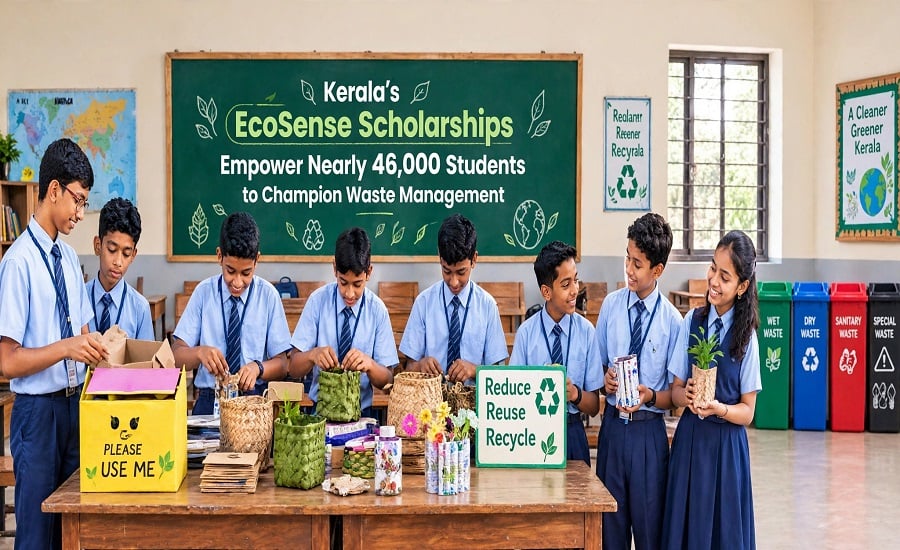
Thiruvananthapuram: Kerala’s Student Green Brigade Scholarship – EcoSense is emerging as a major student-focused initiative to promote scientific waste management, environmental responsibility and sustainable living among young citizens. Implemented by the Local Self Government Department in collaboration with the General Education Department, Government of Kerala, the programme is engaging students in practical waste-management activities at schools, homes and communities.
Under the initiative, 45,880 students across 986 Local Self Government Institutions are receiving scholarships this year. Around five lakh students from nearly 9,000 schools participated in the programme, making EcoSense a state-wide movement focused on learning, participation and behavioural change.
Kerala’s EcoSense Initiative Under Swachh Bharat Mission–Urban 2.0
The EcoSense programme is being implemented in line with the objectives of Swachh Bharat Mission–Urban 2.0 (SBM-U 2.0), which focuses not only on waste-management infrastructure but also on public participation and sustainable behavioural change.
The initiative aims to create a generation of young citizens with practical knowledge and green skills while encouraging them to actively participate in waste-management activities.
The programme seeks to:
- Promote scientific waste-management practices
- Encourage students to develop innovative solutions to local waste-related challenges
- Reduce waste generation
- Promote segregation, reuse and resource conservation
- Build practical understanding of sustainable waste-management systems
- Encourage environmentally responsible behaviour among students and communities
EcoSense Aims to Provide Scholarships to 50,000 Students
The Student Green Brigade Scholarship has been designed to recognise students who actively participate in waste-management activities.
The programme aims to provide scholarships to 50,000 students across Kerala.
The selection pattern is based on the type of Local Self Government Institution:
- 50 students from each Grama Panchayat
- 75 students from each Municipality
- 100 students from each Corporation
Each selected student receives a ₹1,500 scholarship along with a certificate recognising their contribution towards Swachhata and waste-management activities.
Students From Classes 6 to Higher Secondary Included
The scholarship programme covers students from different levels of school education.
This year, students from the following categories were included:
- Classes 6 and 7: Upper Primary category
- Classes 8 and 9: High School category
- First-year students: Higher Secondary category
- First-year students: Vocational Higher Secondary category
The initiative gives students an opportunity to learn about waste management beyond conventional classroom lessons.
Nearly Five Lakh Students Participated
The scale of participation highlights the growing interest among Kerala’s students in environmental action.
This year:
- 45,880 students are receiving the scholarship.
- Students from 986 Local Self Government Institutions are covered.
- Around 5 lakh students participated.
- Nearly 9,000 schools were involved.
The large-scale participation has helped transform EcoSense from a scholarship programme into a broader state-wide movement for environmental awareness and action.
Students Get Hands-On Waste Management Experience
A key feature of EcoSense is its focus on practical learning. Instead of limiting waste-management education to classroom discussions, students were encouraged to understand and practise sustainable waste-management methods in their daily lives.
Students explored:
- Waste-management practices at home
- Ways to reduce waste generation
- Green Protocol practices
- Green School and Clean School initiatives
- Composting of biodegradable waste
- Reuse of discarded materials
- Source-level waste segregation
- Resource recovery
This hands-on approach helps students understand how everyday choices can influence waste generation and environmental sustainability.
Schools Introduce Segregation, Composting and Repair Activities
At the school level, students and teachers undertook several activities to put sustainable waste-management practices into action.
These included:
- Setting up bins for source-level waste segregation
- Converting biodegradable waste into compost
- Establishing repair shops
- Promoting organic farming
- Organising household visits
- Conducting swap shops
- Forming cleanliness clubs
- Reusing discarded materials through craft activities
Such activities encourage students to view waste as a resource that can often be reused, repaired, recycled or recovered rather than simply discarded.
Visits to MCFs and RRFs Help Students Understand Waste Processing
Students also visited Material Collection Facilities (MCFs) and Resource Recovery Facilities (RRFs) as part of the programme.
These visits provided practical exposure to what happens to waste after it is collected from homes.
They also helped students understand the importance of segregation at source, which is essential for effective resource recovery and scientific waste management.
By seeing waste-management facilities directly, students could connect their household-level practices with the larger waste-management system.
Students Become Waste Management Ambassadors
EcoSense also encourages students to identify waste-management challenges in their own communities and take part in addressing them.
Students participated in activities such as:
- Reporting waste-management violations
- Conducting household visits
- Promoting responsible waste practices among families
- Creating awareness in neighbourhoods
- Encouraging proper segregation and waste reduction
This approach positions students as environmental ambassadors who can influence sustainable habits not only within schools but also at home and in their communities.
Green Assemblies Encourage Students to Discuss Environmental Issues
Another important component of the initiative was the organisation of Green Assemblies, or Haritha Sabhas, for children in schools across Kerala.
These assemblies provided students with a platform to:
- Discuss environmental concerns
- Share ideas
- Identify local waste-management challenges
- Explore solutions collectively
- Strengthen awareness about sustainable practices
The Green Assemblies further reinforced the idea that children and young people can play an active role in creating cleaner and more sustainable communities.
EcoSense Promotes Long-Term Sustainable Habits
The programme is designed to go beyond short-term awareness campaigns. By involving students in activities such as waste segregation, composting, reuse and resource recovery, EcoSense aims to develop sustainable habits that can continue beyond the classroom.
The initiative demonstrates how schools can become important centres for behavioural change by connecting education with practical environmental action.
From managing waste at home to understanding how recovered materials are processed, students are being encouraged to become active participants in the journey towards Garbage Free Cities.
Youth Participation at the Heart of Kerala’s Waste Management Efforts
Kerala’s EcoSense initiative highlights the role young citizens can play in strengthening waste-management systems. With thousands of schools and hundreds of local bodies participating, the programme combines scholarships with practical environmental education and community engagement.
By putting students at the centre of waste-management activities, the initiative aims to build a generation that understands the importance of Swachhata, resource conservation, waste reduction and sustainable living.
The programme shows that the journey towards cleaner communities can begin with simple actions in classrooms, homes and neighbourhoods—and that students can become important partners in making those changes happen.