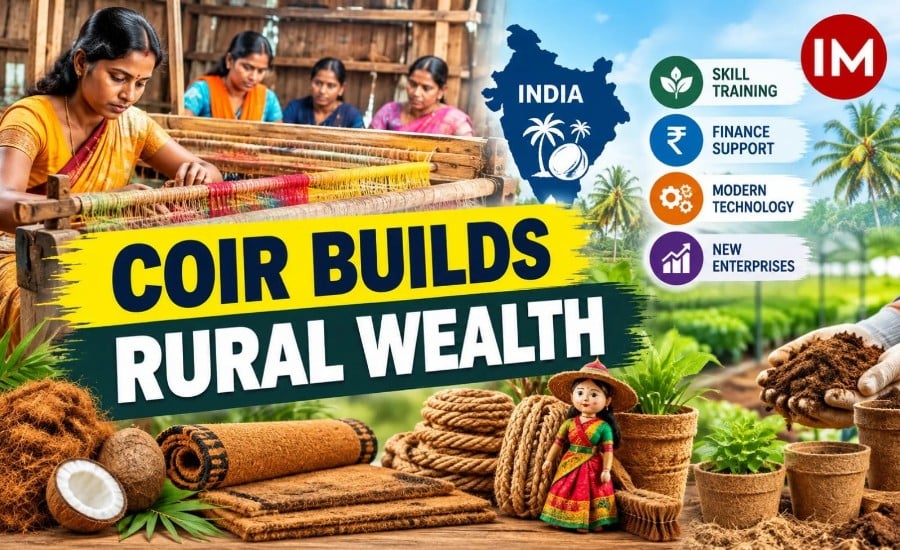
New Delhi: Coconut husk is emerging as a raw material for rural enterprises, with entrepreneurs across India converting coir into products ranging from doormats and ropes to handicrafts, bio-fertilisers and eco-friendly packaging.
The Ministry of Micro, Small & Medium Enterprises (MSME), through the Coir Board and schemes such as the Prime Minister’s Employment Generation Programme (PMEGP), is supporting training, technology adoption, finance and market access in the sector.
Andhra Entrepreneur Builds ₹35 Lakh Coir Enterprise
In Kadiyam of Andhra Pradesh’s East Godavari district, Allam Gowthamy established Adigo Coir Products during 2024–25 after receiving specialised training at the Coir Board Training Centre in Dhawaleswaram.
Read Also: Gujarat Announces GIDC Amnesty Scheme, MSMEs to Get Up to 80% Stamp Duty Relief
The enterprise was set up with a project cost of ₹10 lakh, including a ₹6.50 lakh bank loan and PMEGP assistance. It produces eco-friendly doormats, ropes, decorative dolls and handicrafts.
According to the sources:
- The unit has recorded an annual turnover of around ₹35 lakh.
- Its annual profit is approximately ₹10 lakh.
- The enterprise directly employs six women.
- Gowthamy has trained nearly 120 women in mat weaving, rope making and handicrafts.
- Her enterprise has reportedly inspired around five additional coir units in nearby areas with PMEGP support.
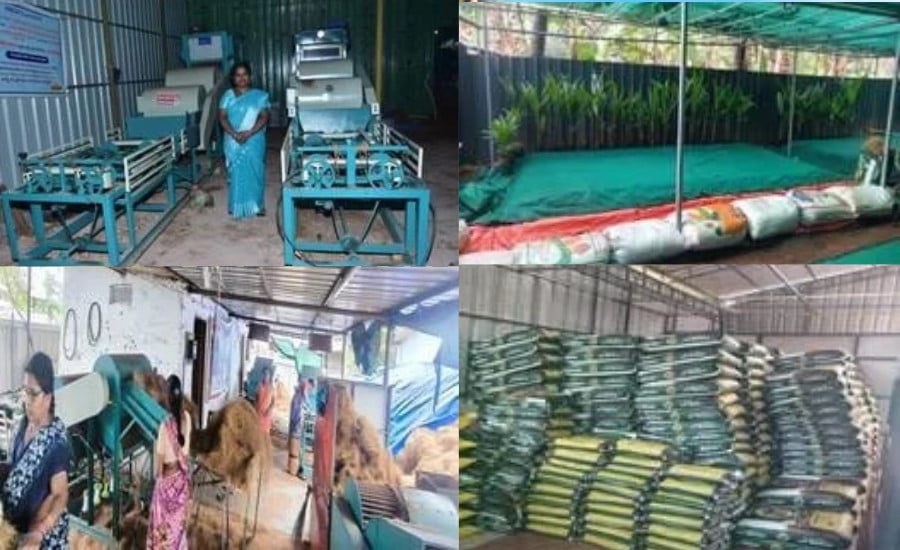
Kerala Unit Turns Coir Pith Into Bio-Fertiliser
In Kozhikode, Kerala, P. Surendran established Sampoorna Plus Agro Fertilizer Enterprises (SAFE) in November 2024, using coir pith to manufacture bio-fertiliser.
With technical support and training from the Coir Board, Kannur and the Central Coir Research Institute (CCRI), Kalavoor, the enterprise produces a coir-pith-based product aimed at improving soil fertility and moisture retention.
The unit has reported:
- A customer base of more than 500.
- Sales exceeding 20 tonnes of bio-fertiliser.
- A turnover of ₹13 lakh and profit of ₹4 lakh in FY 2024–25.
- Employment for five workers, including two women.
Coir Sector Has Strong Rural and Women’s Linkages
India has one of the world’s largest coir industries, with the organised production of coir dating back to 1859, when the first coir factory was established in Alappuzha, Kerala.
India accounts for more than 80% of global coir fibre production, while women constitute nearly 80% of those engaged in fibre extraction and spinning.
Coir-based enterprises now span several stages of the value chain.
Products include:
- Mats and doormats
- Ropes and yarn
- Brushes and household products
- Decorative articles and handicrafts
- Garden and horticulture products
- Eco-friendly packaging solutions
Coir Board Pushes Skills, Technology and Market Access
The Coir Board, a statutory body under the Ministry of MSME, supports the sector through skill development, research, technology promotion, market development, exports and welfare programmes.
The Coir Vikas Yojana (CVY) covers areas such as:
- Technology and research
- Skill development and women’s training
- Domestic and international market promotion
- Industry development
- Worker welfare
The government said these interventions are aimed at helping workers and entrepreneurs acquire skills, adopt technology, improve product quality and access wider markets.
Research Opens New Applications for Coir
The Central Coir Research Institute has also developed coir rail wheel axle packaging cups as an alternative to HDPE plastic cups.
The development highlights efforts to move coir beyond traditional products and explore applications in newer industrial and packaging segments.
The experiences of entrepreneurs such as Gowthamy and Surendran show how processing, training, finance and technology are being combined to create enterprises around a locally available natural fibre.
Read Also: KVIC Turns Traditional Skills Into Rural Businesses, 2.46 Lakh Bee Boxes Distributed Since 2017