Bhopal: Madhya Pradesh is positioning itself for a new phase of economic and industrial growth, with rising investment, expanding employment opportunities and infrastructure development emerging as key areas of focus.
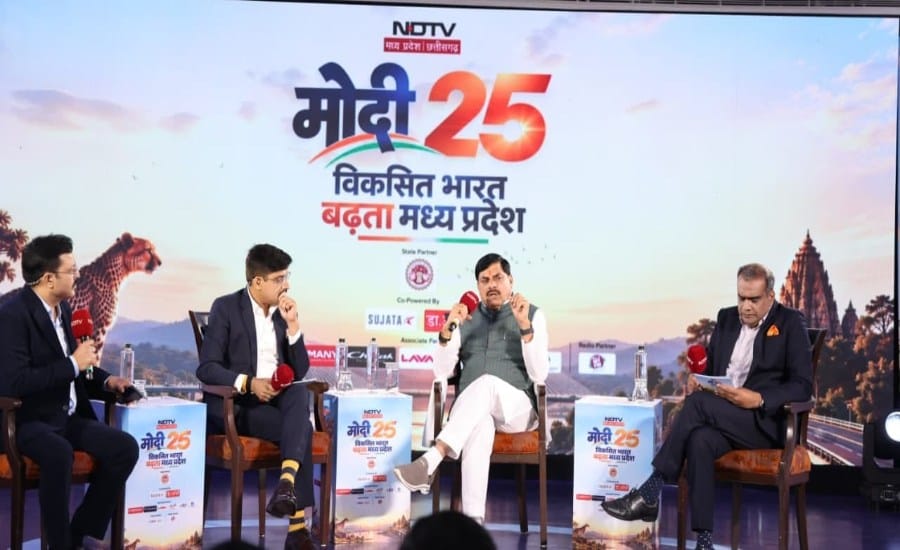
Addressing the ‘Viksit Bharat – Badhta Madhya Pradesh’ conclave in Bhopal on Wednesday, Chief Minister Dr Mohan Yadav said the state’s growth rate had entered double digits and that investment activity was creating new opportunities for employment and self-employment.
The state government has been focusing on creating an investor-friendly environment, strengthening infrastructure and developing sectors ranging from manufacturing and agriculture to tourism and emerging technologies.
Investment Emerging as a Key Growth Driver
According to the Chief Minister, Madhya Pradesh is attracting investors because of its geographical location, natural resources, land availability and infrastructure.
Yadav said industrial investment was helping expand economic activity while also creating opportunities for young people. He highlighted the state’s industrial policies and transparent systems as part of the effort to make it easier for companies to establish and expand operations.
The Chief Minister said Madhya Pradesh had received investment proposals worth around ₹30 lakh crore at the Global Investors Summit 2025 and claimed that more than ₹11 lakh crore had already reached the implementation stage.
The state has also been actively pursuing investors outside Madhya Pradesh. During his recent UAE visit, the Chief Minister said the state received investment proposals exceeding ₹53,000 crore across green energy, healthcare, education, technology, logistics and advanced manufacturing.
Read Also: MP’s Telecom Manufacturing Plan: Gwalior Zone Takes Centre Stage at Bengaluru Investor Meet
Per Capita Income Target Set for 2047
Yadav also highlighted the increase in Madhya Pradesh’s per capita income over the past two decades.
According to figures cited by him, per capita income was around ₹11,000 in 2002-03. It subsequently rose to ₹1.40 lakh and has now reached around ₹1.57 lakh, according to the Chief Minister.
The government has set a long-term target of taking per capita income to ₹22.50 lakh by 2047. Yadav said policies were being framed with a long-term development vision aligned with the goal of building a developed India.
The state’s Economic Survey for 2025-26 had estimated Madhya Pradesh’s GSDP growth at 11.14%, with the economy at current prices estimated at ₹16.69 lakh crore.
Jobs and MSMEs at the Centre of the Growth Push
Employment generation was another major focus of the Chief Minister’s address.
Yadav said more than 85,000 government posts had been filled since his government came to power, while the recruitment process for around one lakh posts annually was continuing.
He also cited the role of the MSME sector in employment generation, saying around 1.20 crore people were associated with the sector. Agriculture remains another major source of livelihoods, with the Chief Minister putting the number of people associated with farming at around two crore.
The government is also promoting employment-oriented industries and has introduced a monthly support mechanism of ₹5,000 for workers’ salaries in certain employment-based industries, according to the Chief Minister.
The broader focus, he said, is to encourage young people to become job creators alongside expanding conventional employment opportunities.
Water, Roads and Industrial Infrastructure
Infrastructure development is being linked with the state’s investment strategy.
Yadav referred to the Ken-Betwa Link Project and the Parvati-Kalisindh-Chambal (PKC) project as important water-related initiatives for different regions of the state. He said the projects would support irrigation and address long-standing water-related challenges.
The state is also highlighting its road network and industrial land availability as advantages for investors. The Chief Minister said Madhya Pradesh has around five lakh kilometres of roads.
He also referred to a Public Works Department application through which citizens can report potholes by uploading photographs, allowing authorities to identify and address road-related problems.
The state is simultaneously developing dedicated industrial zones and sector-specific policies. In July 2026, Madhya Pradesh and the Department of Telecommunications signed an MoU for the first phase of an integrated Telecom Manufacturing Zone in Gwalior, aimed at strengthening telecom and electronics manufacturing.
Tourism and Ujjain Prepare for Larger Footfall
Tourism, particularly religious and wildlife tourism, is another area being promoted as a growth sector.
Yadav said the development of the Mahakal Lok in Ujjain had significantly changed the city’s pilgrimage landscape. He cited a rise in the number of visitors to Ujjain and said preparations were being made for the 2028 Simhastha, when the city is expected to receive a very large number of pilgrims.
Better connectivity, highways and links with neighbouring cities are being developed with the expected increase in visitor movement in mind.
The state is also promoting its natural resources, wildlife destinations and religious sites as part of a broader tourism economy.
Focus on Schools, Skills and Public Services
The development agenda also includes education and public services.
Yadav highlighted the state’s Sandipani schools as an emerging model in school education and said the government had increased the school education budget to ₹38,000 crore.
He said schools that achieve 100% board examination results for three consecutive years are being recognised, while funds have been released for renovation of dilapidated government school buildings. The government has set a target of ensuring that no school operates from a dilapidated building within the next two years.
The Chief Minister also pointed to the government’s welfare programmes for women. He said ₹55,000 crore had so far been transferred to women under the state’s Ladli Behna programme and that additional support was being provided to women working in employment-oriented industries.
New Transport Services From September 25
A new public transport initiative is also scheduled to begin on September 25, coinciding with Pandit Deendayal Upadhyaya Jayanti.
Yadav announced the launch of Mukhyamantri Sugam Parivahan buses, describing them as a new state transport service. He said the orange-coloured buses would operate across the country and highlighted the state’s plan to encourage electric buses through registration-related concessions.
The initiative is part of the government’s wider focus on improving connectivity and public transport while supporting modern and cleaner mobility options.
A Long-Term Development Vision
The government’s development strategy combines industrial investment, employment, infrastructure, agriculture, tourism, education and public welfare.
Recent investor outreach has also focused on sectors such as AI, data centres, electronics, advanced manufacturing, green energy, healthcare and logistics. The state has continued its investor engagement ahead of the next Global Investors Summit, with the government seeking to convert investment proposals into projects on the ground.
At the Bhopal conclave, Yadav framed this approach around a longer-term vision for Madhya Pradesh. The immediate focus remains on attracting investment and creating jobs, while the broader objective is to strengthen infrastructure, raise incomes and expand opportunities across sectors.
For the state, the key challenge will be translating investment proposals and policy announcements into completed projects, sustainable employment and visible improvements in public services. The government’s emphasis on implementation, infrastructure and skills is therefore central to how Madhya Pradesh’s next phase of growth develops.
Read Also: MP CM Mohan Yadav Seeks Tech Investments in Bengaluru as Companies Discuss ₹500 Crore-Plus Proposals