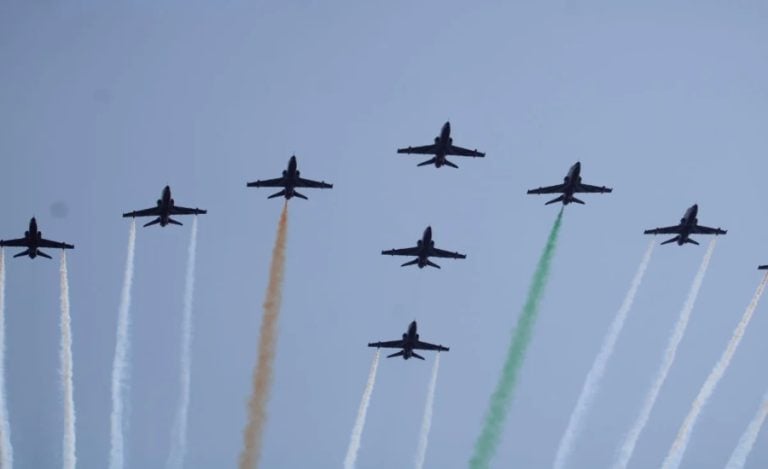
New Delhi: India’s new Air Force Chief, Air Chief Marshal Ashutosh Dixit, has outlined four major priorities for strengthening the Indian Air Force (IAF). These include restoring fighter squadron strength, speeding up indigenous fighter aircraft programmes such as Tejas and AMCA, adopting advanced military technologies, and improving coordination between the Army, Navy and Air Force.
In his first address after taking charge, Dixit said India must develop strong domestic defence capabilities and maintain the ability to respond to changing security challenges.
Ashutosh Dixit Takes Charge As 29th IAF Chief
Air Chief Marshal Ashutosh Dixit officially took charge as the 29th Chief of the Air Staff on October 31, 2026. He succeeded Air Chief Marshal AP Singh, who retired after 42 years of service.
Read also: What Is The OODA Loop And Why Does The Indian Air Force Want To Shorten It?
According to the Ministry of Defence, Dixit has more than 3,500 hours of flying experience. He is an experienced fighter pilot, qualified flying instructor and experimental test pilot.
During his career, he has worked on several important Indian Air Force modernisation programmes, including the Light Combat Aircraft (LCA) Tejas.
Details of Top Priorities of IAF Chief Ashutosh Dixit
One of the biggest challenges facing the Indian Air Force is the shortage of fighter squadrons. The IAF currently has 29 fighter squadrons against its authorised strength of 42. This gap has increased the need to strengthen India’s air combat capabilities.
Air Chief Marshal Ashutosh Dixit said restoring fighter strength to the authorised level would be his foremost priority.
Fighter squadrons play an important role in protecting Indian airspace, responding to enemy threats and maintaining air superiority during military operations. The IAF is also looking to strengthen its combat capabilities through new aircraft and indigenous defence projects.
Tejas And AMCA Projects Get Major Priority
The new IAF chief has placed special importance on Indian-made fighter aircraft and defence technologies. He highlighted three major areas:
- Tejas Mk1 And Mk1A: The Light Combat Aircraft programme is important for increasing India’s indigenous fighter aircraft capabilities.
- Tejas Mk2: The next-generation version is being developed to provide improved combat capabilities.
- AMCA: The Advanced Medium Combat Aircraft is India’s planned fifth-generation stealth fighter aircraft programme.
Dixit also highlighted the importance of Indian-made sensors and weapons. The government and defence industry are working to increase domestic aircraft production and reduce dependence on foreign defence suppliers.
The IAF is also awaiting the induction of 180 LCA Mk1A aircraft being manufactured by Hindustan Aeronautics Limited (HAL) under existing contracts.
New IAF Chief Introduces VAYU Vision For Future Readiness
Air Chief Marshal Ashutosh Dixit has explained his vision for the Indian Air Force through the acronym VAYU. It represents four important priorities for improving the force’s operational strength and future capabilities.
1. V – Vigilance And Operational Readiness
The first priority is to maintain a high level of readiness across all IAF units.
This includes fighter squadrons, radar systems, air defence units and military personnel. The objective is to ensure that the Air Force can respond quickly to any security threat.
2. A – Aatmanirbharta (Self-Reliance)
The second priority focuses on making India more self-reliant in defence production. The IAF will give importance to indigenous aircraft, Indian-made weapons, sensors and advanced military systems. Tejas Mk1A, Tejas Mk2 and AMCA are among the key programmes under this priority.
3. Y – Yukti (Innovation And Technology)
The third priority focuses on innovation and the use of modern technologies in military operations. Modern warfare is changing because of artificial intelligence, drones, cyber capabilities, space-based systems and long-range precision weapons.
The IAF aims to improve its technological capabilities through AI-enabled command systems, counter-drone technology, better maintenance and advanced operational procedures.
4. U – Unity Of Effort
The fourth priority is to improve coordination between India’s three armed forces. The Indian Army, Indian Navy and Indian Air Force need to work together during military planning and operations. Better coordination can improve communication, resource sharing and the overall effectiveness of India’s defence system.
Modern Warfare And New Security Challenges
Dixit also highlighted the changing nature of modern warfare. He said new technologies such as drones, long-range precision weapons, artificial intelligence, space systems and cyber capabilities are changing how military operations are conducted.
These developments require the Indian Air Force to continuously improve its training, equipment and operational strategies.
The IAF must also prepare its personnel to deal with emerging threats and complex security situations.
Welfare Of Air Warriors And Veterans Also A Priority
Apart from military modernisation, the new IAF chief also highlighted the importance of personnel welfare.
He said the training, professional development, morale, safety and dignity of air warriors would receive his personal attention. His priorities also include the welfare of Agniveers (Vayu), civilian employees, veterans, Veer Naris and their families.
This shows that his vision is not limited to aircraft and weapons but also includes the people responsible for operating and maintaining the Air Force.
Read also: Air Marshal Ashutosh Dixit: From Fighter Cockpit to Chief of the Indian Air Force
FAQs
His four priorities are VAYU: Vigilance and readiness, Aatmanirbharta (self-reliance), Yukti (innovation) and Unity of effort among the armed forces.
Air Chief Marshal Ashutosh Dixit became the 29th Chief of the Indian Air Force on October 31, 2026. He succeeded Air Chief Marshal AP Singh.
The Indian Air Force currently has 29 fighter squadrons against its authorised strength of 42. Restoring the strength to the sanctioned level is one of the new IAF chief’s major priorities.