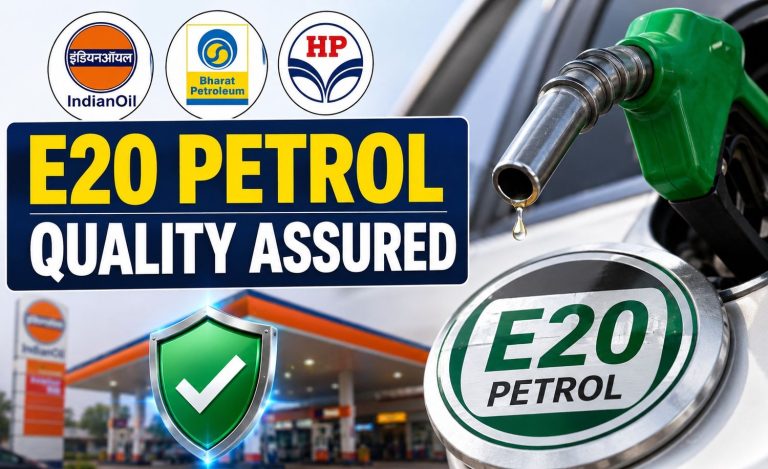
Bangalore: IOCL, BPCL and HPCL have defended E20 petrol quality across India, claiming that their tested samples meet BIS standards. The three oil companies have questioned Karnataka‘s reported findings of excess ethanol in petrol and called for independent testing.
Oil PSUs Defend E20 Petrol Quality
Three major public sector oil marketing companies (OMCs) – Indian Oil Corporation Limited (IOCL), Bharat Petroleum Corporation Limited (BPCL) and Hindustan Petroleum Corporation Limited (HPCL) – have defended the quality of E20 petrol supplied across the country.
The companies said that their tested fuel samples meet the Bureau of Indian Standards (BIS) specifications for E20 petrol.
Their response comes after the Karnataka government reported that petrol samples collected from certain retail outlets contained between 26% and 31% ethanol, raising concerns about fuel quality and vehicle performance.
The oil companies have questioned the sampling and laboratory testing methods used in the state’s October 2026 investigation.
E20 Petrol Quality: What Did Karnataka’s Investigation Find
The Karnataka government’s Department of Food, Civil Supplies, Consumer Affairs and Legal Metrology raised concerns about the ethanol content in petrol sold at selected fuel stations.
According to the reported findings, some petrol samples contained 26% to 31% ethanol, which is higher than the prescribed E20 blend level.
The findings created concerns among consumers about possible effects on vehicle mileage, engine components and repair costs.
However, IOCL, BPCL and HPCL said that the reported results need further technical verification through the prescribed testing procedures.
Oil Companies Say 893 Samples Met BIS Standards
To support their position, the three oil companies cited a nationwide fuel quality monitoring exercise conducted by the OMC/Centre for High Technology (CHT) Quality Coordination Cell (QCC).
According to the companies, 893 E20 petrol samples were collected from depots and retail outlets across 27 states and Union Territories.
All 893 samples reportedly contained ethanol within the prescribed range of 19% to 21%.
The companies also highlighted the results from Karnataka. Out of the nationwide samples, 56 samples collected from different locations in the state were tested.
These samples reportedly showed ethanol content between 19% and 20%, with an average of 19.30%.
Why Are Oil PSUs Questioning Karnataka’s Testing Method
The oil companies have raised concerns about how the samples were collected and tested during Karnataka’s October 2026 exercise.
They claimed that the sampling was reportedly conducted without the participation of OMC representatives.
The companies also said they had not received the corresponding retained samples, complete outlet-wise information or detailed laboratory reports, despite requesting these documents through the State Level Coordinator.
According to the companies, these details are important because they allow fuel suppliers and dealers to independently verify test results.
Rules For Collecting Petrol Samples
The oil companies referred to the Motor Spirit and High Speed Diesel (Regulation of Supply, Distribution and Prevention of Malpractices) Order, 2005, along with the Marketing Discipline Guidelines (MDG) 2024. Under the prescribed procedure, six one-litre samples must be collected during the sampling process.
Two samples are given to the fuel dealer, two are retained by the oil company or government department, and the remaining two are sent to an authorised laboratory.
The procedure also requires properly signed sample labels and communication of test results within the prescribed time. The companies said that following these steps is important for transparent and reliable fuel quality testing.
Dispute Over Laboratory Testing Methods
Another major concern raised by the oil companies relates to the laboratory methods used to measure ethanol content.
The Karnataka laboratory certificates reportedly mentioned Gas Chromatography as the testing method. However, the companies said that the certificates did not provide sufficient technical details about the applicable test standard, sample dilution procedure or reference material used for correction.
According to the companies, these details are necessary to independently verify the reported ethanol levels of 26% to 31%. Under BIS standard IS 17021:2018, as amended, ethanol content in E20 fuel can be measured using specified methods, including Fourier Transform Infrared Spectroscopy, water extraction and Gas Chromatography.
The companies have argued that the reported results should be checked using the correct procedures and reference materials.
E20 Petrol Quality: Oil PSUs Also Raise Questions About Fuel Density
The three companies have also questioned the density readings mentioned in Karnataka’s laboratory reports. According to their statement, the reported density values ranged from 0.742 to 0.749 grams per cubic centimetre (g/cc).
In comparison, their E20 samples tested under the QCC-1 and QCC-2 surveys recorded density values between 0.752 and 0.760 g/cc.
The companies said these differences require further technical examination before drawing conclusions about the actual ethanol content.
Oil PSUs Seek Joint Testing With Karnataka Government
To resolve the dispute, IOCL, BPCL and HPCL have requested the Karnataka government to share complete sampling documents, outlet-wise laboratory reports and details of the testing methods used.
They have also requested access to the retained samples for independent testing at an authorised laboratory.
The companies have proposed joint sampling and testing in the presence of state government and OMC representatives.
They said they are ready to cooperate with the Karnataka government and follow all applicable rules and testing guidelines.
The companies also stated that if any violation is established through the prescribed testing process, appropriate action should be taken.
Read also: E20 Petrol Quality Under Scrutiny: OMCs Find No Evidence of 500 ppm Chloride, Water Ingress