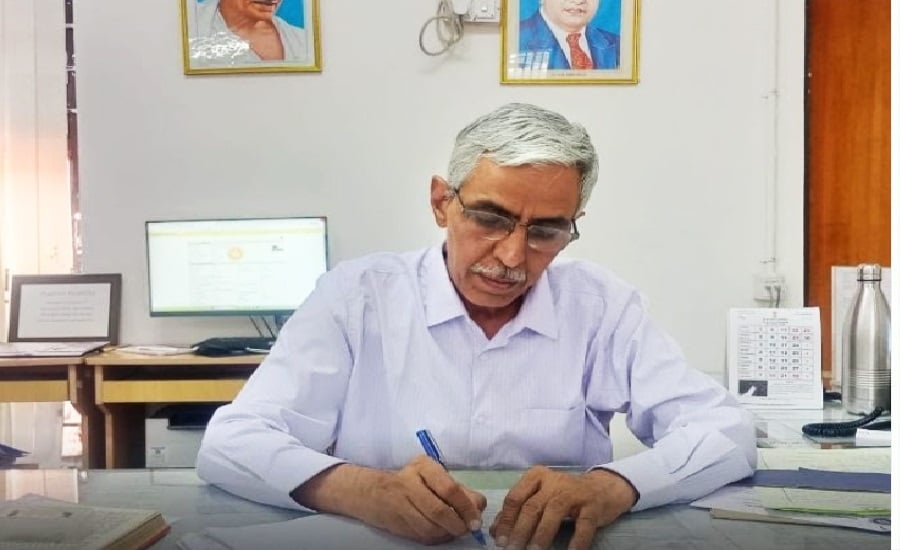
Jaipur: Retired IAS officer Ramniwas Mehta (2014 batch), who served as Secretary of the Rajasthan Public Service Commission (RPSC), has raised pointed questions about the functioning of politics, bureaucracy, the judiciary and society in his book Fear, Courage, and Much More.
Mehta, who retired as RPSC Secretary on July 31, 2024, has used the book to recount several experiences from his career in government service while also examining broader questions about governance and the rights of ordinary citizens.
The book discusses incidents involving alleged political pressure, his legal battle over an administrative decision, the controversial hotel construction issue concerning Udaipur’s Udai Sagar Lake, and his observations about bureaucracy and India’s democratic system.
Why Does the Common Citizen Still Struggle for Rights?
One of the central questions raised by Mehta is why the common citizen continues to remain deprived of basic rights and a fair social environment decades after Independence.
He questions whether the problem lies with elected representatives, government employees or society itself.
In his assessment, elected representatives can sometimes begin behaving like the “kings and maharajas” of the modern era, while some government employees forget that they are public servants. He also raises concerns about individuals who claim to serve the public but instead contribute to increasing difficulties within the system.
Mehta argues that the deterioration of public institutions cannot be attributed to a single section of society and calls for greater accountability from political leadership, government machinery and citizens.
Sharp Questions on the Judicial System
Mehta has also expressed strong views about the functioning of the judicial system.
He observes that for ordinary citizens, the expectation of quick justice can often turn into a prolonged wait marked by repeated adjournments and lengthy legal proceedings.
According to his reflections, the legal process itself can sometimes become synonymous with justice, rather than serving as a quick route to resolving a citizen’s grievance.
He argues that unless such systemic issues are addressed, the common citizen may continue to struggle to obtain the kind of social and institutional environment they deserve.
Advice to Bureaucrats: Maintain Distance From Political Proximity
The former IAS officer has advised bureaucrats to maintain complete impartiality and transparency, particularly during elections.
He argues that impartiality is not merely a statutory or administrative requirement but is also important for an officer’s own safety, credibility and peace of mind.
Mehta has appealed to young people and honest government officials not to compromise on their duty and ethical principles, even when working within a difficult system.
He cautions that during challenging situations, shortcuts and easier but improper options may appear attractive. However, he believes that repeatedly compromising on ethics can ultimately damage an individual’s professional and personal integrity.
Book Draws From Real Experiences in Government Service
Rather than limiting the book to an abstract discussion of governance, Mehta has incorporated several incidents from his own career.
The experiences include dealing with alleged political pressure while serving as an officer, pursuing a prolonged legal battle over what he considered an injustice, and handling contentious administrative matters.
One such episode dates back to his tenure as SDM, Manohar Thana in Jhalawar, in 2005.
Alleged Gun Threat During Deputy Sarpanch Election
Mehta has recalled an incident on February 3, 2005, when he was serving as SDM of Manohar Thana.
According to his account, then-BJP leader Kanwarlal Meena allegedly pointed a pistol at his temple and demanded a re-poll in the Deputy Sarpanch election.
The incident became one of the most serious experiences described by Mehta in the book and is presented as an example of the kind of pressure an officer can face while attempting to discharge official responsibilities.
Mehta writes that following the incident, the then Rajasthan Chief Minister Vasundhara Raje called him on March 15, 2005, and sought details of what had happened.
According to Mehta’s account, Raje listened to him for approximately 12 minutes without interrupting.
He had expected that the incident might result in his transfer from Jhalawar. However, according to his recollection, that did not happen and he continued in the posting for around another year.
Udai Sagar Lake Hotel Case and ₹1 Lakh Fine
Another important episode in the book relates to the hotel construction controversy at Udaipur’s historic Udai Sagar Lake.
Mehta has written about the matter from his time as Secretary of the Urban Improvement Trust (UIT).
According to his account, he rejected an application seeking renewal of a hotel construction permit after finding violations of wetland-related rules.
The hotel owner subsequently challenged his decision before the Supreme Court.
Mehta writes that on October 29, 2014, the Supreme Court imposed a fine of ₹1 lakh on him in connection with the matter. He further states that following the development, the construction permit was renewed by the UIT.
The episode forms another major example in the book of the legal and administrative challenges he encountered during his career.
Questions Over Rajasthan’s Higher Education System
Mehta has also turned his attention to the higher education system in Rajasthan.
He has raised concerns about alleged irregularities involving private universities, fake degrees and PhD degrees being awarded within unusually short periods.
He describes such developments as indicators of what he views as a broader deterioration in educational standards and oversight.
The former officer has also questioned the legislative process surrounding university laws. According to his observations, laws relating to universities are sometimes passed in the state Legislative Assembly without adequate discussion.
He points out that the state government has powers to investigate irregularities and, in appropriate circumstances, even dissolve universities.
Mehta therefore questions why existing monitoring and regulatory mechanisms are not being used effectively when allegations of serious irregularities arise.
‘Fear, Courage, and Much More’ Focuses on Ethics and Governance
Through Fear, Courage, and Much More, Mehta seeks to present his experiences as lessons for young people and government officials.
A recurring theme in his reflections is the importance of remaining committed to public service despite political pressure, institutional shortcomings or personal difficulties.
He argues that young officers and citizens should understand how government machinery actually functions and recognise the challenges that individuals may encounter when attempting to work honestly within the system.
The former RPSC Secretary also stresses the importance of maintaining ethical standards when easier alternatives are available.
About Him
Ramniwas Mehta is a retired Indian Administrative Service (IAS) officer from the 2014 batch of the Rajasthan cadre, who officially retired on July 31, 2026, after a highly distinguished 12-year service in the IAS and a long prior tenure in the Rajasthan Administrative Service (RAS). Born on 15 July 1966 in Jaipur, Rajasthan, he holds diverse academic qualifications including a B.Sc. in Biology, an L.L.B. (Administrative Law), and a B.J.M.C. (Journalism). Over his prolific career spanning 19 administrative postings, his longest single tenure was serving as the Secretary of the Urban Improvement Trust (UIT) in Udaipur for nearly four and a half years. His final major role was as the Secretary of the Rajasthan Public Service Commission (RPSC) in Ajmer, where he served from July 2023 until his retirement.
During his RPSC tenure, he played a crucial role in restoring public trust amidst paper leak controversies by directly resolving candidate grievances, culminating in a historic and emotional farewell where commission employees and senior officials famously pulled his flower-decorated open jeep with ropes.
Following his retirement, Mehta authored a highly discussed book titled Fear, Courage, and Much More. In this memoir, he reflects on the inner workings of the government system and chronicles intense career moments—such as a 2005 incident where a political leader held him at gunpoint while he was an SDM and legal battles concerning wetland violations during hotel construction in Udaipur—while raising critical questions about corruption in higher education, bureaucratic sycophancy, and systemic judicial delays.
Mehta’s Message to Youth and Honest Officers
Mehta’s message extends beyond bureaucrats to the younger generation.
He believes that young people should understand both the strengths and weaknesses of India’s governance system and remain committed to ethical conduct despite the difficulties they may encounter.
The former IAS officer argues that the country continues to await significant positive changes in political leadership, government machinery and the judiciary.
His book, therefore, combines personal experiences with a wider critique of governance, institutional accountability and social values, while urging readers to consider how public institutions can become more responsive to ordinary citizens.