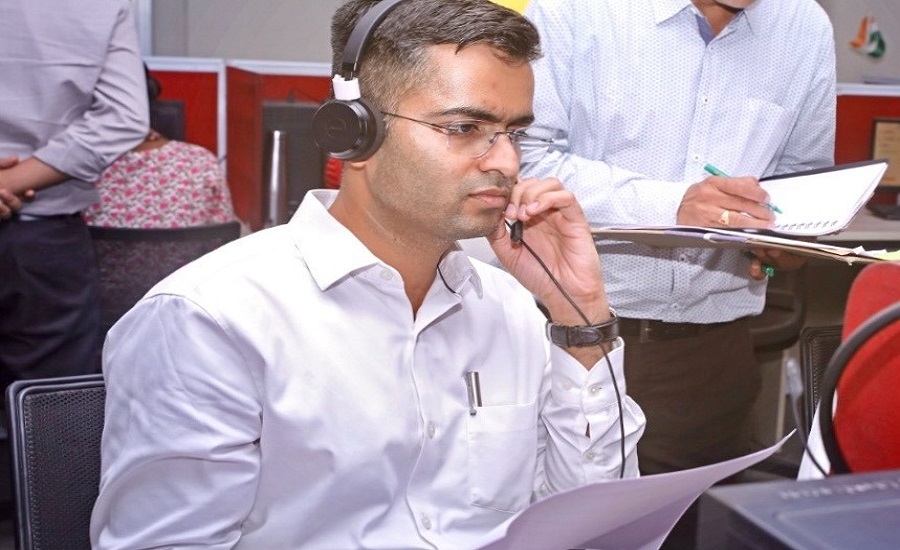
Jaipur: As part of the Rajasthan government’s efforts to ensure quick, transparent and effective resolution of public grievances, Joint Secretary, Finance (Expenditure-II), Pratap Singh (IAS: 2016) conducted a detailed inspection of the Rajasthan Sampark 181 Helpline Centre.
During the inspection, Singh reviewed the functioning of the Sampark portal, the status of complaints registered through the helpline and the pace at which grievances are being resolved and reflected on the Chief Minister’s dashboard.
The initiative is aimed at strengthening the state’s grievance redressal mechanism by using technology, real-time monitoring and coordination between departments.
IAS Officer Directs Officials to Reduce Complaint Disposal Time
Singh directed officials to continuously work towards reducing the average time taken to dispose of complaintsregistered on the CM dashboard.
He emphasised that the state government‘s priority is to provide maximum relief to complainants by combining technology with effective coordination among different government departments.
The officer also stressed the need to ensure that grievance redressal is not merely quick but also addresses the underlying problem so that complaints do not recur.
Sampark GPT Uses AI to Identify Root Causes
A key focus of the inspection was the use of artificial intelligence through ‘Sampark GPT’ for handling complex grievances involving multiple departments.
Singh said intensive data analysis is being undertaken through Sampark GPT to facilitate the effective and permanent resolution of inter-departmental complaints.
The AI-based system can help analyse complicated and multi-departmental cases, identify their root causes and assist officials in determining the best possible solutions.
This approach is intended to move grievance redressal beyond simply closing complaints and towards resolving the underlying issues responsible for them.
IAS Officer Personally Monitors Live Complaints
During the inspection, Singh also listened to grievances being registered live through the 181 helpline.
He immediately coordinated with officials of the concerned departments to facilitate the resolution of several complaints on the spot.
The exercise provided a real-time assessment of how complaints received through the helpline are processed and how quickly departments can respond when coordination is undertaken at the appropriate level.
Who Is IAS Officer Pratap Singh?
Pratap Singh is a 2016-batch IAS officer of the Rajasthan cadre and is currently serving as Joint Secretary to the Government, Finance (Expenditure-II) Department, in Jaipur.
He holds an M.Tech in Aerospace Engineering from Kanpur University.
Over his administrative career, Singh has handled assignments across district administration, urban development, public health engineering and state-level missions.
Key Administrative Assignments
Singh has served as Collector and District Magistrate of Jaisalmer, where he had his longest single tenure of around two-and-a-half years. He has also served as Collector and District Magistrate of Salumber.
He has held responsibilities in the Swachh Bharat Mission in Jaipur and served as Joint Secretary in the Public Health Engineering Department (PHED).
He has also served as Secretary of the Urban Improvement Trust (UIT), Alwar.
Earlier in his career, Singh served in field-level administrative positions including Sub-Divisional Officer (SDO) at Sheo and Dhorimanna in Barmer district.
His experience across field administration and state-level departments has included responsibilities involving district governance, development programmes and public service delivery.
Technology-Driven Grievance Redressal
The inspection of the Sampark 181 centre comes as Rajasthan continues to strengthen its technology-based public grievance mechanism.
The use of AI-assisted analysis, dashboard-based monitoring and real-time departmental coordination is aimed at making the grievance redressal system faster while also improving the quality and permanence of solutions provided to citizens.
Singh’s directions focused on reducing disposal time and ensuring that technology is used not only to monitor complaints but also to identify and address the root causes of complex grievances.