Ranchi: Jharkhand’s Rajendra Institute of Medical Sciences (RIMS), Ranchi, is planning to establish 10 new departments at an estimated cost of ₹466 crore as part of efforts to expand its medical facilities, education and research infrastructure.
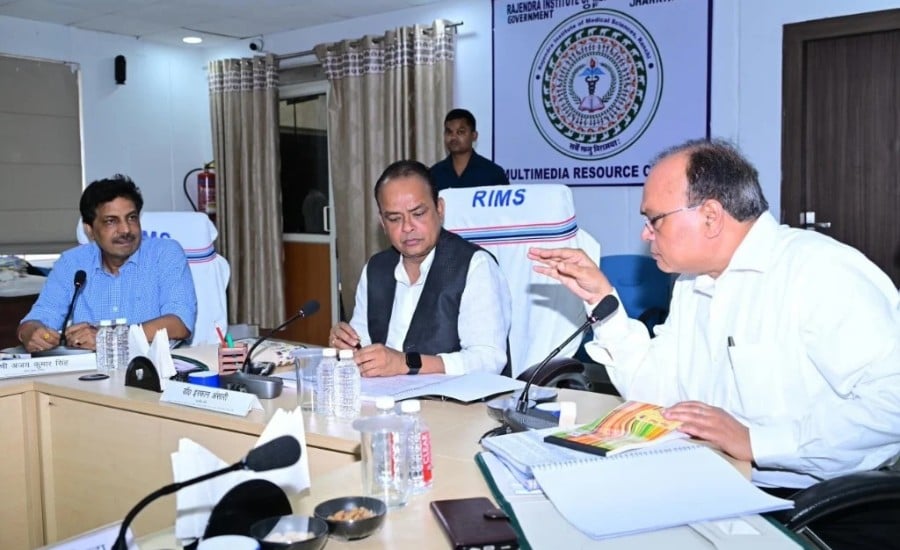
The proposals were discussed at the institute’s 66th Governing Council meeting, chaired by state Health Minister Dr. Irfan Ansari on Thursday. The meeting considered 16 agenda items concerning institutional development, medical education, staffing, equipment, financial management and security.
The council also decided to pursue an increase in postgraduate (PG) seats from 176 to 256 and super-speciality seats from 11 to 150. The proposals will be sent to the relevant authorities for consideration, according to the report.
RIMS Plans 10 New Medical Departments
The proposed expansion includes 10 departments intended to cover specialised areas of medicine and hospital administration.
Read Also: Jharkhand Seeks AIIMS for Ranchi, 400 Ambulances to Boost Healthcare Infrastructure
The departments identified at the meeting are:
- Medical Gastroenterology
- Endocrinology
- Clinical Immunology and Rheumatology
- Clinical Haematology
- Cardiac Anaesthesia
- Neuro Anaesthesia
- Emergency Medicine
- Medical Genetics
- Nuclear Medicine
- Hospital Administration
Health Minister Irfan Ansari said the initiative was intended to strengthen the institute’s capacity in treating serious and complex illnesses, medical education and research.
The proposed departments are estimated to cost ₹466 crore. The report does not specify a construction or operational timeline for the new facilities.
PG Seats to Rise to 256, Super-Speciality Seats to 150
The governing council discussed expanding medical education capacity at RIMS.
According to the figures presented at the meeting, the institute currently has 250 MBBS seats and 176 postgraduate seats. The proposal is to increase PG seats to 256 and super-speciality seats from 11 to 150.
The council decided to send the necessary proposal for increasing PG and super-speciality seats. The reported decision does not establish that the additional seats have already received final regulatory approval.
Faculty Strength to Increase, Non-Teaching Posts to Be Restructured
The meeting also considered changes to the institute’s staffing structure.
The number of faculty positions is proposed to increase from 319 to 335, in line with prescribed norms.
At the same time, the council discussed restructuring non-teaching positions. Under the proposal, the number of sanctioned non-teaching posts would be reduced from 1,962 to 1,862, a reduction of 100 posts
The changes form part of the broader review of RIMS’s human resources and administrative requirements.
106 Nursing Posts and 12 Hospital Managers Proposed
To address staffing requirements amid a growing patient load, the institute will pursue the creation of 106 nursing posts and the appointment of 12 hospital managers.
The meeting also called for the recruitment of 100 Ayushman Mitras to assist beneficiaries of the Ayushman Bharat Pradhan Mantri Jan Arogya Yojana and the Mukhyamantri Jan Arogya Yojana.
Ansari directed officials to publish the recruitment advertisement for the Ayushman Mitra vacancies within 15 days.
The proposed appointments are intended to support hospital management and help eligible patients access assistance under the two health schemes.
RIMS to Strengthen Emergency Care and Diagnostic Facilities
The governing council emphasised the need to improve emergency care facilities and the availability of medical equipment.
The measures discussed include:
- Ensuring the availability of more than 200 ventilators.
- Expanding ultrasound, echocardiography and X-ray facilities.
- Increasing the availability of modern medical equipment.
- Developing a modern burn ward.
- Repairing and restoring lift services.
- Arranging a moksha vehicle to assist families in need.
The report does not specify when all these facilities will be operational or provide a separate budget for each measure.
Security Measures to Be Revised in Phases
The meeting also addressed security arrangements within the RIMS campus.
According to the report, the council decided to gradually reduce the deployment of Home Guard personnel and replace them with personnel from the Special Auxiliary Police (SAP).
The first phase will involve the process of removing 100 Home Guard personnel from the campus.
Other proposed measures include introducing a pass system for entry into the premises and issuing separate identity cards for employees and workers.
The changes are intended to reorganise campus security, although the report does not provide a complete implementation schedule.
Governing Council Committees to Increase from Five to 10
To improve oversight of the institute’s administrative and academic functions, the council decided to increase the number of permanent committees from five to 10.
The committees are intended to support work relating to financial management, recruitment, promotions, academic activities, procurement, security and grievance redressal.
The meeting also discussed constructing hostels for postgraduate students and senior residents under a public-private partnership (PPP) model. An estimate will be prepared, followed by the process of submitting a proposal to the Government of India.
Officials also sought details on the utilisation of ₹240 crore previously available to RIMS, according to the report.
Officials Stress Better Coordination and Resource Management
Additional Chief Secretary Ajoy Kumar Singh, a 1995-batch IAS officer of the Jharkhand cadre, said RIMS needed to serve as a strong support institution for Jharkhand’s healthcare system.
He highlighted the importance of addressing gaps in staffing, hospital management, medical education and security while ensuring effective use of available resources.
The meeting was attended by Health Minister Irfan Ansari, Additional Chief Secretary Ajoy Kumar Singh, Special Secretary Dr Neha Arora, Additional Secretary Shashi Prakash Singh, RIMS Director Dr D.K. Sinha, Additional Director Waghmare Prasad Krishna and other officials.
Separately, information was shared before the meeting about establishing a medical college in Jamtara district under a public-private partnership model.
The decisions and proposals discussed at the RIMS meeting cover specialised medical departments, education capacity, staffing, patient services and campus administration. Several measures, including the increase in medical seats and recruitment, remain subject to the relevant approval and implementation processes.
Read Also: Jharkhand to Set Up New Medical College in Jamtara with 100 MBBS Seats and 420-Bed Hospital