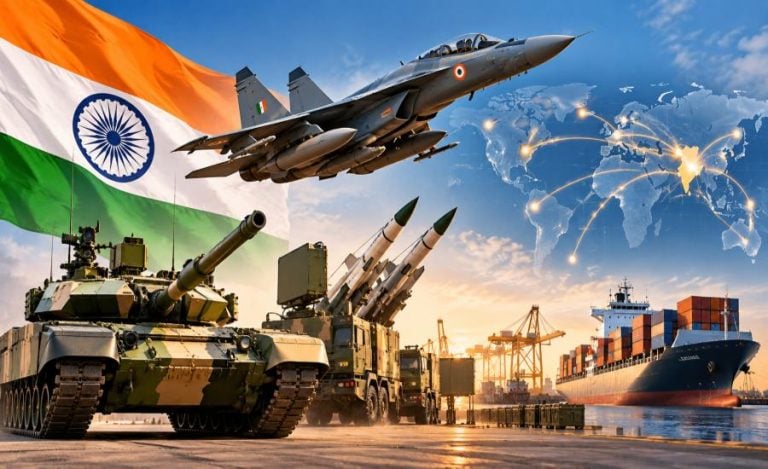
Mhow: Indian defence exports could reach ₹75,000 crore by 2030 if the government, armed forces and private companies work more closely together. Anil K Agarwal, Chairman of International Affairs and Past President of ASSOCHAM, has proposed this ambitious target at the Army War College in Mhow. He believes stronger public-private partnerships, advanced technology and large-scale manufacturing can help India become one of the world’s top 10 defence exporters.
Anil K Agarwal Proposes Higher India Defence Exports Target
Anil K Agarwal has suggested increasing India’s defence export target to ₹75,000 crore by 2030. This is higher than the government’s existing target of ₹50,000 crore.
Read also: How Can This Hidden Threat Can Ruin India’s Next Gen Advanced Missile and Anti-Drone Programme
Speaking to more than 100 senior officers from the Army, Navy and Air Force, Agarwal explained how cooperation between the defence sector and private companies could support India’s growth in the global defence market.
The address took place during the Higher Command Course at the Army War College in Mhow, Madhya Pradesh.
He also highlighted the importance of working together with the Defence Research and Development Organisation (DRDO), Defence Public Sector Undertakings (DPSUs), private manufacturers, MSMEs and start-ups.
India Defence Exports Rise 56 Times In 12 Years
India has made major progress in defence manufacturing and exports over the past decade.
According to official Ministry of Defence data, India’s defence exports reached a record ₹38,424 crore in FY 2025-26, compared with just ₹686 crore in FY 2013-14.
This represents an increase of more than 56 times in 12 years..Indian-made defence products are now exported to more than 80 countries, showing the growing international demand for India’s defence equipment. The public and private sectors are both playing important roles in this growth.
In FY 2025-26, Defence Public Sector Undertakings contributed approximately 54.84% of total exports, while private companies accounted for 45.16%. India’s defence production also reached a record ₹1.78 lakh crore during the same financial year.
Why India Wants To Increase Defence Exports To ₹75,000 Crore
Agarwal believes India can achieve the higher export target because the country’s defence industry is growing rapidly.
He pointed out that defence exports have tripled over the past four years, with an annual growth rate of around 32%.
According to his assessment, India could achieve the government’s ₹50,000 crore target before the expected deadline if the current growth continues. However, reaching ₹75,000 crore by 2030 would require annual growth of approximately 18%.
He believes this target is achievable through better cooperation, stronger manufacturing capacity and investment in modern defence technologies.
Public-Private Partnership Can Strengthen India Defence Exports
One of the main suggestions made by Agarwal was to increase cooperation between government defence organisations and private companies.
He said the armed forces, DRDO, defence PSUs, MSMEs and start-ups should work together on research, product development and testing.
This approach can help Indian companies develop better defence equipment and manufacture it on a larger scale.
A stronger partnership can also reduce production costs and make Indian products more competitive in international markets. The armed forces can support this process by sharing their requirements, providing feedback and helping companies test new equipment.
Drones, Artificial Intelligence And Modern Defence Technologies
Agarwal also highlighted the growing importance of advanced technologies in modern warfare.
Recent conflicts in Ukraine and West Asia have shown how drones, missiles, satellites and electronic warfare systems are changing military operations.
He said India needs to develop the ability to manufacture these technologies quickly and on a large scale. Some of the important technology areas discussed include:
- Artificial Intelligence (AI): Developing intelligent systems for defence operations and decision-making.
- Drones: Manufacturing advanced unmanned aerial vehicles for military use.
- Counter-Drone Systems: Developing technologies to detect and stop enemy drones.
- Quantum Computing: Supporting advanced research and future defence applications.
- Cybersecurity: Protecting military networks and sensitive information.
- Electronic Warfare: Developing systems to detect, disrupt and defend against electronic threats.
- Air Defence Systems: Strengthening India’s ability to detect and counter incoming threats.
He also suggested creating incubation centres for defence start-ups and MSMEs. These centres could connect smaller companies directly with the armed forces, allowing them to test products and receive useful feedback.
India Needs Better Defence Export Support
Agarwal said India should not focus only on manufacturing and selling defence equipment. Indian companies should also provide complete export packages to international customers. These packages could include:
- Training for foreign military personnel.
- Spare parts and maintenance support.
- Financing options for buyers.
- Long-term technical assistance.
- Product testing and certification.
- After-sales services throughout the equipment’s lifetime.
He also suggested giving the armed forces a more active role in promoting defence exports.
The military can help companies understand international requirements, speed up product trials and share operational feedback.
India’s Defence Attachés posted in different countries could also help manufacturers identify new business opportunities.
Trade Agreements Could Open New Defence Markets
India’s international trade partnerships could create additional opportunities for defence manufacturers.
Agarwal highlighted trade agreements with countries and regions such as Australia, New Zealand, the European Free Trade Association (EFTA) and the United Kingdom.
These partnerships could support technology transfers, joint manufacturing and access to international markets.
The proposed India-European Union trade agreement could also create further opportunities for Indian defence companies.
Such partnerships may help Indian manufacturers become part of global defence supply chains.
Read also: Beyond Making Weapons: Why India Needs Atmanirbhar Warfighting, Not Just Atmanirbhar Defence
FAQs
India’s defence exports reached a record ₹38,424 crore in FY 2025-26, according to the Ministry of Defence. This was a 62.66% increase compared with the previous financial year.
Anil K Agarwal has proposed increasing India’s defence export target to ₹75,000 crore by 2030. The proposal aims to strengthen India’s position in the global defence market.
Public-private partnerships can increase defence exports through joint research, advanced technology development, large-scale manufacturing, product testing and better international marketing. Cooperation between the armed forces, DRDO, defence PSUs and private companies can also improve product quality and competitiveness.