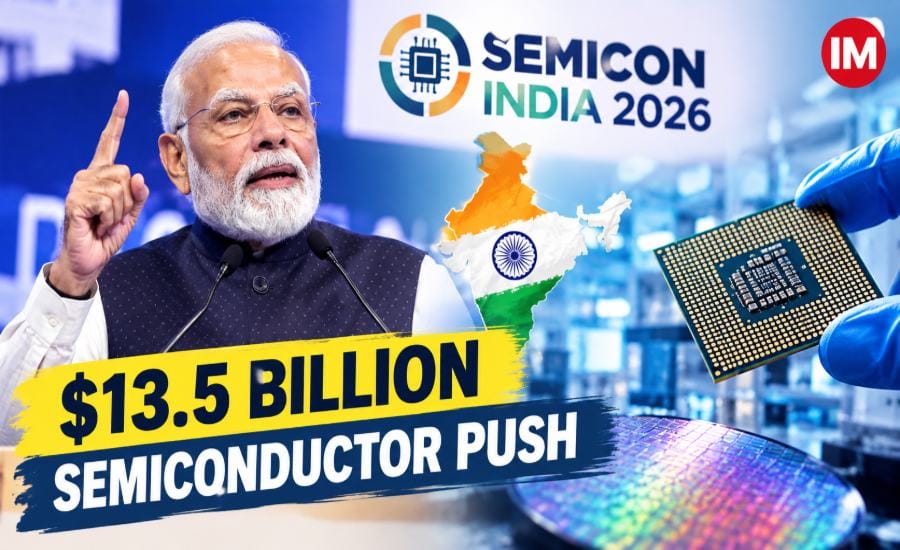
New Delhi: India’s expanding semiconductor capabilities took centre stage at SEMICON India 2026, where more than 600 companies from across the world showcased technologies spanning chip design, advanced packaging, materials, equipment, artificial intelligence and high-performance computing.
Held from September 17 to 19 at Yashobhoomi in New Delhi, the fifth edition of SEMICON India was organised around the theme “Silicon to Systems: Building the Ecosystem.” The event brought together industry leaders, policymakers, investors, academia and start-ups, highlighting how India’s semiconductor ambitions are moving beyond chip design towards manufacturing, research, packaging and system-level applications.
From Chip Design to High-Performance Computing
One of the key highlights was the display of indigenous semiconductor and computing technologies.
C-DAC showcased its high-performance computing and AI capabilities, including the AUM HPC-AI Processor and RUDRA-AUM compute node. The exhibition reflected India’s growing focus on developing indigenous capabilities not only at the chip level but across complete computing systems.
The event also highlighted domestic efforts in processor design, application-specific chips and system solutions for sectors such as telecommunications, automobiles, artificial intelligence and surveillance.
Indigenous Chips for Everyday Applications
Several Indian companies and start-ups demonstrated how semiconductor technologies can support everyday products and industrial applications.
Solutions on display covered smart appliances, connectivity, surveillance, energy management, industrial systems and automotive technologies.
Vervesemi Microelectronics showcased semiconductor solutions for motor control, energy meters and data acquisition, with applications including consumer appliances, electric mobility and drones.
These application-specific technologies underline the role of domestic chip design in building a wider electronics manufacturing ecosystem.
RISC-V Strengthens Indigenous Processor Development
RISC-V was another important area of focus at the exhibition.
C-DAC showcased its indigenous 64-bit RISC-V processor, designed to strengthen capabilities in homegrown processor development and next-generation computing applications.
InCore Semiconductors displayed indigenous RISC-V processor intellectual property and SoC design automation tools. Its processor platforms cover different computing requirements, including embedded systems and edge-AI applications. The company said its processor IP has been silicon-proven across multiple customer chips and technology nodes ranging from 180 nm to 16 nm.
Aheesa Technology also showcased an indigenous internet connectivity device capable of speeds of up to 1 Gbps. The device can enable Internet Service Providers to connect around 64 homes through a single Optical Line Terminal and runs on Vihan, an India-developed software platform powered by C-DAC’s 64-bit RISC-V processor.
AI and Smart Surveillance Take Centre Stage
The convergence of semiconductors and artificial intelligence was another major theme at SEMICON India 2026.
Indian semiconductor start-up Netrasemi showcased AI-capable System-on-Chips for applications including secure surveillance, smart sensors, robotics, drones and mobility.
The company has taped out an indigenous AI SoC for CCTV surveillance using a 12 nm process node. The chip integrates AI/ML accelerators, vision processing and video engines for applications requiring intelligent vision and edge processing.
The exhibition demonstrated how semiconductor innovation is increasingly supporting machine vision, smart infrastructure, autonomous technologies and intelligent surveillance systems.
Building the Semiconductor Value Chain
SEMICON India 2026 also highlighted that a strong semiconductor industry requires more than chip fabrication.
The exhibition covered different stages of the value chain, including:
- Semiconductor materials and equipment
- Testing and advanced packaging
- Research and development
- Chip design and system integration
- Talent and workforce development
This broader approach aligns with Semicon 2.0, approved by the Union Cabinet in July 2026 with an outlay of ₹1,27,500 crore. The programme builds on Semicon 1.0 and focuses on six strategic areas — design, machines and materials, more fabs, advanced packaging, research and development, and talent development.
Start-ups and Students Expand the Talent Pipeline
The Start-up Pavilion provided a platform for emerging companies working in India’s semiconductor design ecosystem.
The government’s Design Linked Incentive (DLI) Scheme has supported domestic chip-design projects in areas such as video surveillance, drone detection, energy meters, microprocessors, satellite communications, broadband and IoT-based SoCs.
The Chips to Startup (C2S) Programme is also helping students, researchers, academic institutions and start-ups gain access to advanced chip-design tools, fabrication services and specialised training.
More than one lakh engineers from over 500 organisations, including around 400 academic institutions and 100 start-ups, have been onboarded by the ChipIN Centre under the C2S Programme and DLI Scheme.
Together, these institutions and start-ups have developed more than 300 chip designs for fabrication in India and abroad and recorded over four crore hours of chip-design tool usage.
From Policy Support to Commercial Production
The exhibition came as India’s semiconductor ecosystem moves towards manufacturing and commercial production.
Under the Semicon India Programme, 12 semiconductor projects have been approved across six states, involving investment commitments of more than ₹1.64 lakh crore. Three facilities have already commenced commercial production.
This marks a shift from building policy and design capabilities towards establishing manufacturing, packaging and related semiconductor infrastructure.
Building a Complete Semiconductor Ecosystem
The central message of SEMICON India 2026 was that India’s semiconductor journey extends far beyond individual chips.
A complete ecosystem requires chip designers, fabrication units, packaging and testing facilities, equipment and materials suppliers, research institutions, start-ups, system companies and a skilled workforce.
By bringing these segments together, SEMICON India 2026 showcased how indigenous innovation can connect with global semiconductor opportunities.
From RISC-V processors and AI-enabled SoCs to advanced computing, application-specific chips and semiconductor manufacturing, the exhibition presented the different layers of India’s emerging semiconductor ecosystem.
The event therefore offered a glimpse of an industry being built across the entire value chain — linking technology, research, manufacturing, talent and investment as India strengthens its position in the global semiconductor landscape.
Read Also: From 375 MW to 1.57 GW: How India’s Data Centres Are Powering the AI Era