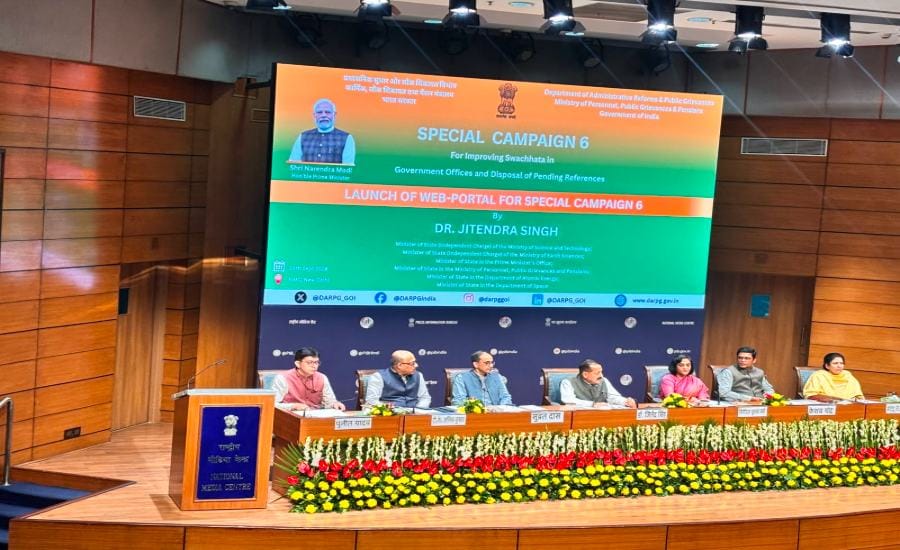
New Delhi: The Ministry of Textiles is set to undertake Special Campaign 6 from October 2 to 31, 2026, with a renewed focus on cleanliness, reducing pendency in government work and improving the management and disposal of e-waste.
The annual campaign aims to make cleanliness a sustained practice in government offices while ensuring that pending official matters, files and public grievances are addressed within defined timelines.
This year, particular emphasis will be placed on the effective collection, segregation and scientific disposal of e-waste generated in government offices.
Three-Phase Campaign
Special Campaign 6 has been structured into three phases, beginning with preparatory work in September and ending with an assessment of the results in November.
The preparatory phase, from September 15 to 30, is already underway. During this period, ministries and departments are identifying areas requiring action, including pending references from Members of Parliament and state governments, inter-ministerial references, Cabinet Notes, Parliamentary Assurances pending for more than three months, public grievances and appeals.
The phase also covers record management. Officials are reviewing physical files and records, identifying files for weeding out, closing e-files and locating pending files. Scrap and redundant materials are also being identified for disposal.
The implementation phase will run from October 2 to 31. During this month-long period, government offices will carry out cleanliness activities, remove waste and scrap, process records and work towards clearing the targets identified during the preparatory phase.
The evaluation phase will be held from November 16 to 30, when the work completed and outcomes achieved by ministries and departments will be reviewed and assessed.
Read Also: Indian Railways Gears Up for Special Campaign 6 to Boost Swachhata and Clear Pending Matters
E-Waste Management Gets Special Focus
One of the key features of Special Campaign 6 is its focus on e-waste management.
The Ministry of Textiles plans to place greater emphasis on the proper collection, segregation and scientific disposal of e-waste generated in government offices. The campaign will therefore move beyond general cleanliness to address the growing need for responsible management of discarded electronic materials.
The action phase will be the main period for achieving the targets identified during preparation. Progress and information related to the campaign will be provided daily through the dedicated Special Campaign portal.
Building on Special Campaign 5
Special Campaign 6 will build on the work carried out by the Ministry of Textiles during Special Campaign 5.
During the previous campaign, the ministry reviewed 19,376 physical files. Of these, 6,264 physical files were weeded out, while 274 e-files were closed.
The file-review exercise also helped free up 25,498 square feet of office space. Disposal of scrap and other redundant materials generated ₹11.35 lakh in revenue.
Cleanliness was another major component of the earlier campaign, with 200 sites successfully cleaned.
These figures provide the operational context for the new campaign, which seeks to continue the process of reducing accumulated records, improving office spaces and addressing pending work.
Public Grievances and VIP References
Special Campaign 5 also recorded progress in handling important references and citizen-related matters.
A total of 63 VIP references were addressed and resolved during the campaign. The ministry also achieved 100 per cent of its identified target for public grievances, redressing all 44 public grievances pending at the start of the campaign.
The experience is expected to inform the implementation of Special Campaign 6, particularly in areas involving pendency and citizen-facing government services.
Daily Monitoring to Track Progress
The campaign will use a dedicated online monitoring mechanism to track progress.
Information on the targets identified during the preparatory phase and the action taken during the implementation phase will be reported on a daily basis through the Special Campaign portal.
This monitoring approach is intended to keep the campaign focused on measurable outcomes rather than one-time cleanliness activities.
For the Ministry of Textiles, the campaign combines office cleanliness with record management, pendency reduction and responsible disposal of waste. The focus on e-waste also adds an environmental dimension to the annual government cleanliness drive.
A Push for Better Government Workspaces
Special Campaign 6 is part of the broader effort to improve the functioning and experience of government offices. By clearing old records, closing pending files, removing unused materials and maintaining cleaner workplaces, such campaigns seek to make administrative processes more organised and responsive.
For the Ministry of Textiles, the next phase will build on the results of Special Campaign 5 while placing greater attention on e-waste management and timely disposal.
With the implementation phase scheduled from October 2 to 31, the ministry will now work towards translating the targets identified during September into measurable action before the final evaluation in November.
Read Also: Indian Railways Approves ₹252 Crore for Kavach 4.0 Across 607.7 Route Kilometres in Lucknow Division