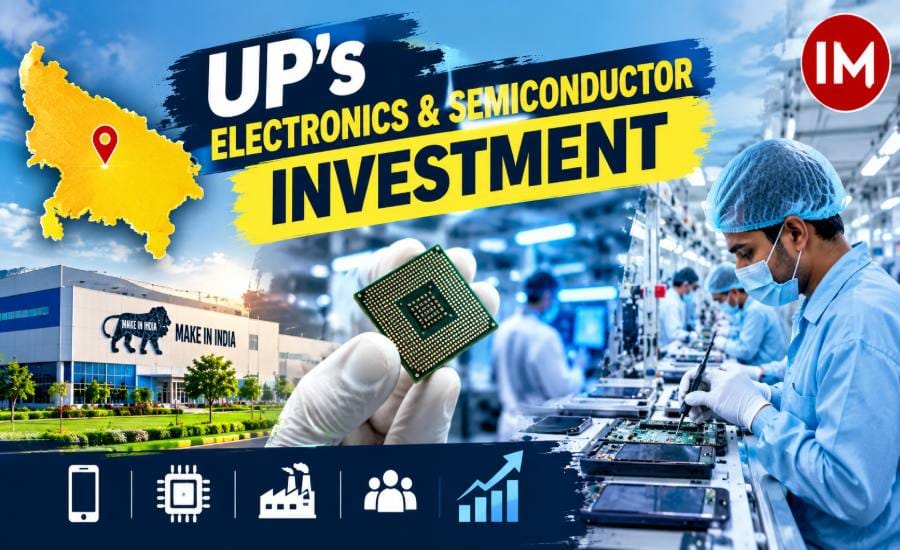
Lucknow: Uttar Pradesh is rapidly strengthening its position as a major electronics and semiconductor manufacturing hub, with investments in the sector crossing ₹430 billion, or more than ₹43,000 crore, according to a factsheet released by the state government.
The state now accounts for more than 55 per cent of mobile phones manufactured in India, with a growing network of electronics companies, manufacturing clusters and semiconductor facilities driving the expansion.
More than 200 companies currently operate in Uttar Pradesh’s electronics manufacturing ecosystem. Together, these investments have generated more than 300,000 employment opportunities, creating a significant industrial and employment base in the state.
Electronics Manufacturing Emerges as a Major Growth Sector
Uttar Pradesh has built its electronics manufacturing base around a combination of investment-friendly policies, improved connectivity and the availability of technical talent.
The state’s growing manufacturing ecosystem covers not only mobile phones but also a wider range of electronic and technology products. This expansion is helping Uttar Pradesh move beyond conventional manufacturing towards more advanced technology-oriented industries.
The state is now attracting investments across areas such as:
- Tablets and laptops
- Consumer electronics and home appliances
- Solar cells
- Defence and logistics drones
- Robotics
- Semiconductor manufacturing
This diversification could help create a broader industrial supply chain within the state while opening opportunities for skilled workers, technicians, engineers and supporting businesses.
Read Also: Uttar Pradesh Sees Growing Women’s Participation in Workforce, SHGs and Entrepreneurship
Gautam Buddh Nagar Becomes Electronics Manufacturing Hub
Gautam Buddh Nagar has emerged as one of the key centres of Uttar Pradesh’s electronics industry, with two electronics manufacturing clusters already established in the district.
These clusters house several major domestic and global companies, including Samsung, LG, Haier, Dixon, Addverb, Raphe and Bhagwati.
The concentration of large manufacturers is helping develop an ecosystem in which suppliers, technology firms, logistics providers and skilled workers can operate closer to major production facilities.
Such clusters can also support the growth of ancillary industries and create additional employment beyond direct factory jobs.
Component Policy Attracts Fresh Investment
The state is also focusing on strengthening electronics component manufacturing, an area that can reduce dependence on external supply chains and deepen domestic manufacturing capabilities.
The UP-Electronics Component Manufacturing Policy-2025 has attracted more than ₹38 billion, or around ₹3,800 crore, in investment, according to the government factsheet.
The policy is aimed at encouraging investment in the component ecosystem, which plays an important role in the production of mobile phones, consumer electronics and other technology products.
A stronger component manufacturing base could help Uttar Pradesh capture a larger share of the value chain rather than remaining focused mainly on final assembly.
Semiconductor Push Takes Shape in Yamuna Expressway Region
Uttar Pradesh’s technology ambitions also extend into semiconductor manufacturing.
A Centre-approved assembly, testing, marking and packaging (ATMP) facility of India Chip Private Limited is already planned in Sector 28 of the Yamuna Expressway Industrial Development Authority (YEIDA) area.
The facility involves an investment of more than ₹37 billion, or approximately ₹3,700 crore.
ATMP facilities are an important part of the semiconductor ecosystem because they handle key stages after chip manufacturing, including assembly and testing.
The project therefore adds a new dimension to Uttar Pradesh’s electronics manufacturing capabilities and could help the state develop expertise in higher-value semiconductor-related activities.
1,000-Acre Semiconductor Park Planned
The state is also developing a dedicated 1,000-acre semiconductor park in the Yamuna Expressway region.
The planned park is expected to serve as a future industrial hub for semiconductor-related investments and supporting industries.
Its location within the wider YEIDA industrial region could provide companies with access to established connectivity, industrial infrastructure and a growing manufacturing ecosystem.
The development also signals a shift in Uttar Pradesh’s industrial strategy towards emerging technologies with long-term economic potential.
Investment and Jobs Could Expand Together
The scale of investment already attracted to the electronics sector has a direct employment dimension. More than 300,000 employment opportunities have been generated through the state’s electronics manufacturing growth.
As new factories, component units and semiconductor facilities come up, demand could increase for engineers, technicians, machine operators, software professionals, logistics workers and other specialised talent.
The presence of major companies can also create opportunities for local suppliers and smaller businesses providing packaging, maintenance, transportation, warehousing and other industrial services.
For Uttar Pradesh, this means the electronics sector can potentially contribute not only to investment but also to a wider employment ecosystem.
UP Eyes a Larger Role in India’s Technology Economy
The growth of electronics and semiconductor manufacturing is positioning Uttar Pradesh for a larger role in India’s technology-driven industrial economy.
With more than 55 per cent of India’s mobile phones now being manufactured in the state, the existing base provides a platform for expanding into components, semiconductor-related activities, robotics, drones and other advanced technologies.
The combination of major manufacturing companies, new investments, dedicated industrial clusters and planned semiconductor infrastructure could further strengthen the state’s position as a technology manufacturing destination.
For Uttar Pradesh, the larger significance lies in building an ecosystem that connects investment with manufacturing, skills and employment. If the planned projects progress as envisaged, the state could strengthen its contribution to India’s electronics supply chain while creating new opportunities for workers and technology-focused businesses.
Read Also: UP: 70 Unnao Villages Get Approval for Development Works Under PM Adarsh Gram Yojana