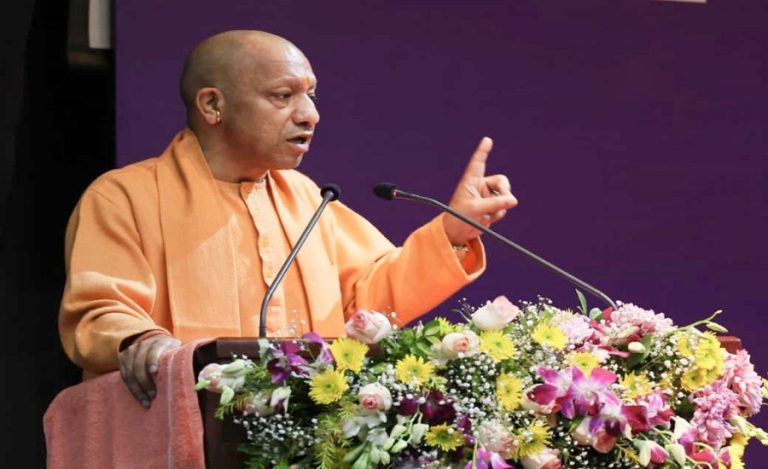
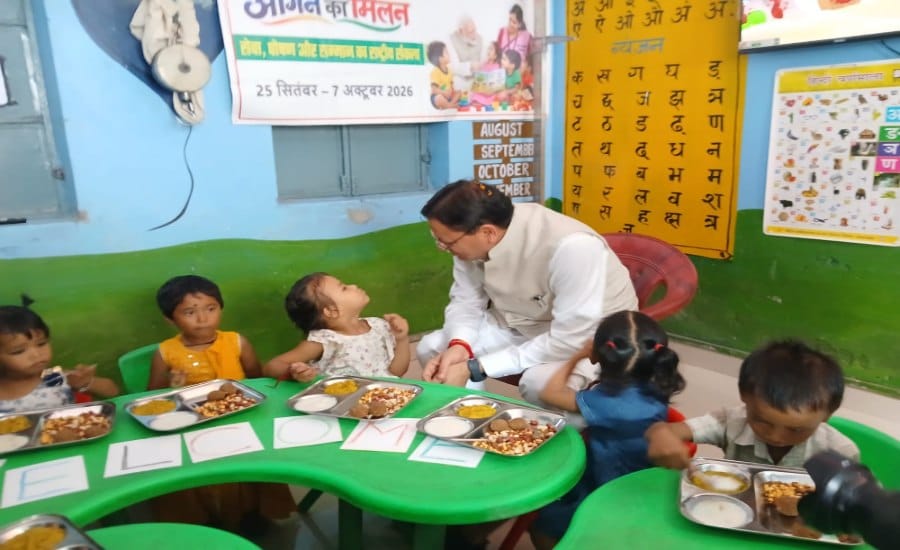
Dehradun: Uttarakhand Chief Minister Pushkar Singh Dhami highlighted maternal and child health, nutrition and early childhood development during the ‘Aangan Milan’ programme held at the Anganwadi Centre in Gosikua Bhudai, Khatima, on Monday.
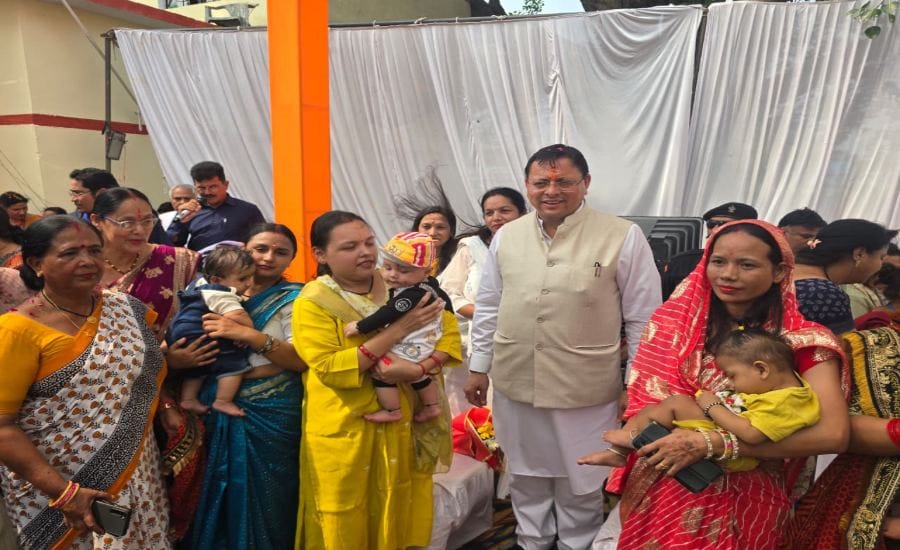
The programme brought the Chief Minister into direct interaction with children, pregnant women, mothers, Anganwadi workers and ASHA workers. Dhami reviewed the role of government welfare schemes and services while emphasising the importance of taking public welfare initiatives closer to families.
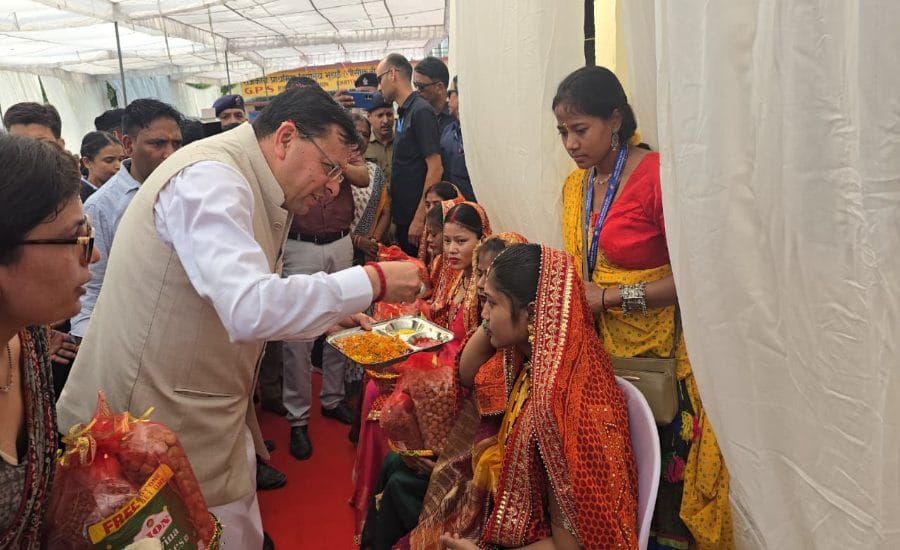
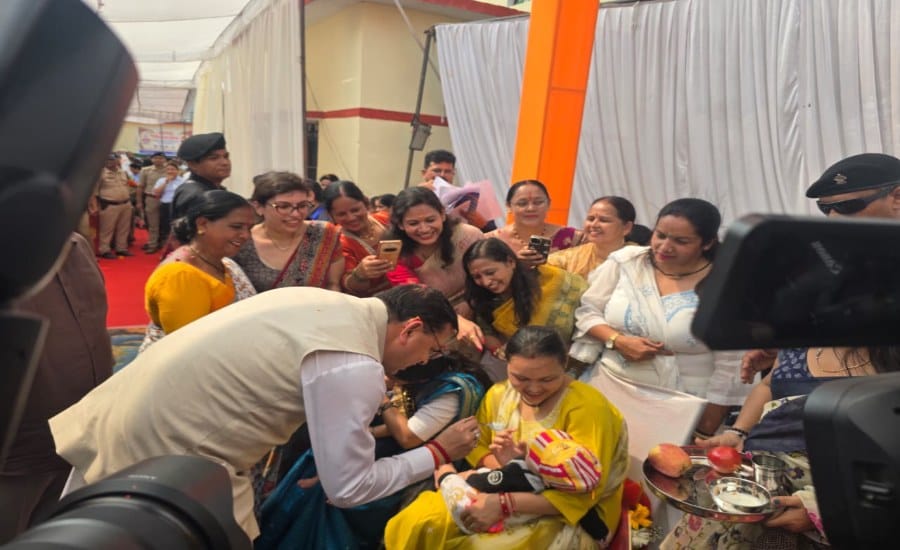
During the event, the Chief Minister served food to children, participated in a traditional godbharai ceremony for pregnant women and distributed nutritional kits to 10 expectant mothers. He also presented Mahalakshmi Kits to 10 beneficiaries, performed the annaprashan ceremony for five young children and honoured nine Anganwadi workers and two ASHA workers.
‘Aangan Milan’ to Take Service Closer to Families
Dhami described Aangan Milan as a platform to take service, care and dialogue directly to people and households. Similar programmes are being organised across Uttarakhand, he said.
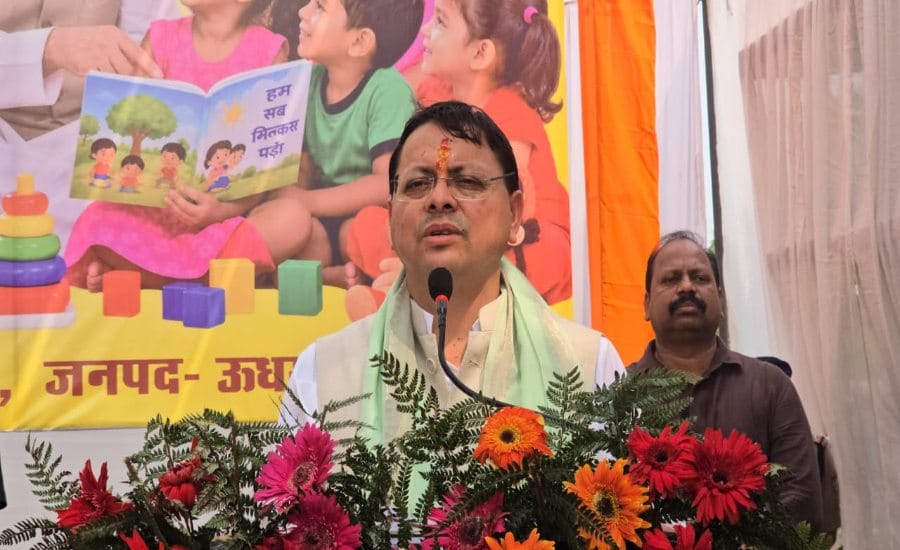
The Chief Minister stressed that Anganwadi centres should not be seen only as places where children receive nutrition. They also play an important role in early education, care, values and overall childhood development.
He praised Anganwadi workers for connecting families with government welfare schemes while looking after the health and nutrition of children.
Dhami also shared a personal connection with the Anganwadi system, saying that his own children studied at an Anganwadi centre in Nagla Tarai.
Read Also: Uttarakhand CM Reiterates Development Push, Says Champawat to Become Model District
Maternal and Child Nutrition Remains a Priority
The Chief Minister said the health and nutrition of mothers and children remain among the state government’s key priorities.
He highlighted several schemes and services aimed at providing nutritional and financial support to women and children. These include the Mahalakshmi Kit Scheme, nutrition programmes and the Chief Minister’s Women Nutrition Scheme.
The government is also working to improve access to safe maternity care in remote and difficult areas.
For pregnant women in geographically challenging locations, the state is developing birth waiting homes so that they can stay closer to health facilities before delivery. Dhami also referred to the availability of helicopter ambulance services when required.
Through the Janani Shishu Suraksha Programme, essential healthcare services are provided to pregnant women and newborns.
The Chief Minister also highlighted the Pradhan Mantri Matru Vandana Yojana, under which financial assistance is provided to pregnant and lactating women to support their nutritional and healthcare needs.
Focus on the First Years of Childhood
Dhami said early childhood is one of the most important stages of a person’s life.
During these formative years, children need nutritious food, proper care, early education and a supportive environment. Providing these elements early can help build a stronger foundation for their health and future development.
This makes the role of Anganwadi centres broader than basic childcare. They can serve as local points for nutrition, early learning, health awareness and the delivery of welfare services.
The Chief Minister said strengthening these centres can help ensure that children receive the support they need during their early years.
‘No Child Should Remain Malnourished’
A major focus of Dhami’s message was the state’s objective of ensuring that no child remains malnourished.
He said child nutrition cannot be treated as the responsibility of the government alone. Families and communities also have an important role in ensuring that children receive adequate nutrition and care.
According to the Chief Minister, the combined efforts of the government, society and families can create a stronger foundation for maternal and child welfare.
The state aims to make Anganwadi centres more effective spaces for:
- Child nutrition and health
- Early childhood education
- Positive values and care
- Overall physical and developmental growth
The approach places local Anganwadi workers at the centre of implementation because they are directly connected with children, mothers and families.
Anganwadi and ASHA Workers Recognised
The programme also acknowledged the contribution of frontline workers.
Dhami honoured nine Anganwadi workers and two ASHA workers during the event. These workers often serve as the first link between government welfare programmes and families at the community level.
Their responsibilities extend beyond distributing nutrition or providing information. They help connect eligible beneficiaries with government schemes and support awareness around maternal and child health.
By recognising their contribution, the programme also highlighted the importance of frontline workers in delivering welfare services at the grassroots.
Nutrition, Health and Women’s Welfare Linked Together
The Aangan Milan programme reflects a broader approach in which maternal health, child nutrition and women’s welfare are treated as interconnected priorities.
Support during pregnancy can influence maternal well-being and the health of newborns, while adequate nutrition and early care can shape a child’s development during the formative years.
For a state like Uttarakhand, where remote and difficult terrain can make access to healthcare challenging, doorstep-level welfare delivery becomes particularly important.
Measures such as birth waiting homes, emergency transport support, nutrition assistance and community-level Anganwadi services can help bridge gaps between families and essential services.
A Stronger Foundation for Uttarakhand
Dhami also planted a sapling during the programme as a symbol of prosperity and greenery.
He further spoke about Prime Minister Narendra Modi completing 25 years in public life as Chief Minister and Prime Minister, describing his public service and commitment as an inspiration.
However, the central message of the Khatima programme remained focused on families, particularly mothers and young children.
The government’s objective of reducing malnutrition and strengthening Anganwadi centres places early childhood development at the heart of its welfare approach. If government services, frontline workers, families and communities work together, these local centres can become stronger platforms for nutrition, early learning and health awareness.
The larger significance of Uttarakhand Aangan Milan lies in bringing welfare delivery closer to households. By focusing on healthy childhood and empowered mothers, the state is seeking to build the foundations of a healthier and stronger Uttarakhand.
Read Also: From Parks to Bus Stands: Uttarakhand’s Cities Get a New Development Push